Return to: Hymenoptera Index |
Insect Index
Gall wasps Cynipidae are themselves small, unremarkable and
difficult to identify. The larvae live within galls which they induce
on various plants, oak being a great favourite. A common pattern
is for an alternation of 2 generation each year, one sexual and one
parthenogenic, producing different types of gall (even on different plant species).
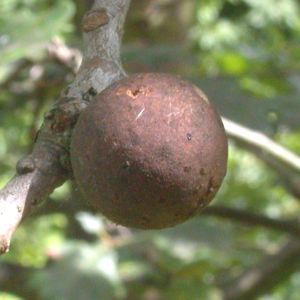
Andricus kollari (Hartig, 1843)
|
- A Marble Gall on the stem of Quercus robur.
- The larvae causing these in summer are asexual. The adults lay eggs on
Turkey Oak Q. cerris which form smaller galls containing a sexual generation.
- The adults from the marble galls may emerge in Autum as here, completing two generations in a year; or in spring thus taking two years to complete the cycle - this is more common in northern Britain.
- These galls have spread from southwestern Britain since introduction in the 19th century.
- This gall is about 18mm diameter. A complex collection of inquilines and
parasitoids may develop within.
- Cambridge TL464614, 29 Aug 2002.
|
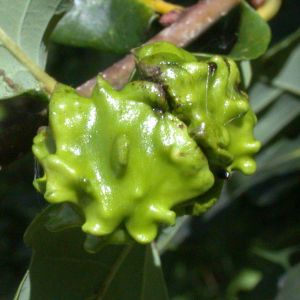
Andricus quercuscalicis (Burgsdorf, 1783)
|
- These growths on the acorns of Quercus robur are called Knopper Galls.
- The larvae causing these in summer are asexual. Adults emerge in
spring to produce a new sexual generation on the catkins of
Q. cerris (itself an invasive non-native species).
- These galls have rapidly become widespread in Britain since they
first appeared about 1960.
- Single galls are about 22mm across.
- Cambridge TL464614, 21 Aug 2002.
|
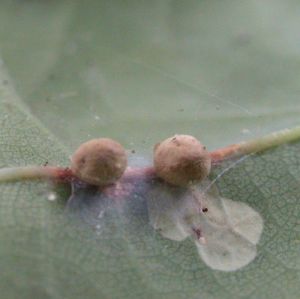
Cynips divisa (Hartig, 1843)
|
- Two Currant Galls on the underside of a leaf Quercus robur.
- These galls are about 2mm diameter.
- Cambridge TL464614, 29 Aug 2002.
|
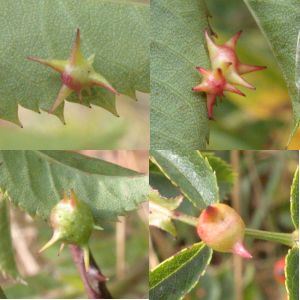
Diplolepis nervosa (Curtis, 1838)
|
- These are known as Spiked pea galls
- somebody must have worked for weeks on some of these names :-)
- A selection of galls from nearby rose bushes.
- Pupae overwinter in the fallen leaf-galls, adults emerge in spring.
- Up to about 6mm across (tip to tip).
- Cambridge TL463614, 11 Sep 2002.
|
Diplolepis rosae (Linnaeus, 1758)

|
- This growth on a wild rose is called a Bedeguar Gall, or more
picturesquely a Robin's pincushion. (Bedeguar comes from a French, and ultimately a Persian, word meaning 'wind-brought').
- Several D. rosae larvae form the gall, and they may been joined
by the harmless inquiline cynipid Periclistus brandtii (Ratzeburg) and (as in marble galls) a
complex ecology of parasitoids and hyperparasitoids.
- The species consists almost exclusively of parthenogenic females.
- This example is about 7cm in diameter.
- Cambridge TL463614, 18 Jul 2002.
- Synonym: Rhodites rosae
|
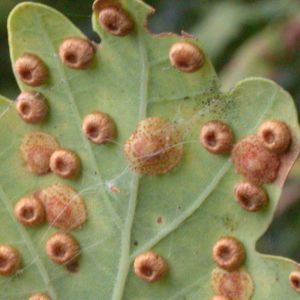
Neuroterus numismalis (Geoffroy in Fourcroy, 1785)
Neuroterus quercusbaccarum (Linnaeus, 1758)
|
- Under a leaf of the same long-suffering Quercus robur as the Knopper Galls are these two types of spangle galls:
- The flat Common Spangle Galls of N. quercusbaccarum. up to 5mm diameter
- The cupped Silk Button Spangle Galls of N. numismalis. about 2mm diameter
- Again these are an asexual generation: the sexual generation of N. quercusbaccarum form currant galls on young leaves and catkins in spring, in this case still on Q. robur; those of of N. numismalis are inconspicuous leaf galls.
- Cambridge TL464614, 2 Sep 2002.
|
Return to: Hymenoptera Index |
Insect Index