
 Vegetables - Sweet corn
Sweet corn is sometimes called maize, but that usually means "field corn" grown by farmers for animal feed. Americans call it corn, but in UK, that covers wheat and other crops as well. Sweet corn is definitely not hardy, so sow after the last frost.
There are different varieties. I haven't found much difference between them, but I tend to use one that has a mixture of yellow and white kernels, as it seems to work, and looks fun. Some varieities describe themselves as Super Sweet. Sweet corn can often go starchy if kept too long after harvest, or harvested too late, and Super Sweet presumably negates this. But fresh sweet corn is sweet anyway.
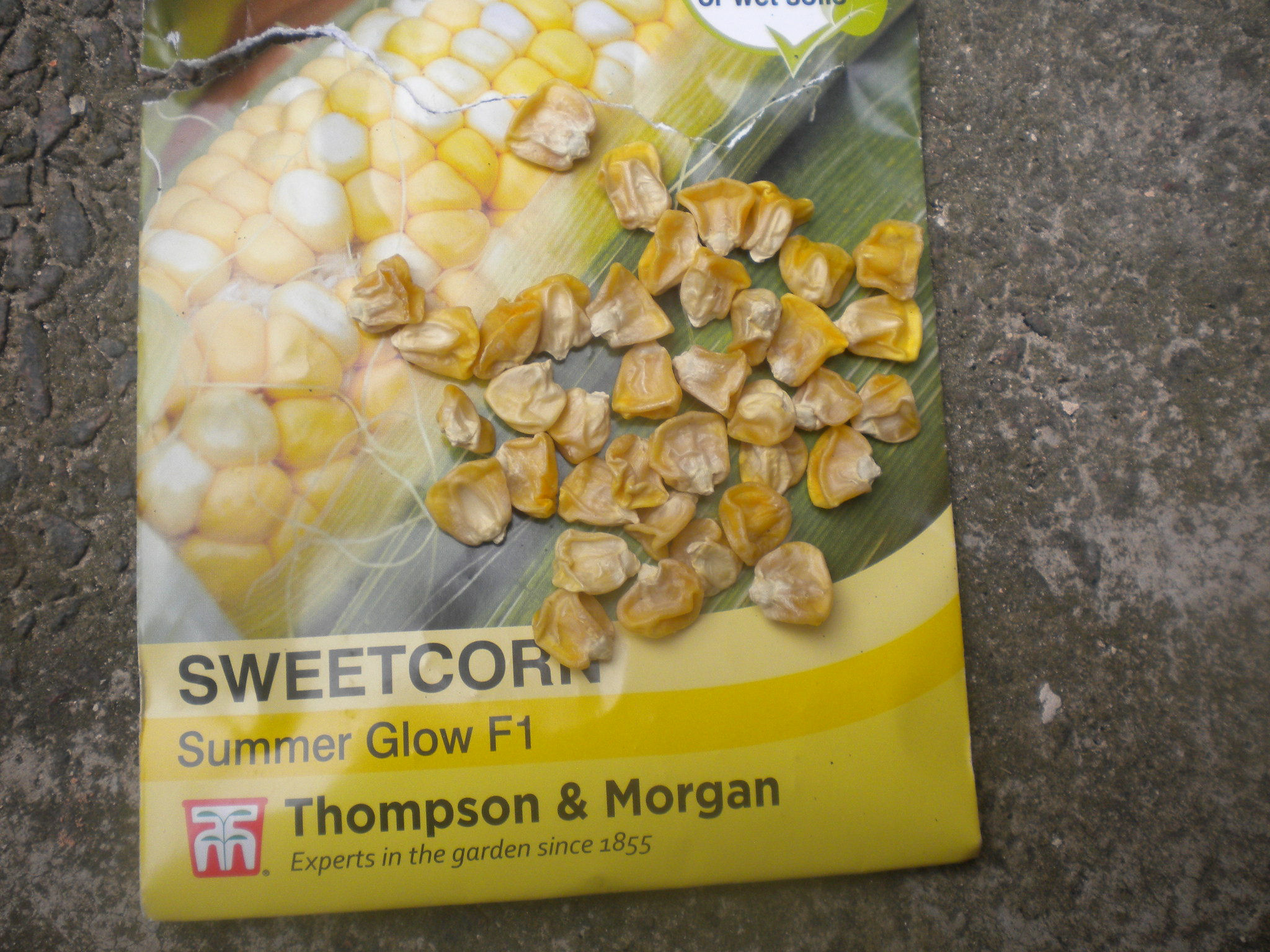
It is grown from seed. I forgot to photograph the seeds - sorry! But they look like dried up kernels of sweet corn. Sometimes they are treated with fungicide - I've seen them pink!
There can be a problem with germination. If you sow them in the ground, they can rot before germinating. I think they require quite warm soil to germinate. But if you sow them in pots, the seed immediate develops a very long root, so you require a big pot, and that would need a lot of potting compost if you have one pot per seed. So I have developed my own technique. I use just one tall, thin pot (which happens to be transparent). I sow an entire packet of seed in the same pot. The seeds (which are quite big - they're a single kernel of corn, dried) are touching, or nearly, on the surface of the compost, then I cover them with a bit more compost. I sow them around the first week in May (which is when the last frost might happen), and keep the pot on my kitchen window sill. The seeds germinate quite quickly, and the roots grow straight downwards, not interfering with each other. I plant them out before the roots reach the bottom of the pot! The seedling has a leaf or two by then.
To plant out, I carefully get the contents of the pot out of the pot, and break apart the different plants. I dig a hole, with a trowel, big enough for the plant's root, if I can, put a plant in, and firm it up. Plant them in a square, rather than a line, as they need to germinate each other's cobs, and that way, they are more likely to reach their neighbours. It's a bit of a hassle, doing all this planting out, but it does mean that I get excellent germination, and the plants grow well.
The plants grow tall. As it says in the song "The corn is as high as an elephant's eye". Each year, we look at the plants and say "Maybe a small elephant!" Each plant develops a tassel on top, and cobs develop between stalk and leaf (a bit like brussel sprouts, although these are seed heads, not shoots) .The cobs gradually fatten. They are surrounded by leaves. You can peel these back a bit to see if the seeds have developed, and whether they are yellow. When they are, you can harvest them by breaking them off the plant. You can leave the plant there, in case another cob develops, but I must admit that I usually only get one cob per plant, and some plants don't produce one at all.
Once harvested, strip the leaves away from the cob, and remove the silky threads. Boil for a few minutes, and serve with lots of butter! Home grown sweet corn is very nice, particularly if eaten as quickly as possible after harvesting.


Click on photos for large version.
© Jo Edkins 2021 - Return to Garden index