
A chevron or arrow is a solid shape common in Torchon lace. A chevron can point either down or up.
It can be worked in either cloth stitch or half stitch. The effect of the two are different, but they are worked the same except for the stitches.
Originally, I gave a fairly brief description of chevrons. At the bottom of this page, there is a fuller analysis.

Cloth stitch chevron pointing downwards. See pattern 27.

Pattern representation of a chevron pointing downwards
This pattern shows a narrow chevron pointing down. It is possible to have wider chevrons, such as in the photo, and the lengths can be as long or short as you want. I hope you can see how to adapt the following explanation for those.
The following diagram avoids the complexities of the individual stitches by showing each pair of threads as a single line. Where one line crosses another, you should work it in cloth stitch or half stitch.
A chevron pointing down starts with two arms, and two worker pairs (one for each arm). When the shape splits into two, then one of the worker pairs become passives, leaving one worker pair. The diagram explains how many workers are in use at a particular point.
|
|
Working: Work one arm of the chevron, taking in pairs from inside the chevron, and discarding to the outside of the chevron. Work down to the row above the pin where the arms meet. You should work both ends of this row. Now work the other arm in the same way. Hopefully, at this point, there is one worker pair at the edge, and the other worker pair near the middle (but above the central pin). Now work that middlish pair back to the edge. Work the other pair to the central pin, and put in the pin to hold it in its row. It has now become a passive pair. Work the other pair (at the edge) right across the whole chevron, and carry on working the rest of the rows, discarding pairs to left and right, as they are now all outside the chevron. The last two pairs (if you haven't made a mistake!) are worked together after the bottom pin, as usual at the end of a shape (unless it is touching another shape below). Then you have all the pairs free to work the lace below the chevron.
The problem is deciding which worker pair to leave in the centre to become a passive pair, and which pair stays as workers. The pattern above assumes a certain pattern in the workers, which would be caused by the chevron pointing up. If you have problems, then try various combinations of workers becoming passives or not. Try to make sure that the chevron looks balanced on either side, and there isn't too much of a hole or sparse working or lack of symmetry on either side. You will never be able to get it exactly symmetrical and completely smooth.
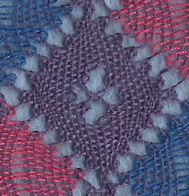
An open diamond
This shape seems to have chevrons pointing sideways as well as up and down! In fact, the side chevrons are zigzags.
This analysis is baded on pattern 564.
There are various choices that you can make when doing a chevron. If it points downwards, then you start with two worker pairs, one at each point. You work down points until they meet. At that point, you should only have one worker pair.
The choices are:
Do the two worker pairs start in the same direction (such as left) or are they mirrorred (such as inward, or outward)?
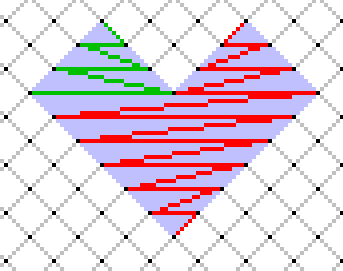
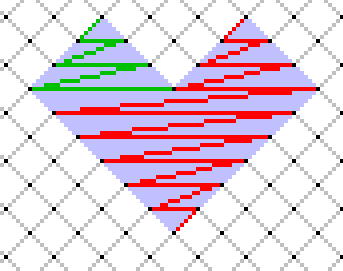
When they meet, does the excess worker pair stop at the middle, or at one end? In the following patterns, the worker pairs have been coloured differently, to make it easier to see what's happening.
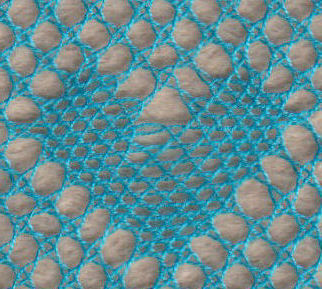
This starts with both worker pairs starting outwards. One of the worker pairs ends in the middle. The left hand side looks a little sparser than the right, especially in the middle. The effect can be seen in the cloth stitch version, but not as much.
 |
 |
 |
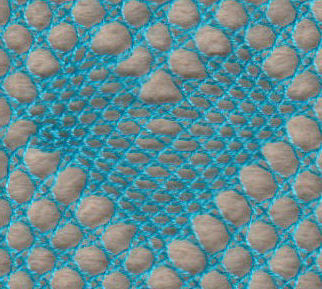
This starts with both worker pairs starting outwards. One of the worker pairs ends at the edge. This looks better, but a pin on the left gets reused, and this is visible.
 |
 |
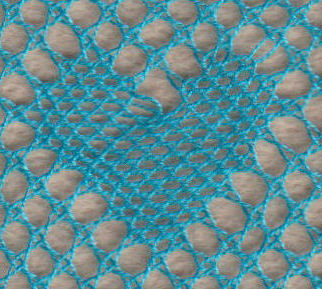
This starts with both worker pairs starting inwards. One of the worker pairs ends at the middle. Here the middle looks cluttered.
 |
 |
This starts with both worker pairs starting inwards. One of the worker pairs ends at the edge. I didn't reuse the pin this time, and it looks better, but there is a slight gap in the middle.
 |
 |
Here, both worker pairs start to the left (in the same direction, rather than mirroring each other). The surplus worker pair ends in the middle. This is pretty good, but the left side does look sparser as a whole, than the right. I did a cloth stitch version as well, in case that led to problems, but it doesn't seem to.
 |
|
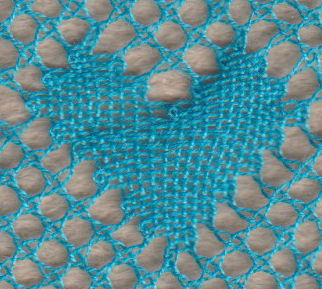 |
I think the last one is the best, as it's easiest, and it doesn't seem to lead to messes in the middle or at the edge. It is counter-intuitive for a lacemaker, though, as we'd assume that the pattern ought to be mirrored.
© Jo Edkins 2016 - return to lace index


