
A spider is a feature used in Torchon lace (and perhaps elsewhere) where a number of pairs is brought together at a pin, and then separate again. I call the pairs "legs", which means that we can have 8 legged spiders (see below), which makes sense, but you can also have 12 and 16 legged spiders! There are also different types of spiders. See spiders for how to make the various forms.

A spider sits within a diamond, of 4x4 for 8 legged spider, but larger for larger spiders. Usually a spider is framed, possibly within solid cloth stitch or half stitch, or possibly within a ground. However it is possible to have spiders next to each other, and this is what this page discusses.
The obvious thing to do is just to fit the spiders next to each other. They fit within diamonds, and so this diamonds can sit by each other. But there is a problem. When a spider is framed by other stitches, then the legs splay out, and the effect of the spider is clearly seen (see above). But if you have spiders next to each other, these legs are not kept apart, and so you have two (or more) legs sitting side by side. However, this has its own effect, and this is spider ground.

It is possible to make the legs splay apart by having a line of Torchon ground between the spiders. This is spider and line ground. This picture shows 8 legged spiders, but you could do it with 12 or 16 legged spiders.

The legs lying together are because two legs from one spider go onto the next spider. There is nothing keeping them apart, so they lie together. However, with a litttle care, it is possible to offset the position of the spiders, so one leg of a spider goes to one spider, and the other go to a different spider. As they are different spiders, the legs are kept apart. However, by having these spiders offset, there is a single point between four spiders which doesn't belong to any spider, and has to be worked as a Torchon ground stitch. This is spider and dot ground. I think this can only be done with 8 legged spiders. It also has rather a ragged edge, which has to be filled with more Torchon ground.
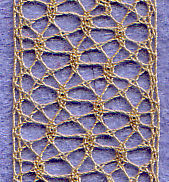
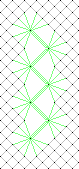
We have seen above that if you put spiders next to each other, with legs from one spider all going to the next, then the legs don't get separated, but stay next to each other. You get a fun effect if you do this with half of the spider, but leave the other half spread out, in Torchon ground. This creates a line of spiders travelling down the lace, creating a wave effect - very pretty!
© Jo Edkins 2024 - return to lace index