
 Greek Keys
What is a Greek key?
Simple Greek key
Generator
Turns
Other patterns
Corners
Two dimensions
Pictures
Make a Greek key
Greek key website
handout
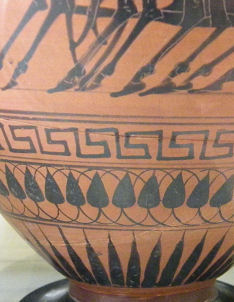
Greek keys are square double spirals, arranged in a line. They are not magical! The ancient Greeks liked them, though. They are called "keys" because the shape looks a bit like old keys. But there are also called frets or meanders.
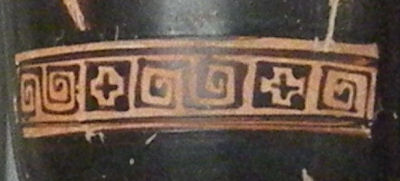
Jug from Athens 8C BC - Fitzwilliam museum)

The easiest way to draw Greek keys is to use squared paper. Rymans sell it.
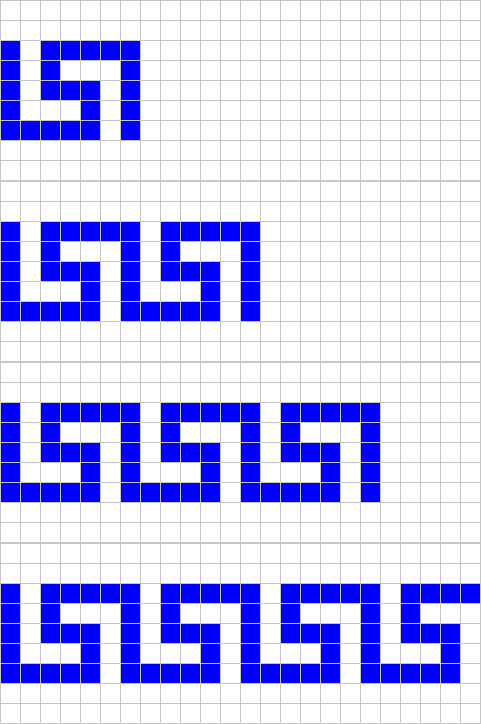
Draw 3 squares across. Then, from the ends, 2 up and 2 down. Then, 4 to the right and 4 to the left., Then 4 down and 4 up.


Now repeat this pattern, overlapping the vertical line. You may find it easier to copy following the line on rather than starting from the centre.
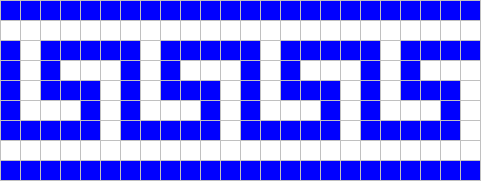
This is a Greek key (see above). But often, they drew a line above and below to frame it.
Athens 5C BC (Fitzwilliam museum)
You can look at the key in a different way. If you look at a simple pattern such as a chess board, you can see it as black squares on a white back ground. But you can "flip" your vision to see it as white squares on a black ground. This is a useful technique for patterns. See what happens with Greek keys.


There is a pattern between the double spiral of the Greek keys. I call this the generator. There are also horizontal lines. These are not the original framing lines, but come just inside them. Try flipping above to see this. Below, I have drawn the generator in red and green.
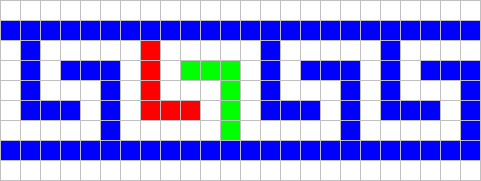
Greek keys can be bewildering to look at. These generators are simpler, so you can figure out what's going on.
We can make Greek keys with more turns. I've coloured in one of the generators to make it easier to see what's going on.

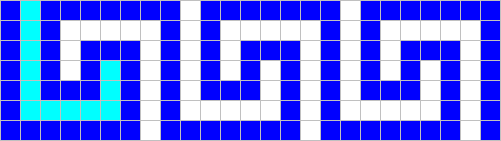


Athens 5C BC (Fitzwilliam museum)

This is getting very complicated! But I hope that the generator helps you understand it better. I don't think that I would use a generator to actually draw a Greek key (although you can if you want to). If I wanted more turns, I would draw a key as in the first example, and adding extra sides on top and bottom. However, I do use the generator to analyse someone else's pattern.
So have we found all possible patterns - either the original, or flipped, or more turns? No! Look at this:
Athens 5C BC (Fitzwilliam museum)
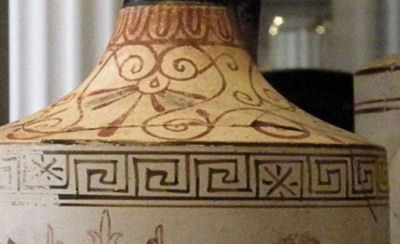
It's certainly a Greek key! But try to follow the line. It starts from the bottom line, and ends up at the top.
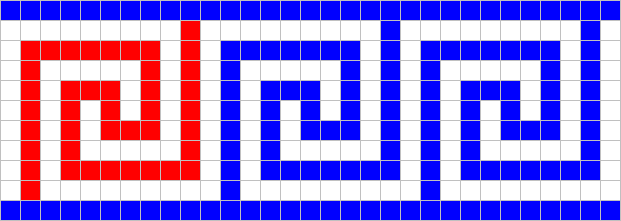
Well, generators often start or finish on the line. Perhaps this is a flipped pattern. So now, try to follow the white area between the lines. It certainly seems to wind round, but it starts in the middle of one key, and ends up in the middle of the next. (The Greek key at the start was continuous.)

This is definitely a different pattern!
Here is another pattern. It has a tight spiral that leads into another spiral.
Athens 5C BC (Fitzwilliam museum)
Here are some different patterns. I give the generator, the basic pattern, the framed basic pattern, and the inverse, with black and white reversed. The inverse shows the generator marked in red.

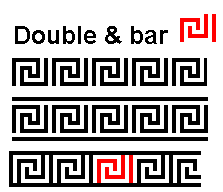


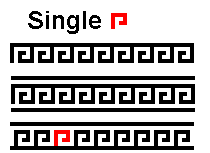

My Greek keys website gives plenty more. You can choose more turns, and different styles as well.
The ancient Greeks used Greek keys as a strip, sometimes going right round a vase and joining up (which must have taken some care!) They didn't use it as a border, round something. This was very sensible of them. Corners are hard! The problem is that the basic unit is not a squre:
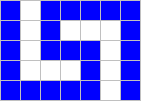
You can continue the pattern round to the next side, but it may niggle on your eye that part of the pattern sticks out. (Maybe not... People's reactions to patterns vary!)

It definitely helps to put a border!

This is not the only solution. I have investigated this more fully on my Greek key website, perhaps to an excessive extent!
Greek keys are traditionally a line, or one dimension. It is possible to make it two dimesional.
This is just repeating lines of Greek keys.
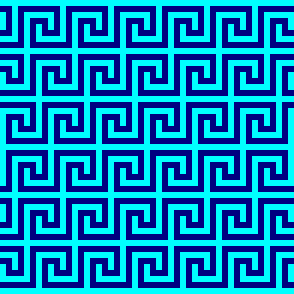
This one is more complicated!
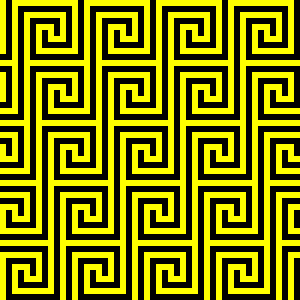
My Greek key website gives some more, plus you can generate your own (but not colour them, unfortunately.)
The website goes on into triangular Greek keys, fractal Greek keys...
Coffin - East Greece 6C BC (Fitzwilliam museum)
Athens 5C BC (Fitzwilliam museum)
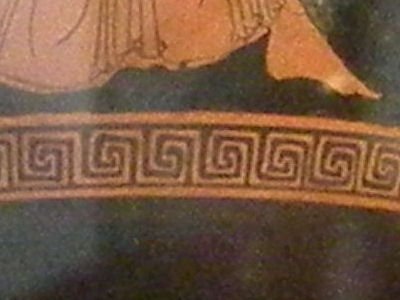
Athens 5C BC (Fitzwilliam museum)

Rosemarkie panel, Ross and Cromarty, 9C AD - triangular keys!

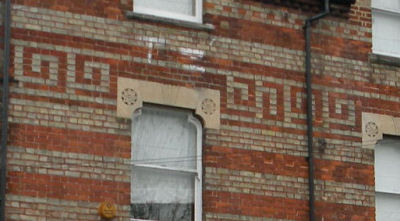
house on Glisson Road
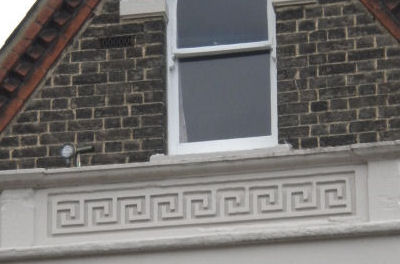
From Saffron Walden - wonky!
You can choose from four different styles of key - standard, standard and bar, edge to edge or "T" shapes. The generator is in red.
"Reverse" swaps over the red and black, to give the inverse Greek key.
"Lines" increases or decreases the number of lines above or below the Greek key. You can run it down to zero lines.
"Turns" winds the Greek key round one more (or less) turn.









© Jo Edkins 2025 - Return to Patterns index