
 Celtic knot I
What is a Celtic knot?
How to draw a rectangular Celtic knot
How to draw a free-form Celtic knot
Knots
Picture
Celtic Knots website
Design a Celtic knot online
handout
A Celtic knot is a drawing of a string or rope which seems to cross itself. It is not necessarily Celtic! There are certainly Celtic knots in the Isle of Man, Ireland and Wales, and this explains the name. But there are examples in Roman mosaics, before any Celtic examples.

There are Saxon stone carvings, and later on, Islamic decoration. The correct term is "interlace", but I have always thought of them as Celtic knots! This is a wide subject, with more than one way to draw the knots, so this is the first group, concentrating on illuminated manuscripts.

These are not real knots, but only the appearance of one. You do this by drawing the strands of the knot, then outling them, but the outline is continuous for one strand, and not the other. The eye decides that one strand is going underneath the other.

To draw the knot, you need two felt-tip pens - a thick pen of pale colour, and a thin pen of dark colour. Take the thick pen. Draw a number of lines next to each other.


Draw a number of lines going the other way, crossing the first lines.
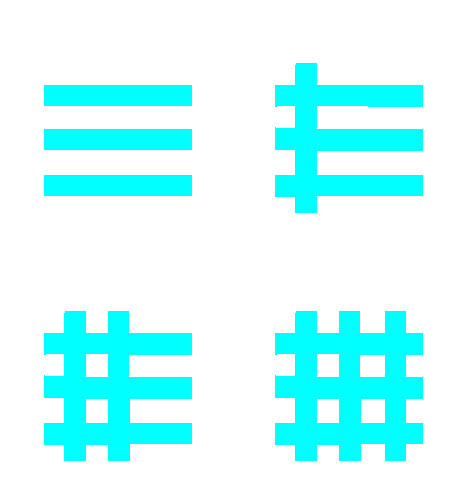
Join each line to the next line, going round a corner if necessary. You can also make ends into a head or tail!
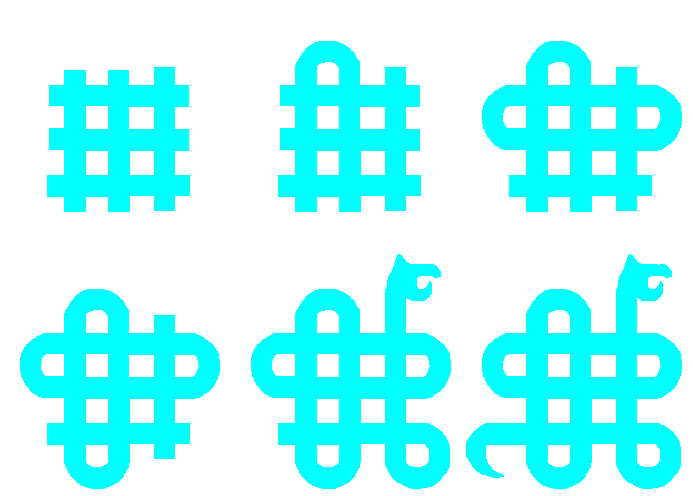
Change to the dark coloured pen. Take one cross-over. Outline one of the lines.
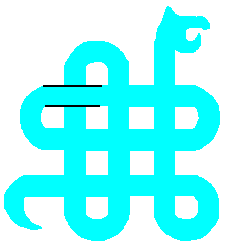
Take the next cross-over. Outline the line going the other way. Tidy up any gap.
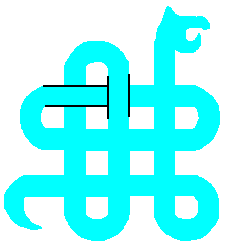
Outline all the cross-overs - remember - over, under, over, under. You can outline the underneath strands as well.

Outline everything else. Perhaps add an eye!
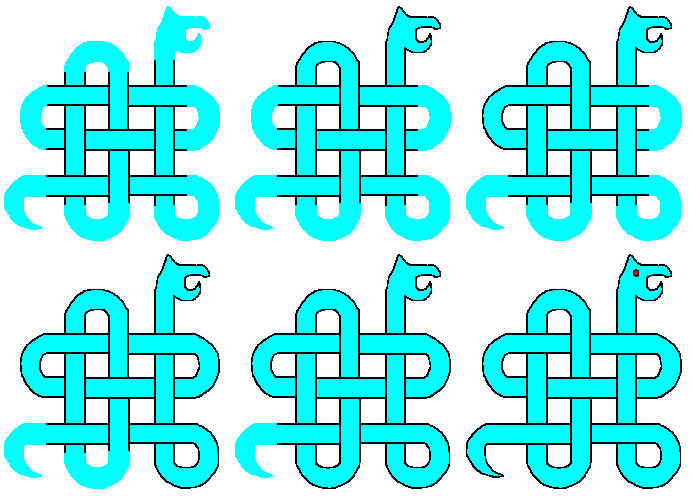
This knot is up-and-down. If you look at knots in the illuminated manuscripts, they are usually tilted.
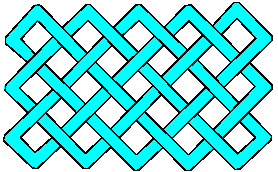
The easiest way to do this is to tilt the paper! The proper way to do it is to draw the lines as tilting, to start with. The lines will be different lengths, to fit the overall rectangle. The technique afterwards is the same.
Some Celtic knots have straight lines and a regular form, as above. Some are free-form, perhaps showing animals with intertwined legs!

As before, you start by drawing the basic shape. To practise, usi9ng the thick, pale pen, draw a wiggly line which crosses itself, more than once. Then outline it with the thin, dark pen as before.
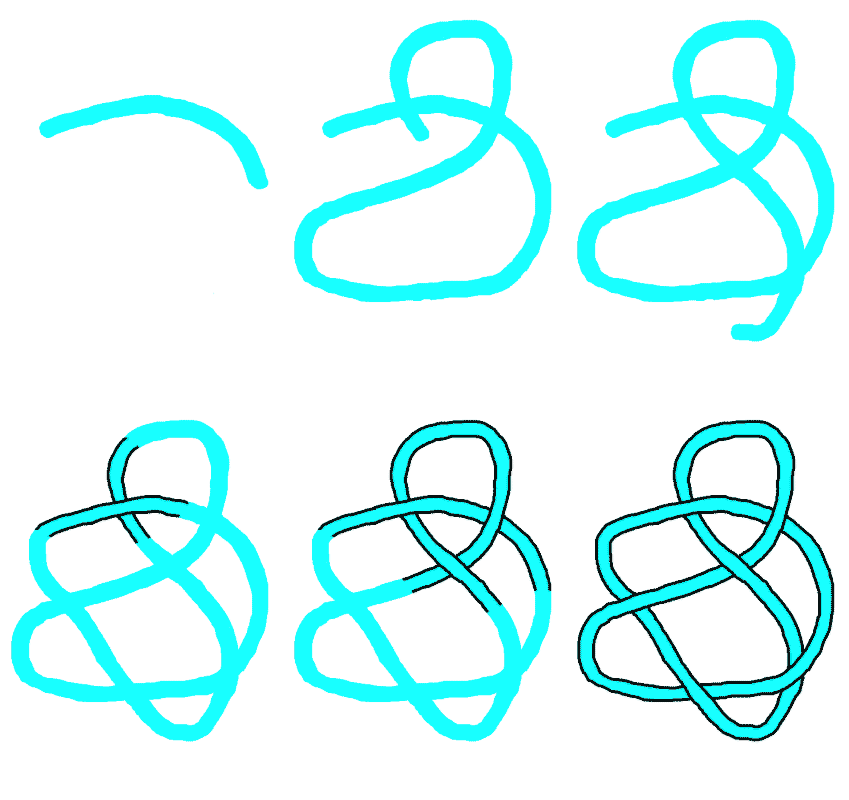
There are some rules about drawing the line. The line must cross itself, but only in a simple way. There mustn't be three lines all crossing at the same point. The end of the line can join the start, or you can leave the two ends (perhaps as a head and tail!) but you mustn't have one end inside a loop and the other outside. If you follow these rules, then the unders-and-overs should work.
Of course, you can make the original lines much more complicated! Some artistic ability is necessary here (which I don't have!) But it is possible to have an attractive pattern which is quite simple. The following was done by a 9 year old child.

Was this method used by the makers of the illuminated manuscripts? I don't know. (I learned it from Tony Hart, from the children's art program on TV.) They certainly could have used it, with pale paint for the shape, then letting it dry before doing the outline, possibly with a pen. It suits both regular and free-form patterns. But there is no evidence.However, we can use the method!
When looking for ideas for celtic knots, you might find simple knots interesting. Mathematicians like knots! It is part of a branch of mathematics called topology.
The Bowen knot is a heraldic knot, used in certain coats of arms. Mathematicians would consider this not to be a knot at all, as you can just pull it into a simple loop.

This is a Solomon's knot or Solomon's seal. Mathematicians also don't regard this a a "true" knot, calling it a link. It is found in many cultures. The Roman's liked it.

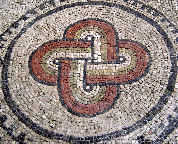
This is a trefoil knot. It is widely used. Mathematicians accept this is a knot!

This is a cinquefoil knot, otherwise known as a pentacle or pentagram. It is named after the flower. This is a more complicated mathematical knot.

Borromean rings. These are interesting. The rings are interlocked, and you can't pull one away. But if you cut one ring, the other two separate. So any two rings are not linked, but all three are. Mathematicians like this kind of thing!

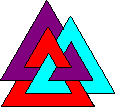
This is a Valknut, which is similar. I've coloured it so you can see the similarity. The name is modern, but the symbol is an ancient germanic symbol, around 8C AD.
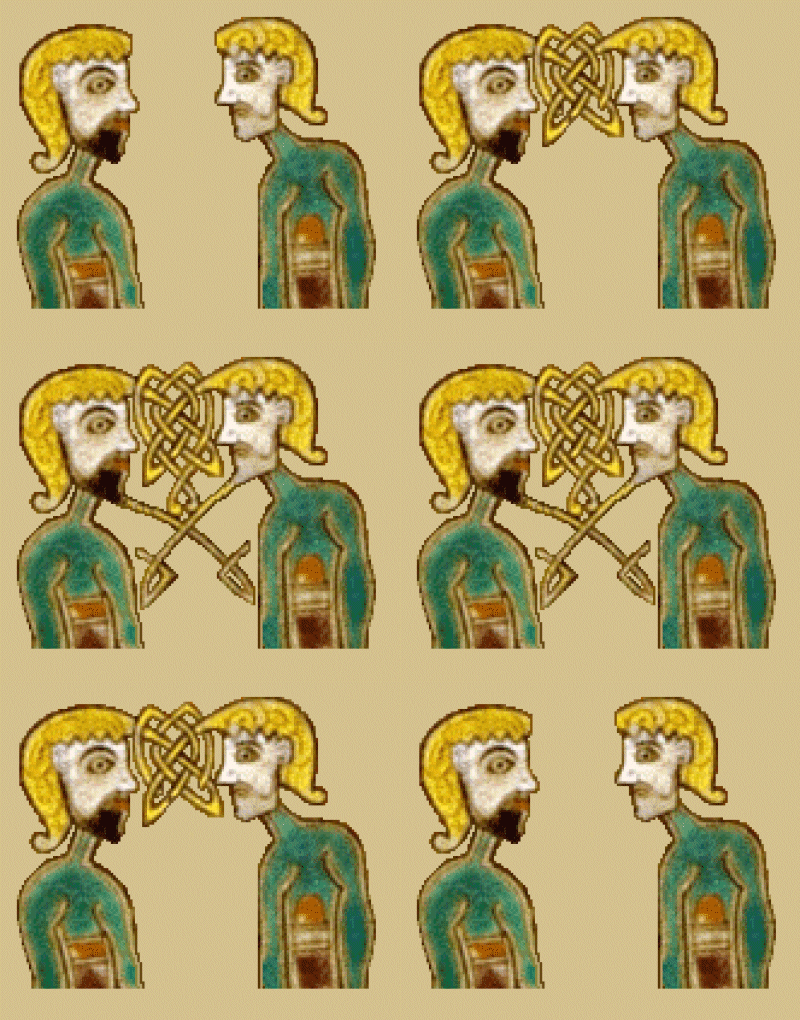
Here is a fun picture to finish! The complete picture comes from the Book of Kells, and yes, they are pulling at each other's beards! But I have made it into an animation:
© Jo Edkins 2025 - Return to Patterns index