
 Shapes
Triangle
Rectangle
Pentagon
Circle
Old use of shapes
Shapes website
Solids website
handout
So far, we have done lines. Now we move to simple shapes, triangles and squares, etc.
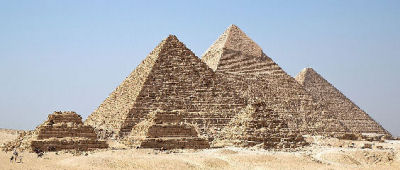
Pyramids of Giza, Egypt 2.5M BC
A triangle has three sides (or angles). It is a very stable shape. If you make a triangle out of string, pulling outwards at three places, then there is only one triangle you can make. You can't distort it by pulling harder on one corner. If you made a shapes with more sides, then pulling on one corner pulls it into a new shape.
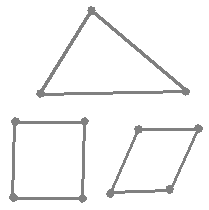
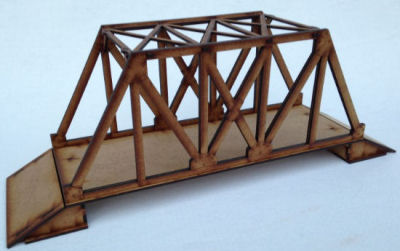
So triangles are used in architecture and engineering to make strong structures.
A four-sided shape is called a quadrilateral. If all sides are the same, it is a square. If all angles are the same, it is a rectangle, and the angle is a right angle or 90 degrees. It is called "right" angle, as it is the proper angle to stop a wall falling over! So it is a natural shape to use for buildings.
Skara Brae, Orkney 3M BC

The Ancient Egyptians had to lay out their fields every year after the Nile flood. We have seen how easy it is to distort a rectangle into a different shape. They needed a way to produce a right angle. Use circle of rope with 12 equally spaced knots. Pull apart at 3rd, 7th and 12th. The sides of the triangle are 3,4,5. There is a right angle between side 3 and side 4. Pythagoras proved this is true for all triangles where "the square of the hypotenuse (longest side) is equal to the sum of the squares on the other two sides - 3x3 + 4x4 = 5x5. It also works for triangle 5,12,13. Pythagoras knew about the general rule (and proved it) but the Egyptians knew about the 3,4,5 triangle earlier, and used it.

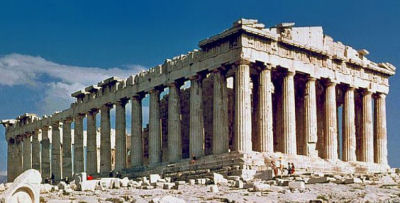
The Parthenon (Athens 5C BC) looks like a very rectangular buildings (although the pillars have slightly curved edges), but there is a triangle at the top - the pediment.
There is an interesting rectangle that we use a lot - A4 paper. This has sides in proportion 1 : 1.414 (or 1 to root 2, if you want to be mathematical!) Fold A4 in half to get A5, and again to get A6, etc. These are all the same shape. This does not necessarily happen with rectangles.

Another interesting rectangle is the Golden Rectangle. This has sides in proportion 1 : 1.618. If you remove a square from it, this leaves another (smaller) rectangle with sides in the same proportions. You can carry on doing this, producing smaller and smaller rectangles with sides in the same proportion. Now, if you draw a quarter of a circle in each square (and you've arranged the squares in the right place!) you get shape called a Fibonacci spiral, which is rather like a logarithmic spiral (not a true one because a true spiral is not made up of bits of circles!) This is called a Fibonacci spiral because the Golden Rectangle is connected with the Fibonacci series, which is great fun, but not part of this course!


A shape with five sides is a pentagon.
There is a surprisingly easy way to construct a regular pentagon (where sides and angles are equal). Take a piece of paper about an inch wide (or 2.5 cms) and quite long. Tie a simple knot in it! Gradually pull the paper through until the knot is tight. The cut the ends off. The result is the pentagon.

A pentacle is a star with five points, as seen on this Greek coin, Turkey 3C BC

You can draw a pentacle quite easily (although it probably won't be regular). Draw five dots, in a circle at roughly regular intervals.
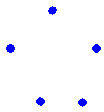
Draw a line between two dots that are not next to each other.

Do the same for the rest of the dots.
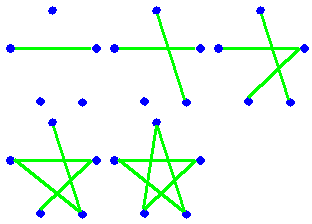
This will look better if you make the dots smaller and the same colour as the lines! The star may look wonky, but still attractive.
You can try this using more dots. Six dots produces the Star of David. For more dots, there may be more than one star, depending whether you join the next but one dots, or next but two.
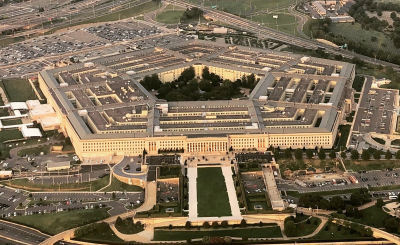
The Pentagon (USA 1943) is a famous five sided building!
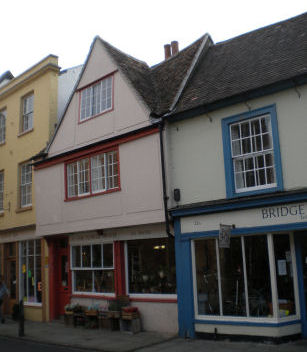
We think of ordinary houses as being rectangular, but since there are sloping roofs, the end, with the gable, looks like a pentagon (but not a regular one). Sometimes this end faces the street.
There are fun things to do with circles, but, you really need a pair of compasses! You can get a circle by drawing round a plate or glass, but you don't know where its centre is, and you need this for this.
Draw a circle with a pair of compasess. Be careful not to alter the span after you've finished!

Put the point of the compass somewhere on the edge of this first circle, and draw another one of the same size.
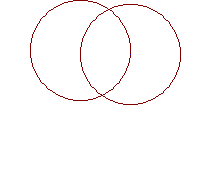
Put the point of the compass somewhere where the two circles cross, and draw another one of the same size.

Carry on doing the same. A flower appears!

If you join the end of the petals, you get a regular hexagon (six sided shape).

There is another pattern you can make with circles. This is a Ichthys or fish. It is an early Christian symbol. The letters of the Greek name are the initials of a phrase in Greek translated as "Jesus Christ, God's Son, Saviour". You make it with two overlaping arcs (part of a circle).

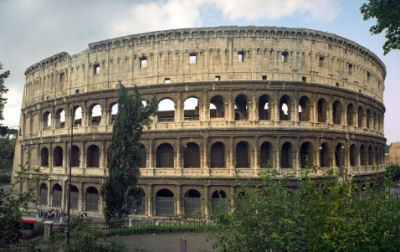
Circles used in architecture:
Stonehenge, Wiltshire 2.5M BC

Colosseum, Rome 80 AD
We even have one in Cambridge! Round Church 1130 AD

The floor plan is inspired by the rotunda in the church of the Holy Sepulchre, Jerusalem. It also uses the Norman round arch. Later churches used the Gothic arch, which is pointed. Chapter House, York Minster 1290 AD

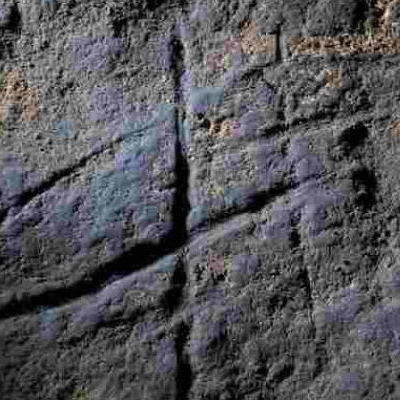
When did using shapes as patterns start? You could say that these are the oldest patterns of all. Here are Neanderthal lines scored into a cave wall (Gibraltar 37M BC). Do they make a shape? (Some people suggest a hashtag!)
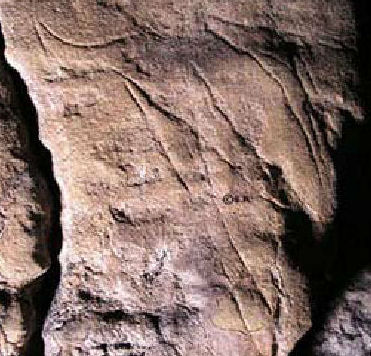
These lines in Cresswell Crags (11M BC) might be triangles.
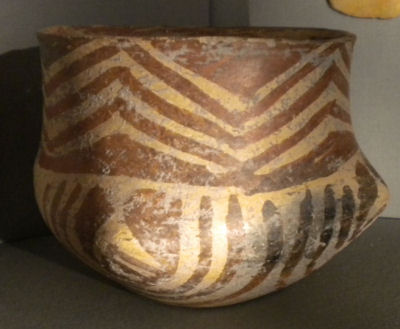
This pot from Anatolia (late 6M BC) has lines rather than shapes, but triangles are suggested. It's in the Fitzwilliam museum.
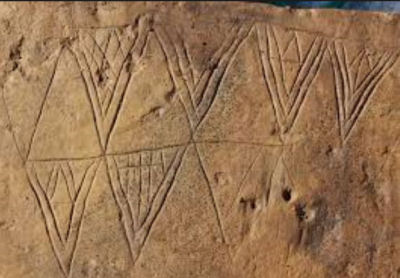
These are diamonds and triangles, at the Ness of Brodgar, Orkney 3M BC.
© Jo Edkins 2025 - Return to Patterns index