
 Spirals
Clockwise spiral
Anti-clockwise spiral
Double spiral
Nested spiral
Triple spiral
Joining spirals
Logarithmic spiral
Pictures of manmade spirals
Pictures of natural spirals
Puzzle
handout
Spirals are very old patterns!
Egyptian pot 35C BC - Fitzwilliam museum)

In this session, we will be covering Archimedean spirals, with equal distance between each circling. Logarithmic spirals spread out more, further from the centre.
Step 1 - Draw a capital C (not too close to the edge of the paper!). Put a blob on the bottom end.

The C should be about the comfortable size of a capital C for your pen. The blob determines whether you're drawing a clockwise or anti-clockwise spiral.
Step 2 - Draw a line from the top as if making an O, but miss!


This is the crucial stage! Click on Repeat, if you want to watch it again.
Step 3 - Carry on round the outside.
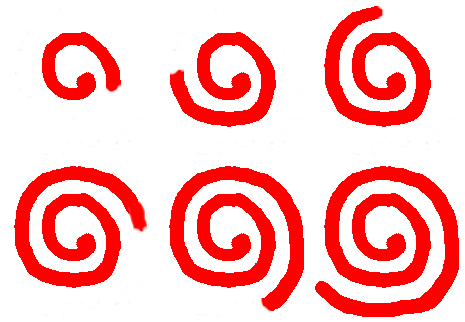
The spiral magically appears... If you find it hard to draw the line, try turning the page. You may find it easier drawing the line at a certain angle. You are allowed to take the pen off the paper and start again. However, some people find it easier to draw it as a single line.
When you you stop? When it's big enough, or possibly when you reach the edge of the paper, or when you lose control of it!
Step 1 - Draw a capital . Put a blob on the top end.

Step 2 - Draw the line as before, but going the other way.

You may find it easier to draw clockwise or anti-clockwise spirals.
Do you think that this method is how they were originally done? It seems reasonable to me. Starting at the centre and going outwards, when the line starts to get out of control, you can just stop. If you start at the outer edge and move inwards, it gets trickier. But of course, we can't tell.
This course is about patterns, not symbols. What is a symbol? It has a meaning. The patterns on this course may well have had meaning, and so were symbols. But often they are so old that we don't know what this meaning is. It's fun to guess, but that's all it is - guessing!
Symbols can often have more than one form. Some people think that, for example, clockwise is "good" and anti-clockwise is "bad". I don't! Both forms seem to happen in old spirals. Perhaps the maker found it easier to draw one way. But there is another point. We have been starting at the centre, and drawing outwards, which is how I have named these spirals. But someone looking at these spirals would tend to start at the edge, and follow it inwards. That goes in the opposite direction! So if clockwise is "lucky" and anti-clockwise is "unlucky", which is which?
Greek carving 4C BC - Fitzwilliam museum)
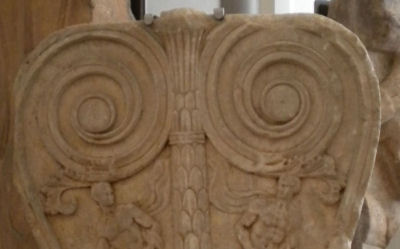
Rather than "meaning", I tend to think of patterns on this course as "magic". I don't believe in magic, but it seems that some patterns should attract meaning - that they are magical! Spirals are definitely magical! If you rotate a spiral, it comes to life!
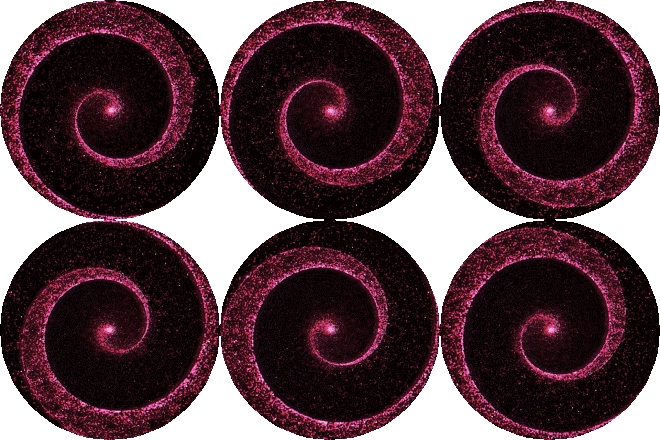
So what kind of meanings can we think of? Movement, definitely. But there is also growth. Think of a snail's shell.
Step 1 - Draw a capital S. No blobs, because we're going to do both ends.

Step 2 - Draw lines from each end, as before, but this time, do both top and bottom.

Step 3 - Carry on round both outsides.
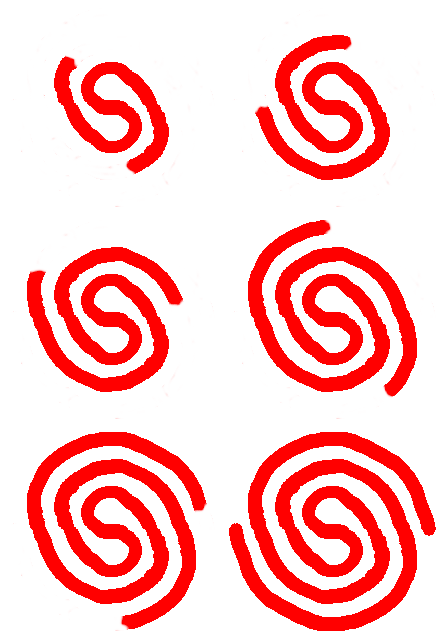
You will need to do a bit of one, then a bit of the other.
Newgrange, Ireland - 32C BC

I have heard of of a meaning for double spirals: that they represent death, and life after death. You travel inwards to the centre, where you die. But then you travel outwards again, as an after-life, or a reincarnation. (But then again, who knows!)
Nazca, Peru 5C BC - 5C AD
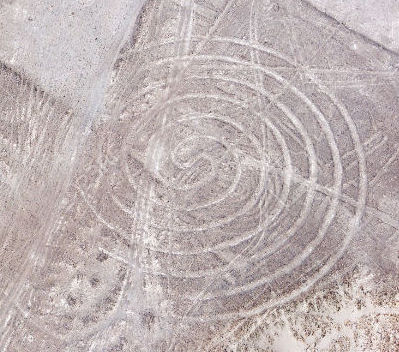
When working out whether a spiral is single or double, always look at the centre!
We have drawn the double spiral as a single line on a white background.

But you get an interesting effect if you colour in that background. You will find the background turned into two single spirals wound round each other.


If you want to draw these nesting spirals a different way, draw a double spiral, then rub out the middle.

Step 1 - Draw a capital Y.

Step 2 - Draw lines from all ends, as before
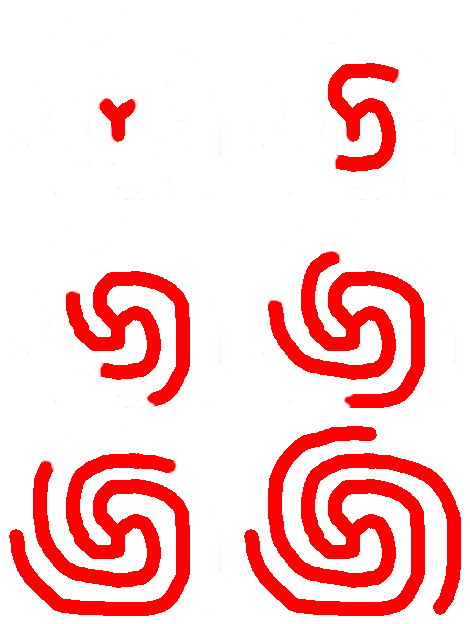
You will need to do a bit of one, then a bit of another, and so on. A simple version of this is called a triskelion.
Iron Age Castro culture triskelion

Some think that these multiple armed spirals represent the sun.
Of course, you're not restricted to just three spirals! Four would start with an X, and so on.
The spirals above were all just one spiral. Can you join spirals together? Yes.
We'll start with single spirals. There are two ways to do this.
Joining two spirals going the same way: You do two spirals side by side, and when they meet in the middle, one will be going up and the other down - so this can be the same line.

Joining two spirals going in different directions: Here you can just draw a line along the top joining them.
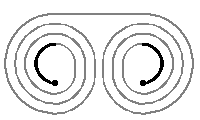
Pictish carving, Scotland 7-8C AD
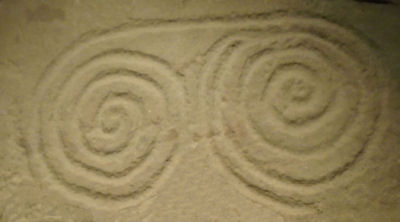
It is quite tricky to draw these, as the two spirals must be identical, or the differences tend to catch the eye. It is also easy to make mistakes. If you look carefully at the Pictish spiral pattern, you will see that there is a line which doesn't belong to either spiral. The maker has put it in to hide the fact that his spirals have too big a gap in the middle. I enjoy seeing ancient craft people making the sort of mistake that I make!
You can't do more than 2 single spirals, as each only has one exit, so they have to join together. However, double spirals have two exits, so you can put them in a line. One exit joins the previous, and the other the next.

Of course, they don't have to be in a line...

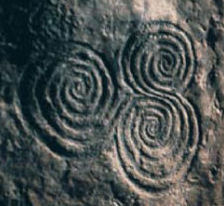
This is another form of triskelion (see above). It is three double spirals meeting in the centre. It's a bit tricky to draw! But then they seems to have had a few problems in the past as well...
Newgrange, Ireland 32C BC
So far, we have been looking at Archimedean spirals, where each circling is the same distance from the previous. There is another type called a logarithmic spiral, where each circling goes further out.
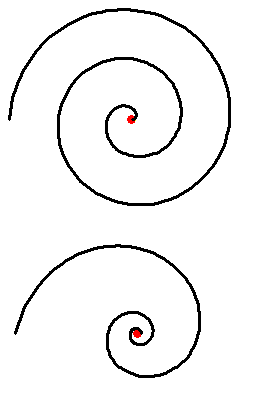
Many shells have logarithmic spirals, such as ammonites (below) or snails. As the creature gets bigger, it needs more room.

Together with the examples above, you can see the spread of use in both geography and time. See if you can identify which types of spirals they are!
Etruscan clasp - 9C BC (in Fitzwilliam museum)

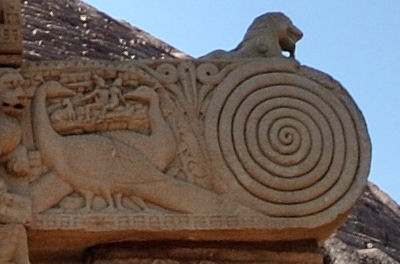
Sanchi Stupa, Madhya Pradesh, India - 1C BC
Serpent Mound, Ohio, USA - 3C BC

Nazca, Peru 5C BC - 5C AD

Monks stone, Burra, Shetland - 7C AD

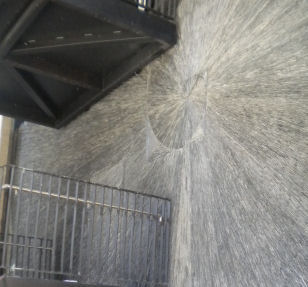
Thompon Lane, Cambridge - modern

Corn Exchange Street, Cambridge - modern
We must not forget that there are examples of spirals in nature as well!
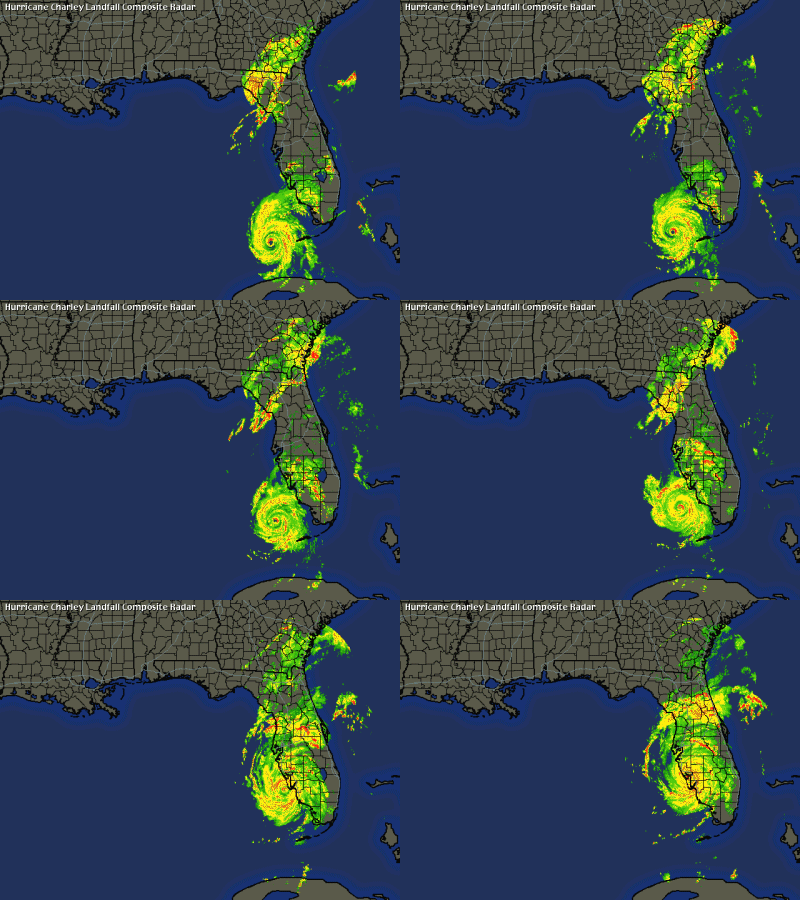
Hurricane

Tornado (a three diensional form of a spiral called a helix)

Whirlpool

Galaxy (double spiral)

Galaxy (many arms)

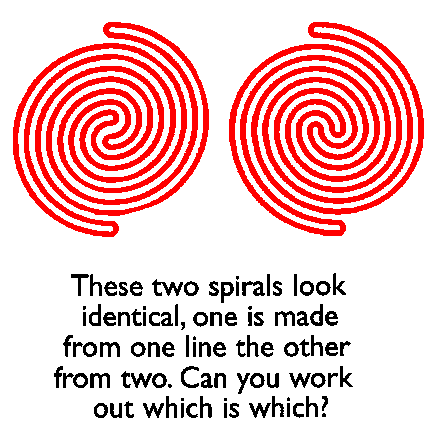
FInally, if you now think you understand everything about spirals, try this puzzle! Click on the puzzle for the answer.
© Jo Edkins 2025 - Return to Patterns index