
 Tessellations
What are tessellations?
What shapes tessellate?
Mixing shapes
Other shapes
Islamic patterns
Penrose tiles
Tessellations website
Colour in regular tessellations
Draw irregular tessellations
handout
Tessellations are geometric tiles covering a flat surface with no overlaps and no gaps. So they are simple shapes which fit snugly.
The shapes can be simple ones, such as triangles or squares. They don't have to be regular (all sides and angles the same), but we will start by looking at these.
What simple regular shapes fit together? By experimenting, you can find that triangles, squares and hexagons fit, but no other simple shape does.
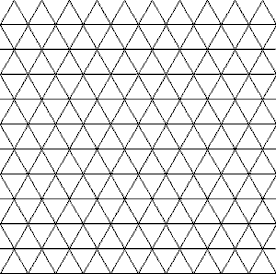


Why?
We have to look at the angles of regular shapes. To fit snugly, the shapes must have angles which add up to 360 degs (a complete circle).
The angles of a triangle add up to 180 degs, which is half a circle or a straight line. This can be proved mathematically (Euclid), but you can also demostrate it. Cut out a triangle (this works for any shape of triangle, not necessarily a regular one). Mark the angles. Now cut the triangle into three, and rearrange the bits so the angles are together. You will find that they do make a straight line!

A triangle has three angles, so for a regular triangle, an angle must be 180 / 3 = 60 degs. You can divide 60 into 360 (6 times), so that means regular triangles can fit together.
Once we know that a triangle's angles add up to 180 degs, we can work out the total for all simple shapes (whether regular or not). You can divide all shapes into triangles, as below. Four sided shapes have two triangles, five sided shapes have three triangles, six sided shapes have four triangles, and so on.

The total of the angles for a shape is the same as the totals of the angles of all those triangles. So a four sided shape has angles adding up to 2x180 = 360 degs, five sided shape add up to 3x180 = 540 degs, six sided shape add up to 4x180 = 720 degs, and so on. Going back to regular shapes, a square has angles of 360 / 9 = 90 degs. A regular pentagon's angles are 540 / 5 = 108 degs. A regular hexagon's angles are 720 / 6 = 120 degs. (You probably knew that a square's angles were 90 degs, but it's satisfying to prove it!) Now a square's 90 degs devides into 360 degs (a full circle), so does a regular hexagon's 120 degs. But a regular pentagon's 108 degs does not, neither does any other regular shape. I must emphasise that this is only true for regular shapes.
It is possible to buy squared paper and even triangle paper. Rymans does these, squared paper is called Quadrille pad and triangle paper is called Isometric pad. Six triangles together make a hexagon, so you can use the triangle paper for hexagons as well. However, my Tessellations website has large grids which you can print off for yourself for free (apart from the cost of the printing). It's fun to try colouring them in different ways. You can use colour to create various repeated simple repeated patterns, or more complex shapes. We have already used squared paper for Greek keys and some mazes.
So far, we have looked at tessellating just one shape, shape as a triangle. You can have a tessellation with a mix of more than one shape. Forget regular pentagons! They just don't work, by themselves or as a mix. BUt other shapes do mix, and even in different combinations.
The angles of two squares and three triangles add up to 360 degs (2x90 + 3x60). But they can be arranged in more than one way:
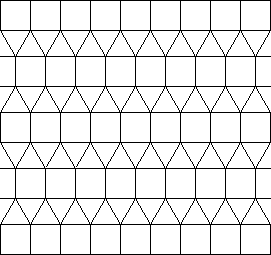

Unfortunately you can't buy grid paper like this!
Triangles and hexagons can be mixed in two ways as well, but for a different reason. You can have two hexagons and two triangles (2x120 + 2x60), or one hexagon and four triangles (1x120 + 4x60). You could get this effect by using an Isometric pad, as it's just a comination of hexagons and triangles, and six triangles make a hexagon.


It's possible to combine triangles, squares and hexagons together. I'll leave you to work out the angles!

The largest shape that can tessellate is a hexagon, but you can use bigger shapes if you combine them with smaller shapes to fill out the gaps, such as octagons and squares.
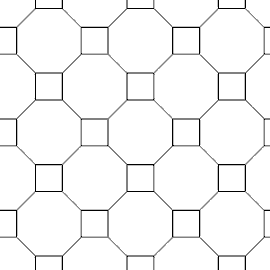
There are large grids of all of the above, plus more at my Tessellations website. You can also Colour in regular tessellations online.
Tessellations are strictly speaking geometric shapes. However, you can fit together irregular shapes. The master of this was M C Escher. He not only fitted repeated patterns together, he flipped them and rotated them. In Mathematics, these combinations of patterns are called wallpaper groups. There are 17 of them. There is a story that a mathematician was enormously impressed that Escher's patterns used all but one of the wallpaper groups. Escher promptly asked which one he'd left out, and constructed a new pattern using it!
Translate
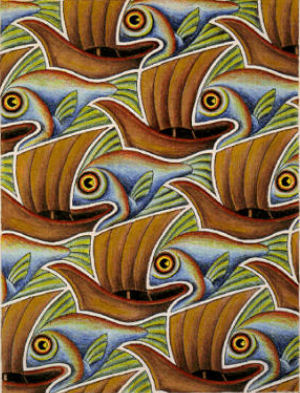
Yellow reflects black
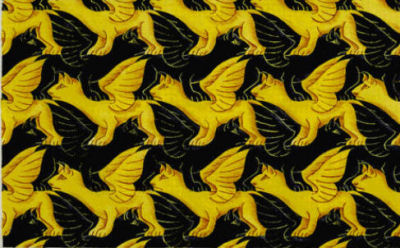
3 way rotation (look where the heads meet)
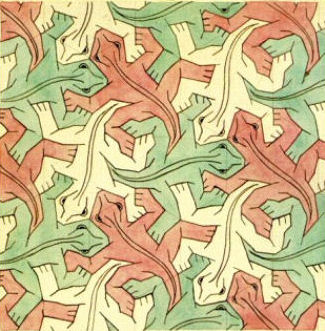
Glide reflection

You can try Draw irregular tessellations online, seeing what the different wallpaper groups do!
Islamic decoration made from geometric tiles set into plaster is called zellige.
Alhambra, ~1350 AD - M C Escher was greatly inspired by the art here.

Mosque, Samarkand ~ 1400 AD
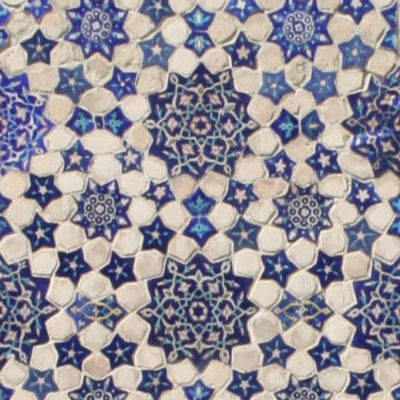
Shrine, Iran ~1430 AD

Tiles, Marrakech

Normally tessellations repeat a pattern. However, Roger Penrose has figured out tiles which are very simple, and yet never repeat! If you look at the pattern below, there are two types of tile, a fat diamond and a thin diamond. They fit together without gaps, and one part of the pattern is similar to another, but not exactly. Mathematicians like this kind of thing!

© Jo Edkins 2025 - Return to Patterns index