
History |
I do get a little irritated by accounts of Scottish history. They get fixated by the Declaration of Arbroath, William Wallace and Robert the Bruce, Mary Queen of Scots, and Bonnie Prince Charlie. All right - these are important, but they deal with the relationship of Scotland to England (as in - hostile...). But where is an account of how the country of Scotland, or the city of Edinburgh was formed and developed? (By the way, I have done a separate website on Kings of Scotland.
Edinburgh does give some more if you keep your eyes open. There is Hutton Memorial Garden, celebrating James Hutton, the "father of modern geology". The mortsafe in Greyfriars Kirkyard is interesting, both in a macabre way, but also showing that Edinburgh was at the forefront of medical research. The Witches Memorial is apologetic about the number of witches killed by the Scots.
Grassmarket has the Coventers Memorial. There seems to be an ambivalence about the Coventers, whether they were heroic defenders of their faith, or bigots about anyone else's faith. Possibly both! There must have been a tension between the Coventers (serious Protestants) and the Jacobites (serious Catholics). I suspect that Walter Scott wrote his Waverley novels to try and reconcile the memories of the two sides. He was a Tory (so naturally anti-Coventer), but also pro-Union (so anti-Jacobite), yet he wanted to give Scotland a history to be proud of. The English say cheerfully "The Cavaliers were Rong but Romantic, the Puritans were Right but Repulsive" (1066 and All That), but the Scots seem less likely to express such frivolous concepts.
Edinburgh, the royal burgh was founded by King David I in the early 12th century on land belonging to the Crown, though the date of its charter is unknown. Despite this, Edinburgh doesn't seem very interested in David. There is a mural in the National Portrait Gallery, but only describing his "good works". There were other murals, including a reference to James III. I wonder how many Scots could disentangle all those Jameses!
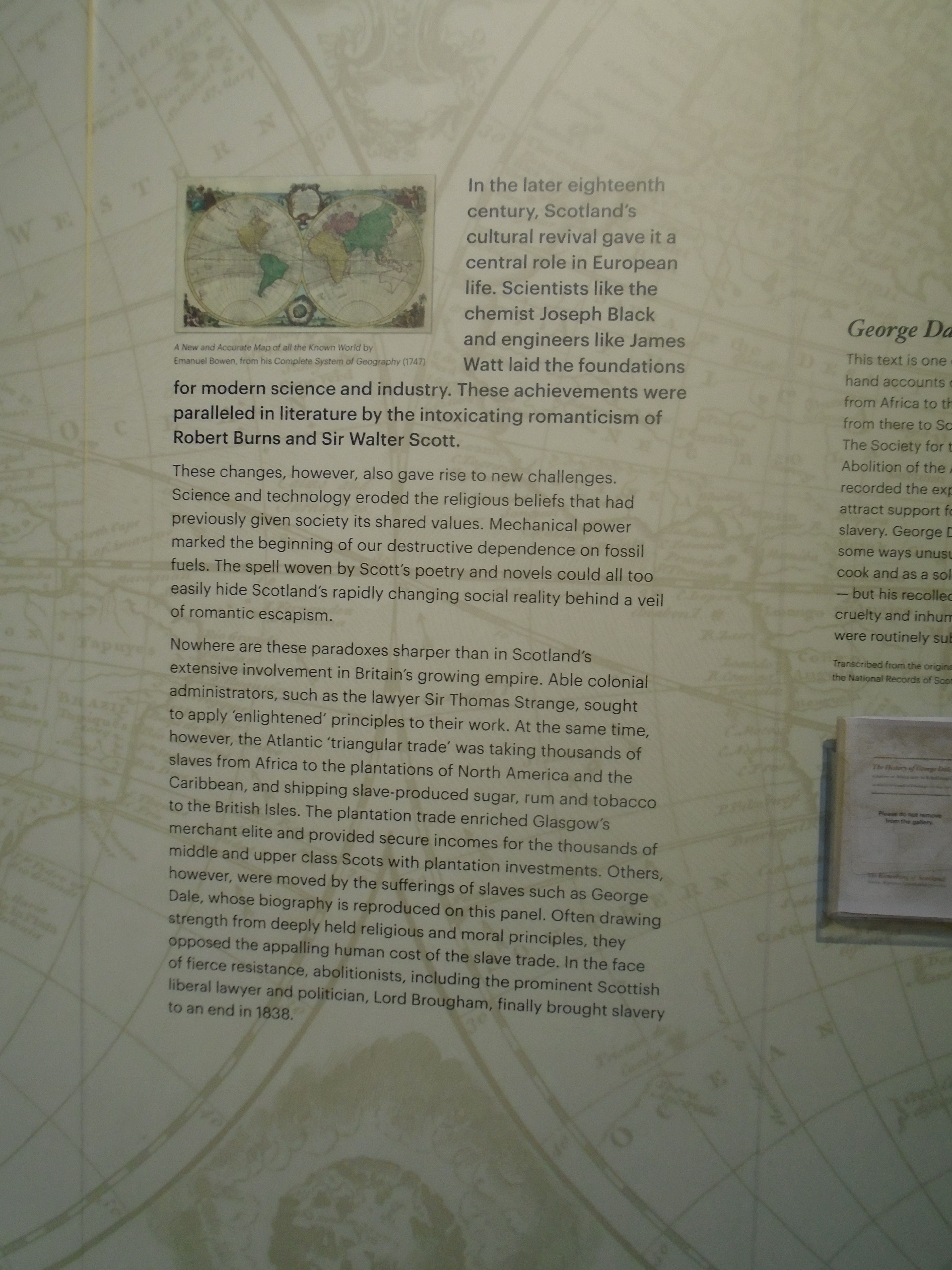
The National Portrait Gallery also had this history of Scotland, accompanying one of the displays.


I found this account of Jenny Geddes in one of the Edinburgh alleyways. You could claim it as an anti-English story, since Charles was king of England. But he was king of Scotland as well. The Scots were against him at this point, for being too Catholic, but later decided they liked Oliver Cromwell even less (as being the wrong type of Protestant) and ended up supporting Charles II against Cromwell. And lost....

In Lady Stairs Close, there are slabs filled with quotes from Scottish writers, but I couldn't find any by Walter Scott or Robert Burns, despite them being featured in the Writers Museum in the close. There was one by Robert Louis Stevenson: "there are no stars so lovely as Edinburgh street-lamps". This was so intriguing that we tracked it to its source, and found this splendid piece, which I think describes some of the contradictions of the Scots. The Scots are, indeed, a kindly people.
----------------------------
CHAPTER IV - THE SCOT ABROAD
A few pages back, I wrote that a man belonged, in these days, to a variety of countries; but the old land is still the true love, the others are but pleasant infidelities. Scotland is indefinable; it has no unity except upon the map. Two languages, many dialects, innumerable forms of piety, and countless local patriotisms and prejudices, part us among ourselves more widely than the extreme east and west of that great continent of America. When I am at home, I feel a man from Glasgow to be something like a rival, a man from Barra to be more than half a foreigner. Yet let us meet in some far country, and, whether we hail from the braes of Manor or the braes of Mar, some ready-made affection joins us on the instant. It is not race. Look at us. One is Norse, one Celtic, and another Saxon. It is not community of tongue. We have it not among ourselves; and we have it almost to perfection, with English, or Irish, or American. It is no tie of faith, for we detest each other's errors. And yet somewhere, deep down in the heart of each one of us, something yearns for the old land, and the old kindly people.
Of all mysteries of the human heart, this is perhaps the most inscrutable. There is no special loveliness in that gray country, with its rainy, sea-beat archipelago; its fields of dark mountains; its unsightly places, black with coal; its treeless, sour, unfriendly looking corn-lands; its quaint, gray, castled city, where the bells clash of a Sunday, and the wind squalls, and the salt showers fly and beat. I do not even know if I desire to live there; but let me hear, in some far land, a kindred voice sing out, "Oh, why left I my hame?" and it seems at once as if no beauty under the kind heavens, and no society of the wise and good, can repay me for my absence from my country. And though I think I would rather die elsewhere, yet in my heart of hearts I long to be buried among good Scots clods. I will say it fairly, it grows on me with every year: there are no stars so lovely as Edinburgh street-lamps. When I forget thee, auld Reekie, may my right hand forget its cunning!
The happiest lot on earth is to be born a Scotchman. You must pay for it in many ways, as for all other advantages on earth. You have to learn the paraphrases and the shorter catechism; you generally take to drink; your youth, as far as I can find out, is a time of louder war against society, of more outcry and tears and turmoil, than if you had been born, for instance, in England. But somehow life is warmer and closer; the hearth burns more redly; the lights of home shine softer on the rainy street; the very names, endeared in verse and music, cling nearer round our hearts. An Englishman may meet an Englishman to-morrow, upon Chimborazo, and neither of them care; but when the Scotch wine-grower told me of Mons Meg, it was like magic.
From the dim shieling on the misty island
Mountains divide us, and a world of seas;
Yet still our hearts are true, our hearts are Highland,
And we, in dreams, behold the Hebrides.
And, Highland and Lowland, all our hearts are Scotch.
There are many songs about Scottish history. Here are the ones I know about.
Penned by musician Roy Williamson, Flower Of Scotland is a relatively recent piece, and was only adopted by the national team in 1997, although by then it had already been in informal use since 1993. Fittingly in the context of Scottish football (or not, depending on your allegiance), the lyrics are a reference to the victory scored by Robert the Bruce over Edward II's English army at the Battle of Bannockburn in 1314.
O Flower of Scotland,From Wikipedai: "Scots Wha Hae" (English: Scots Who Have) is a patriotic song of Scotland written using both words of the Scots language and English, which served for centuries as an unofficial national anthem of the country, but has lately been largely supplanted by "Scotland the Brave" and "Flower of Scotland". The lyrics were written by Robert Burns in 1793, in the form of a speech given by Robert the Bruce before the Battle of Bannockburn in 1314 during the Scottish Wars of Independence.
Scots, wha hae wi Wallace bled,First published in 1633. In 1513, Flodden Field was fought during the War of the League of Cambrai between the Kingdom of England and the Kingdom of Scotland and resulted in an English victory. The battle was fought near Branxton, in the county of Northumberland, in northern England, between an invading Scots army under King James IV and an English army commanded by the Earl of Surrey. In terms of troop numbers, it was the largest battle ever fought between the two kingdoms. The English won, and this is (naturally) an English song.
King Jamie hath made a vow,
Keepe it well if he may
That he will be at lovely London
Upon Saint James, his day.
Upon Saint James his day at noone,
At faire London will I be,
And all the lords in merrie Scotland,
They shall dine there with me.
Then bespake good Queene Margaret,
The teares fell from her eye:
Leave off these warres, most noble king,
Keepe your fidelitie.
The water runnes swift and wondrous deepe,
From bottome unto the brimme;
My brother Henry hath men good enough;
England is hard to winne.
Away, quoth he, with this silly foole
In prison fast let her lie:
For she is come of the English bloud,
And for these words she shall dye.
With that bespake Lord Thomas Howard,
The queenes chamberlaine that day:
If that you put Queene Margaret to death,
Scotland shall rue it alway.
Then in a rage King Jamie did say,
Away with this foolish mome
He shall be hanged, and the other be burned,
So soone as I come home.
At Flodden Field the Scots came in,
Which made our English men faine;
At Bramstone Greene this battaile was seene,
There was King Jamie slaine.
Then presently the Scots did flie,
Their cannons they left behind;
Their ensignes gay were won all away,
Our souldiers did beate them blinde.
To tell you plaine, twelve thousand were slaine
That to the fight did stand,
And many prisoners tooke that day,
The best in all Scotland.
That day made many a fatherlesse child,
And many a widow poore,
And many a Scottish gay lady
Sate weeping in her bower.
Jack with a feather was lapt all in leather,
His boastings were all in vaine;
He had such a chance, with a new morrice-dance,
He never went home againe.
From Wikipedia: Bonnie Dundee is the title of a poem and a song written by Walter Scott in 1825 in honour of John Graham, 7th Laird of Claverhouse, who was created 1st Viscount Dundee in November 1688, then in 1689 led a Jacobite rising in which he died, becoming a Jacobite hero. The older tune Bonny Dundee adapted by Scott had already been used for several songs appearing under variations of that title and referring to the bonnie town of Dundee rather than to Claverhouse.
From 1668 John Graham, the laird of Claverhouse was at the forefront of Royalist repression of the Covenanters, for which he was called "Bluidy Clavers" (Bloody Claverhouse) by his covenanting opponents. In 1688 he was made 1st Viscount of Dundee by James VII of Scotland (James II of England). When William of Orange overturned James in 1688 in what was called the Glorious Revolution, Claverhouse was one of the few Scottish nobles who remained loyal to James. After trying to influence the Convention of Estates of Scotland on James's behalf, at some danger to himself, he led his cavalry out of Edinburgh to carry on the struggle in the field and was killed at the moment of victory in the battle of Killiecrankie (1689). His forces were subsequently defeated at the Battle of Dunkeld. Over a century later he was immortalised in a poem by Walter Scott which was later adapted into a song.
This song is interesting, as it hints at the conflict of Scots against Scots, rather than assuming it was always the fault of the English.
Tae the Lords o' convention 'twas Claverhouse spoke
E'er the King's Crown go down there are crowns to be broke
So each caviler who loves honor and me
Let him follow the bonnets o' Bonnie Dundee
Come fill up my cup, come fill up can
Come saddle my horses and call out my men
Unhook the West Port and let us gae free
For it's up with the bonnets o' Bonnie Dundee
Dundee he is mounted and rides up the street
The bells tae ring backwards, the drums tae are beat
But the provost douce man says, 'Just let it be.'
When the toon is well rid o' that devil Dundee
Come fill up my cup, come fill up can
Come saddle my horses and call out my men
Unhook the West Port and let us gae free
For it's up with the bonnets o' Bonnie Dundee
There are hills beyond Pentland and lands beyond Forth
Be there lords in the south, there are chiefs in the north
There are brave downie wassles three thousand times three
Cry hey for the bonnets o' Bonnie Dundee
Come fill up my cup, come fill up can
Come saddle my horses and call out my men
Unhook the West Port and let us gae free
For it's up with the bonnets o' Bonnie Dundee
Then awa tae the hill to the lee and the rocks
Ere I own a usurper I'll crouch with the fox
So tremble false wigs in the midst of yer glee
For you've no seen the last of my bonnets and me
Come fill up my cup, come fill up can
Come saddle my horses and call out my men
Unhook the West Port and let us gae free
For it's up with the bonnets o' Bonnie Dundee
From Wikipedia: The Massacre of Glencoe took place in Glen Coe in the Argyll region of the Scottish Highlands on 13 February 1692. An estimated 30 members and associates of Clan MacDonald of Glencoe were killed by Scottish government forces, allegedly for failing to pledge allegiance to the new monarchs, William II/III and his wife Mary II.
This song seems to be modern, by Jim Mclean, 1962. It seems reasonably accurate. The massacre was ordered by the Scottish government (which was separate at the time), but King William had, indeed, "signed".
Oh cruel is the snow that sweeps Glencoe
And covers the grave o' Donald
And cruel was the foe that raped Glencoe
And murdered the house o' MacDonald
They came through the blizzard, we offered them heat
A roof ower their heads, dry shoes for their feet
We wined them and dined them, they ate o' our meat
And slept in the house O' MacDonald
Oh cruel is the snow that sweeps Glencoe
And covers the grave o' Donald
And cruel was the foe that raped Glencoe
And murdered the house o' MacDonald
They came from Fort William with murder mind
The Campbell had orders, King William had signed
Pit all tae the sword, these words underlined
And leave none alive called MacDonald
Oh cruel is the snow that sweeps Glencoe
And covers the grave o' Donald
And cruel was the foe that raped Glencoe
And murdered the house o' MacDonald
They came in the night when the men were asleep
That band of Argyles, through snow soft and deep
Like murdering foxes, among helpless sheep
They slaughtered the house o' MacDonald
Oh cruel is the snow that sweeps Glencoe
And covers the grave o' Donald
And cruel was the foe that raped Glencoe
And murdered the house o' MacDonald
Some died in their beds at the hands of the foe
Some fled in the night, were lost in the snow
Some lived to accuse him, what struck the first blow
But gone was the house of MacDonald.
Prince Charles Edward Stewart, the young Chevalier or Young Pretender, raised his standard at Glenfinnan, at the start of the '45 Jacobite Uprising on August 19, 1745. The campaign lasted through the winter and although his army reached as far as Derby, by early in 1746 he was back in Scotland and was finally defeated at Culloden Moor on April 16, 1746.
This well-known song about those times attributed to both James Hogg, the Ettrick Shepherd, who lived from 1770 to 1835 and Carolina Oliphant (Lady Nairnie) who lived from 1766-1845. As both these writers took traditional works and improved them, it may that neither of them wrote the original. There is yet another version by Charles Gray (1782 - 1851).
Twas on a Monday morning,
Right early in the year,
When Charlie came to our town
The Young Chevalier.
Charlie is my darling, my darling, my darling.
Charlie is my darling, the young Chevalier.
As he cam' marchin' up the street,
The pipes played loud and clear.
And a' the folk cam' rinnin' out
To meet the Chevalier.
Charlie is my darling, my darling, my darling.
Charlie is my darling, the young Chevalier.
Wi' highland bonnets on their heads
And claymores bright and clear,
They cam' to fight for Scotland's right
And the young Chevalier.
Charlie is my darling, my darling, my darling.
Charlie is my darling, the young Chevalier.
They've left their bonnie highland hills,
Their wives and bairnies dear,
To draw the sword for Scotland's lord,
The young Chevalier.
Charlie is my darling, my darling, my darling.
Charlie is my darling, the young Chevalier.
Oh, there were many beating hearts,
And mony a hope and fear,
And mony were the pray'rs put up,
For the young Chevalier.
Charlie is my darling, my darling, my darling.
Charlie is my darling, the young Chevalier.
From Wikipedia: "The Skye Boat Song" (Roud 3772) is a late 19th-century Scottish song adaptation of a Gaelic song composed c.1782 by William Ross, entitled Cuachag nan Craobh ("Cuckoo of the Tree"). In the original song, the composer laments to a cuckoo that his unrequited love, Lady Marion Ross, is rejecting him. The 19th century English lyrics instead evoked the journey of Prince Charles Edward Stuart ("Bonnie Prince Charlie") from Benbecula to the Isle of Skye as he evaded capture by government soldiers after his defeat at the Battle of Culloden in 1746.
Original lyrics:
Dating from 1792, 'Ye Jacobites By Name', is possibly a revision for James Johnson's 'Scots Musical Museum', which is based on the English air, entitled Up, Black-nebs [revolutionaries] by Name. It is thought that the original was an anti-Jacobite tune before Burns reworked it, and it is the Burns version which has endured. With the defeat of the Jacobite army at Culloden in 1746, the direction of the union of England and Scotland was sealed, and this song is a call to the Jacobites, though it is not exactly in praise. 'Your fautes I will proclaim/Your doctrines I maun blame', possibly a criticism of the failure of the Jacobite Rising, led by Bonnie Prince Charlie.
Ye Jacobites by name, give an ear, give an ear,Written by Cliff Hanley in 1956 for Robert Wilson. The music is often played on bagpipes without words. Wikipedia thinks that this is one of the unofficial Scots anthems (the others being Scots Wha Hae and Flower of Scotland - see above).
This doesn't seem to refer to any history at all. However, it assumes that only Highland Scots are brave (which I'm sure that the rest of Scotland would dispute). There is also a reference to emigrant Scots, which could be a reference to the Highland clearances. There is also a reference to the kindness of the Scots, which I agree with!
Hark when the night is falling© Jo Edkins 2025