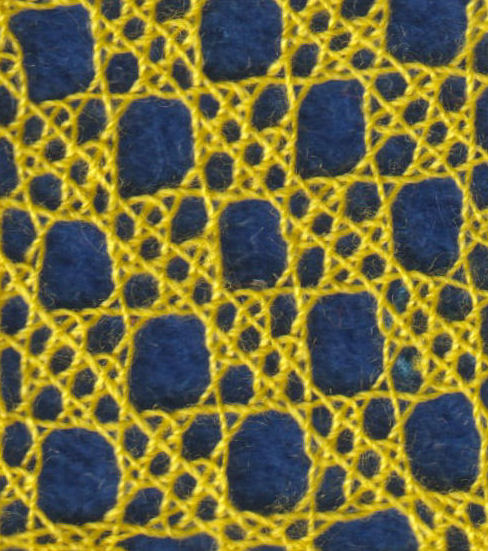
Filled rose ground is similar to rose ground but it has an extra stitch in the centre. It might be a good idea to learn rose ground first, to understand the basic principle. I am not sure where this ground is used. I found it in the book "Introduction to Bobbin Lace Stitches" by Bridget M. Cook and Geraldine Stott. See pattern 590.
The traditional representation of this ground in a pattern may not be shown at all. But if it is, it will be something like the one on the left. I prefer to mark where the threads go - right.

There are different versions of this, using different stitches, such as half stitch and cloth stitch. The stitches are worked in the same order, see below.
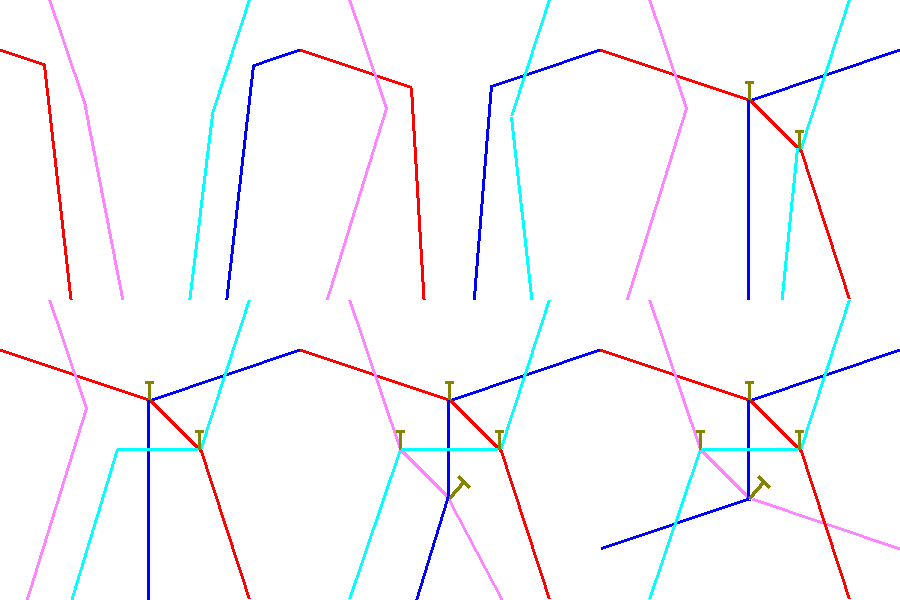
The diagram below shows one unit of Filled rose ground. It shows each pair of threads as a line. The description explains which stitch is used at each stage. The details of each stitch are not shown below - follow the links if you are not familiar with them.
|
|
Working:
Please note that as half stitch is used, the pairs of bobbins get split up. The colour of the pairs above shows their position within the four pairs. It does not refer to specific bobbins.
This shows the cross-overs both above and below the centre. Like rose ground, there are only one set of cross-overs between units. So if the cross-overs have already been done coming out of the previous unit, do not do them again!
Type 1 (described as rose ground B in "Introduction to Bobbin Lace Stitches")
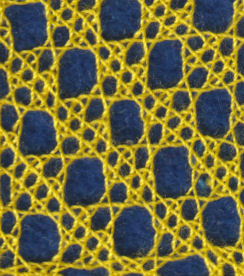 |
1. Work left two pairs in half stitch. |
Type 2 (described as rose ground D in "Introduction to Bobbin Lace Stitches")
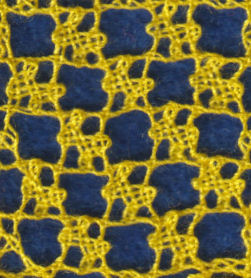 |
1. Twist both twice. Work left two pairs in cloth stitch, then twist both twice. |
© Jo Edkins 2026 - return to lace index