
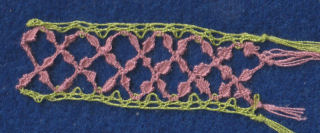
This continues a series of tallies patterns. This features the wide petal-shaped tallies you find in Maltese lace. This requires you to change the width of the tally as you work it. In this pattern they are combined to make flowers.
The complete series is pattern 577 - small square tallies, pattern 578 - small wide petal tallies by themselves, pattern 579 - joined small wide petal tallies, pattern 580 - multiple long thin tallies.
Pattern:

Bobbins: 12 pairs (6 green for footside, 6 pink for petals)
Style: Maltese
Size: 2.5 inches long
Stitches:
cloth stitch and twist
twist
tally (red)
lazy join or windmill
join 2 pair + 1 pair
Details:
twisted footside
Description:
Follow the links above for explanation of how to work the different parts of the lace. In some places in the footside, a pair leaves the footside, twisted a few times, round the pin, then returns to the footside.
This is deliberately a simple pattern, to practise tallies. Often tallies are part of a more complicated pattern, so I wanted something very simple, with lots of tallies but little else! These are quite simple tallies to start on, if you want to learn the technique, which, I admit, is tricky.
There are general comments which apply to all tallies. They are made with four bobbins (not pairs!) and these behave differently. There are the two outer bobbins, which guide the width of the tally. There is the worker bobbin, which makes the rows. And there is the other one, which doesn't do much! (But needs tightning.) I define a "row" as follows - take the worker bobbin to one of the outer bobbins, then across to the other, then back to its original position. Click here for a description of this - it is quite different to any other lace stitch. However, it isn't hard. That isn't the problem - tightening is the problem! If you over-tighten the worker bobbin, the whole tally is ruined. You can't do anything about it. You have to undo the whole thing and start again. If you don't tighten enough, the tally is out of shape and messy.
With these tallies, they start with a point, get fatter, then end up in a point again. I find it easier if I start a tally with a cloth stitch and twist, well tightened. Then make rows of the tally, getting wider and wider. For each row, use the outer bobbins to widen the row. Tighten the other (non-worker) bobbin. Tighten the worker bobbin enough (but not too much!) to remove any loops. Once to get past the centre of the tally, tighten the worker pair a little more (not too much!) to lessen the tally width. At the bottom, do a cloth stitch and twist. Put a pin between the two pairs, and pull each bobbin (carefully!) to tighten the tally and reveal its shape. This pin get be taken out later, but it helps to secure the tally until it gets worked into the rest of the lace.
This pattern is different to pattern 578 because the centre of the lace is nothing but tallies. In each part, there is one tally (or petal) which joins to the footside. That is easy enough. The other two tallies (petals) have to cross each other at the bottom with a lazy join. That requires you to do one tally, secure it at the bottom with a pin, then do the other tally (petal). When they've both been finsihed. do the first two steps of the lazy join, remove the pin securing the first tally, replace it as the pin in the middle of the lazy join, and complete the lazy join.
As you can see, my first few tallies were too narrow. I found that in order to make wide tallies, the worker bobbin must always be loose. Leaving it on the pillow means that the very slight drag downwards of the bobbin over-tightens the tally. So keep that bobbin in your hand while doing the row of the tally, and then put it on the pillow, tucked under the threads, at right angles to the other bobbins, so its thread is loose. Pull apart the outer two bobbins. Tighten the middle one which isn't the worker. Now, very carefully, pick up the worker bobbin and pull it to remove any looseness, but not too much! Allow enough to give the width of the tally. (Yes, sometimes I don't manage that! Practice, practice...) IF there is a problem, try pulling the outer two apart again. I also found that sometimes it helped to prod the tally with a pin, trying to get the rows even. Sometimes I had to undo the whole thing and start again.
Never get the bobbins muddled up! If you tug the worker pair as if it was one of the others, you have ruined the tally.
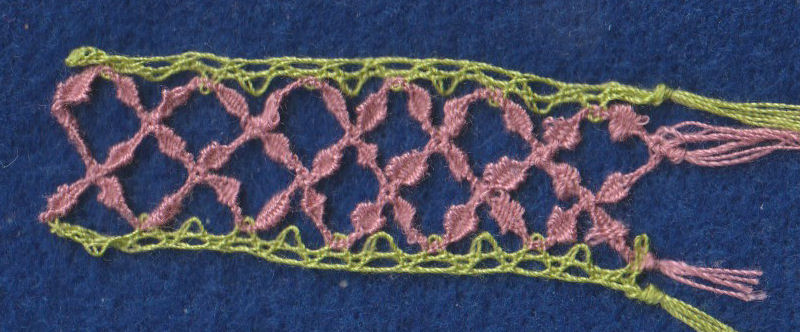
Close up of the lace, so you can see the working in more detail
© Jo Edkins 2026 - return to lace index