

Fans are a common Torchon headside, but this is an interesting variant. It makes an interesting piece of lace using a small number of bobbins. I have tried out a number of different ways of working cloth fans, but these are optional.
| Pattern: | 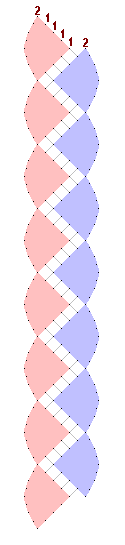 |
 |
Bobbins: 8 pairs
Style: Torchon
Stitches:
half stitch
cloth stitch
twist pair
Details:
cloth stitch fan (red)
half stitch fan (blue)
starting on a diagonal
Description:
If you have worked the fans headside pattern, then you know how to make fans. If not, click here for a description on how to do a fan, which includes an animation, that you can repeat, or step through. Rather than ground between the fans, this pattern has two headsides, and fits the fans together.
The pattern starts on a diagonal, so uses false starting pins. Click here if you have not met them before.
This pattern has the left fans as cloth stitch and the right fans as half stitch. You can also make them all cloth stitch, and perhaps make the worker pairs different colours. To do that, you hang 2 pairs of the first colour on the left, 2 pairs of the second colour on the right, and the rest as the background colour.
The photos show that while I have done cloth and half stitch fans, the cloth fans have variations. You can do these or not, as you wish, and you can combine them in different ways. But here is what I did:
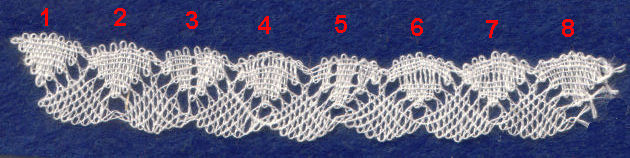
Half stitch fans: all the same
Worker pair twisted (or not) at the edge:
1: twisted once
2: twisted twice
8: not twisted at all at the edge
You can see that more twists introduces a bigger loop at the edge. Either you like this or you don't, so you can decide which to do.
The rest of the fans have used twists to produce patterns within the fan.
3: half the fan is worked, every passive pair is twisted, second half of the fan is worked. This leaves the impression of a line from point to edge, splitting the fan in two. You can twist the passives twice if you want a more emphatic line.4: worker pair is twisted just before the edge passive pair. In the next row, the pair is twisted just after the edge pair. This separates the edge passives from the rest of the fan. It tends to push the edge pair outwards, which helps the curve of the fan (which can flattern out, otherwise).
5: all passives twisted about a third through the fan, and two thirds through, to produce two blank areas. This is a similar idea to 3.
6: worker pair twisted two pairs from the edge (rather than just the edge pair like 4)
7: similar to 6, but only in the middle of the fan (rather than every row), to produce a hole in the middle rather than a blank line across the whole fan.
You can choose the type of fan that you like above, and use that throughout, or possibly two, and alternate them. Or you could do what I did, try out different styles, and use the piece as a type of sample, to learn more about fans. Perhaps you can even think of some other ways of choosing which pairs to twist.
You can also amuse yourself by finding how many mistakes I have made in working the half stitch fans! One of them isn't a mistake - the thread just ran thick for some reason.
© Jo Edkins 2019 - return to lace index