
A Torchon cloth stitch diamond usually has the same worker pair throughout. However, it is possible to have a diamond where there is no worker at all. Each pair on the left works through each pair on the right. See pattern 219.

Cloth stitch ground diamond on left and conventional diamond on right
As can be seen from the photos, the ground diamond is a lot less dense than the conventional diamond. I call it a 'ground' diamond, as essentially the pairs behave as they do in Torchon ground, but without the twists, or pins.

The pattern is like any other diamond.
The following diagram avoids the complexities of the individual stitches by showing each pair of threads as a single line. Inside the diamond, all stitches are cloth stitch, except at the pins, where it is half stitch, pin, cross (or cloth stitch with a pin in the middle).
|
|
Working: All rows of this type of diamond are worked diagonally rather than horizontally. So the first row runs along the entire edge of the diamond. You can choose either edge. The diagrams above take the first worker pair from the left, and works it in half stitch, pin, cross, across the four pairs from the right. That worker pair is then discarded, so there are now 4 pairs in the diamond. For all rows inside the diamond, the next pair from the left is taken as the worker pair, the first and last stitch is half stitch, pin, cross, and the rest are cloth stitch. The last row is similar to the top row, using the last pair on the left as workers.
It is also possible to do the same technique using half stitch.
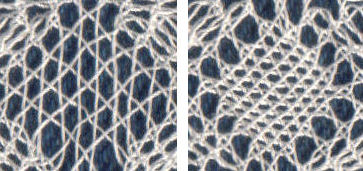
Half stitch ground diamond on left and conventional diamond on right
As said above, these ground diamonds are less dense than the traditional methods. This is because they have less stitches. A ground diamond with 4 pins each side has 16 stitches. A conventional diamond of the same size has 56 stitches. That is a big difference! You may find the resulting effect ugly, and wonder why anyone would bother. (Of course, you may feel that you'd like to have a diamond with less stitches!) You might want to produce a range of different diamonds, for their visual differences. You might also be interested in why conventional diamonds are worked the way they are!
I thought I had invented this technique. I was playing around seeing what effect different approaches to diamonds would have. However, I have since discovered it elsewhere. It is hard to come up with original ideas in lace!
© Jo Edkins 2016 - return to lace index


