
 Puzzle mazes
Mazes are divided into two groups, unicursal mazes (with one path) and puzzle mazes. This page is about puzzle mazes, where you can get lost! It is quite difficult to design an original, good unicursal maze. It is much easier to design a puzzle maze. Here is how to do it.
How to draw a branching maze
Solving a branching maze
Island mazes
Garden mazes
Stories about maze
Pliny
Pictures
Make a maze online
Mazes website
handout
There are two types of puzzle mazes - branching mazes and island mazes. We will discuss the difference later. This is how to draw a branching maze.
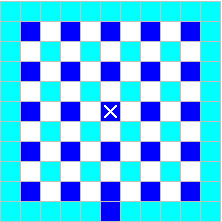
Using squared paper, draw out this pattern.

The pale blue will be the walls. The drak blue will be the pattern. The white might be either.
Fill in round the edge. The maze needs to be surrounded by walls! But leave a gap middle bottom for the entrance, and fill that in as a path (dark blue). Also mark the middle somehow to remind you that is the middle - your destination.
Draw a path (dark blue) from the start to the middle, by joing the dark blue squares. Don't go straight to the centre, but the path doesn't have to be too long. It's important that this is a single path, and doesn't loop itself.

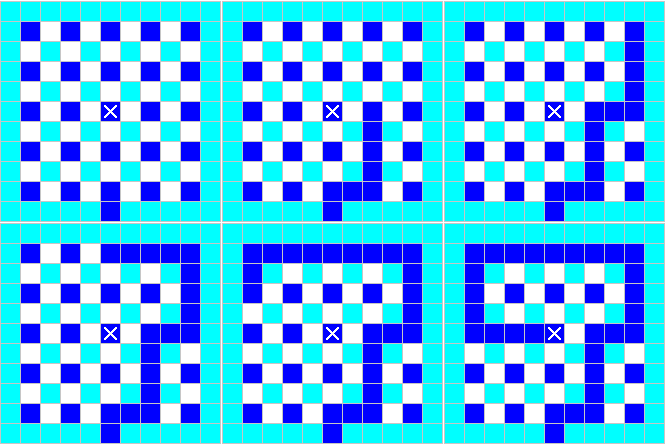
This will be your maze's "solution" - the quickest way to the centre.
Now to create a deadend. Choose a white square, and join it to your main path. Again, no loops.
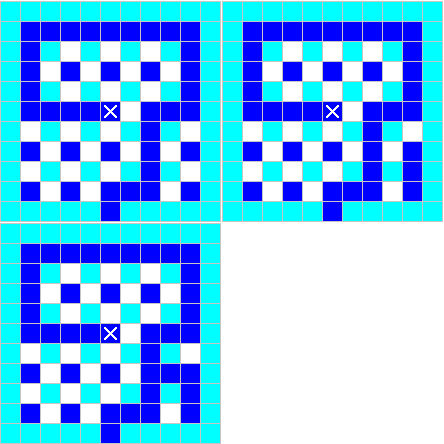
Create some more deadends. You can even have a deadend leading off a deadend. No loops! There will still be some white squares left.
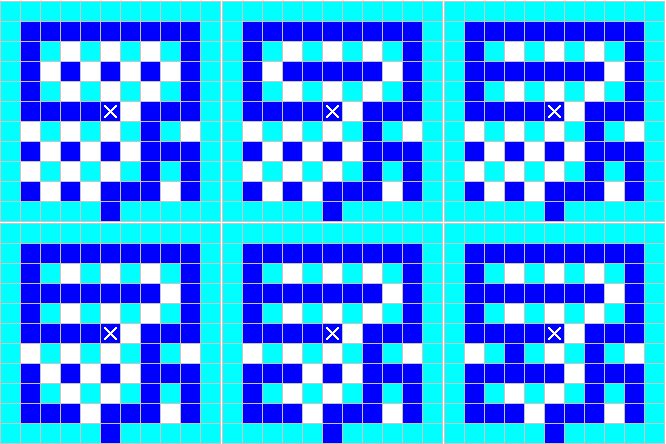
Colour all remaining squares in light blue, as they are walls.
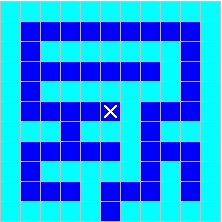
Try "walking" your maze with your finger. You can see the correct path, but imagine, at each branch, that you can't, and could go down either path.
A branching maze has all its paths connected, and no loops. That means that there is a technique for solving it which will always work.
When you walk the maze, always take the left path. You can imagine running your left hand along the wall (or hedge) and never taking your hand off. If you are in a deadend, then you run your hand along the back of the deadend, which will bring you out again. This techniqiue will guarantee to get you to the centre.
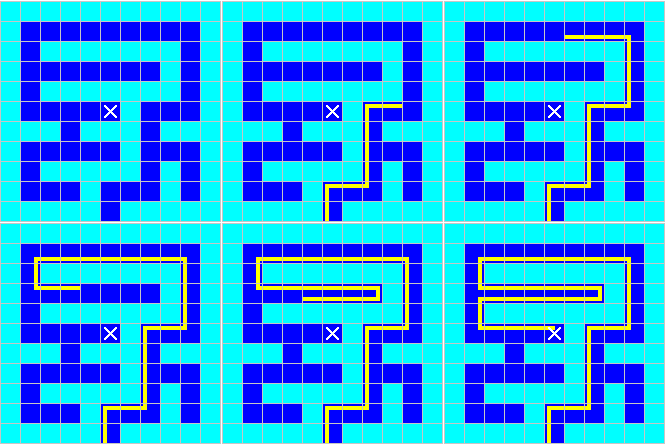
You can see from the example that you don't necessarily take the quickest route. In fact, at the centre, if you turn round and walk out, still taking the lefthand turn every time, you will walk down every path in the mazes, inclduing all deadends! But at least you will manage to get to the centre. There is nothing magic about it being a left turn, either. You could take every right turn instead, if you wish. (I haven't animated this!)
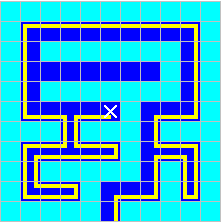
This technique of solving branching mazes became well known, so maze designers wanted to think up a maze which couldn't be solved that way. The answer is surprisingly easy. If you put loops in the design, then the walker who takes every left (or right) turn may trapped in a loop and just walk out again without ever having reached the centre. Here is a very simple island maze:

This is what happens if you take every left turn:

Why is it called an island maze? The walls are divided into separate areas, or islands. If you look back to the branching maze, you will see that the pale blue area is all connected. To create an island island, you divide up the walls into islands. In the example above, if you put your hand on the left hand wall, it will never leave the red area, and that never gets anywhere close to the centre.

So, if island mazes can't be solved by a single technqiue, then surely they are the best type of maze? Well, yes and no. The best mazes in the world today will be island mazes. However, all island mazes have more than one path to the centre, which can make them easier to solve. The simple island maze above certainly has some junctions where a wrong choice takes you out of the maze again. But for other junctions, it doesn't matter which path you choose. Proper maze designers, such as Adrian Fisher, know exactly how to complicate a maze enough to make it fun to walk, but this takes skill. A branching maze is still a true puzzle maze, and can be fun to walk. Not everyone knows the trick!
Designs of puzzle mazes are not as old as unicursal mazes. They seem to have arisen as a garden feature. Before mazes, there were decorative features in formal gardens called parterres or knot gardens. These were divided up into small areas edged with short hedges. The areas might contain flowers, or gravel. They looked good from above, from a window of the house perhaps. Some of them had paths, so you could take a long walk, looking at each part.
Parterre, Provand's Lordship, Glasgow

Gradually the paths became important, and the hedges higher, so you couldn't see where you were going. There was an aim, to get to the centre. There were branches, so you could take the wrong turning. Hampton Court maze is an early garden maze, made in 1690.
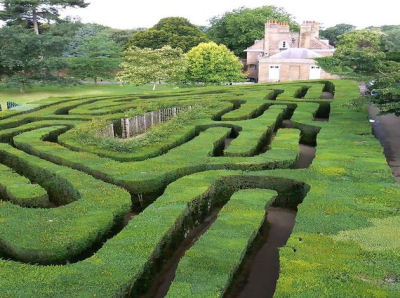

Hampton court maze also demonstrates a problem with hedge mazes. It is very hard to grow hedges that close together. Obviously you have to spend a lot of time keeping them trimmed. But a more serious problem arises if a plant dies off. Hampton Court shows a plan of the maze at the entrance. Unfortunately, it is wrong. A couple of shrubs have died, leaving extra gaps. This matters!

The most famous maze story is Thesues and the Minotaur.
The Minotaur was a monster, half man, half bull, who ate men. King Minos of Crete told Daedalus, the inventor, to build a house that was so complicated that the Minotaur would never escape from it, so Daedalus built the Labyrinth. King Minos had a vast empire, and as a tribute he demanded people sent to to feed to the Minotaur. They were driven into the Labyrinth, and wandered around, lost, until the Minotaur found them.
Part of King Minos' empire was Athens, in Greece. The son of the king of Athens was Theseus, a hero. He was so angry that Athenian people were being killed in this way that he volunteered to go. In Crete, Ariadne, the daughter of King Minos, fell in love with Theseus, and told him how to find his way through the Labyrinth. She gave him a thread, with one end tied to the door of the Labyrinth. Theseus could unwind the thread as he tried to find the Minotaur. When he wish to return, he could follow the thread back again, rewinding it as he went. Ariadne also gave Theseus a sword. He went in, found the Minortaur and killed him. Then he returned, and fled from Crete with Ariadne and the rest of the Athenians.This story has been connected with unicursal mazes. A Cretan coin has the Classical pattern on it, and Roamn mazes sometimes have the Minotaur in the centre. However the original Labyrinth, if it ever existed, was not a unicursal maze. Theseus needed a thread to help him retrieve his path after he had killed the Minotaur, so the Labyrinth must have been a branching maze. This myth was not only the original Labyrinth (the name of the Minotaur's prison), it also explains the derivation of the word clue. A clue helps you solve a mystery, and it is derived from the word for thread. Theseus needed the thread to solve the maze.
There is some historical foundation for this myth, surprisingly enough. There was a Cretan empire in the Mediterranean which included mainland Greece. It is called Minoan, after King Minos. There is a magnificent palace at Knossos. The archaeologists couldn't find a Minotaur, but they did find the palace itself very confusing, with many rooms, some at different levels, so it was easy to get lost. Perhaps ancient Greeks visiting Knossos told those at home about their experience, and this gradually changed into the story of the Labyrinth. And the Minotaur? Well, the Minoans loved bulls, and there is a fresco on the wall of the palace, showing an extraordinary display of acrobats jumping over a bull. This must have been incredibly dangerous, and no doubt people did get killed by the bull.

In 1350, Higden, monk of Chester wrote "Rosamund was the fayre daughter of Walter, Lord Clifford, concubine of Henry II, and poisoned by Queen Eleanor, AD 1177. Henry made for her a house of wonderful working, so that no man or woman might come to her. This house was named Labyrinthus, and was wrought like upon a knot in a garden called a maze. But the queen came to her by a clue of a thredde, and so dealt with her that she lived not long after." There is no reference to this particular maze earlier.
This account is a little garbled. "A knot in a garden called a maze" is unicursal, and wouldn't hide anyone. Also the "clue of a thread" doesn't help you find the centre, it helps you get out again.
There are other maze stories on my mazes website.
Pliny (died A.D. 79) mentions labyrinths in his Natural History. He describes the Cretan labyrinth: "containing passages that wind, advance and retreat in a bewilderingly intricate manner. It is not just a narrow strip of ground comprising many miles 'walks' or 'rides,' such as we see exemplified in our tessellated floors or in the ceremonial game played by our boys in the Campus Martius but doors are let into the walls at frequent intervals to suggest deceptively the way ahead and to force the visitor to go back upon the very same tracks that he has already followed in his wanderings." That is a very interesting distinction between unicursal mazes "in our tessellated floors" and branching mazes, which "force the visitor to go back upon the very same tracks that he has already followed in his wanderings."
Hampton Court maze was made in 1690, which is quite early. However, there is this painting of Lord Edward Russell in 1573. It has a branching maze in the background 9although not a very good one!

The following mazes are from 'Le Thresor des Parterres de l'universe', by Daniel Loris and published in MDCXXIX (1629), so earlier than Hampton Court.
I'm not sure how you get to the centre of this one!
This shows a possible problem with puzzle mazes. There are too many paths to the centre.

This has the opposite problem. Choose the right entrance and turn right for a very short path to the centre. Nothing else works.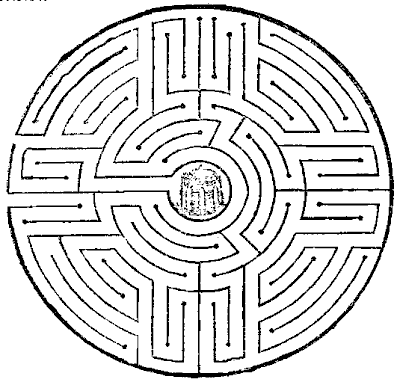
Saffron Walden is very proud of its turf maze! But it also has a branching maze - Bridge End maze (1828)

And finally, the modern maze at Longleat:

Start at the bottom, in the middle. Click on the white squares to make them blue. Click on white squares to draw a dark blue path to the centre (as above), and then draw the branches off the main path. If you make a mistake, clicking on the blue square will turn it white again. When you have finished, the "Fill maze" button with complete the maze.
If you want, you can make an island maze (as opposed to a branching maze).
I'm afraid that you can't save or print the maze. The only way to preserve the maze is a screen capture.
© Jo Edkins 2025 - Return to Patterns index