
 Unicursal mazes
What is a maze?
Classical mazes
Roman mazes
Chartres mazes
Mazes website
handout
The first question (since this is part of the Patterns course) is "Are mazes patterns?" I claim they are. They have designs, which can be traced out in lines or blocks. They follow rules.
Mazes are definitely magic!
But what is a maze? Most people think about getting lost, with high hedges blocking your view, and possibly a monster chasing you! However, there are two distinct groups of mazes - unicursal and puzzle. You get lost in puzzle mazes, and that group is the next session.
Unicursal mazes have no choices. They have a single path from start to centre (hence the name). There are no dead-ends. Everyone travels the same path, without choices. And there is absolutely no chance of getting lost. Because of this, unicursal mazes tend to be flat. They are on a vase, or a coin. They are flat on the ground, as a mosaic, or cut into the soil, or laid out with stones. No hedges!
So the next question is why? We can understand the fun of getting lost in a puzzle maze, the challenge of solving it. But why bother walking along a path which takes quite some time, and you know you're going to get to the centre, easily?
The first answer is, actually it is fun. You walk, twisting and turning, being able to see all around you, but the view constantly changing, nearly getting to the centre but then turning away again, and finally, arriving at the centre. Children often run a maze (and interestingly enough, they don't cheat). Some people use the exercise as a meditation, or in some spiritual way. I met an idea that you take a problem or trouble into a maze, symbolised by a stone that you carry. Then when you reach the centre, you leave the stone and the problem there, and return without it. Some feel that it reflects the nature of life - that we can't really see our path ahead, that we are constantly changing our direction, but we all know that the end is there - death! (Charming.) Others, like me, just walk a maze for fun. Sometimes the design is just used as a pattern, to decorate something. I enjoy this difference of attitudes among maze enthusiasts.
The second answer is even more interesting. We have various old and even ancient designs for mazes, and they are all unicursal mazes. There are old stories about getting lost in mazes but the designs themselves are single path. Here is an ancient maze design: scratched on a clay tablet, Pylos, Greece, 12C BC. It is a particular design which we will draw ourselves in a bit. The path is between the lines, and there are no choices.

Before tackling this design, I want to make one point. There is another word for maze - labyrinth. Some people call unicursal mazes labyrinths, and puzzle mazes as just mazes. I prefer not to. Both are old words (Shakespeare uses both), but this division of meaning is a modern one. If you have to make this division, I think they got it the wrong way round! The original labyrinth held the Minotaur, and people got lost in it, so it must have been a puzzle maze. And the turf mazes of England (see below) have always been called that, and they are unicursal mazes. So I prefer to use maze to mean both types, and unicursal or puzzle to distinguish between them. And I use labyrinth as little as possible, because it's tricky to spell!
The oldest maze design is the Classical maze. It can be in a square form (as above) or, more usually, in a round form as here:
Etruscan vase, Tragliatella, Italy, 6C BC
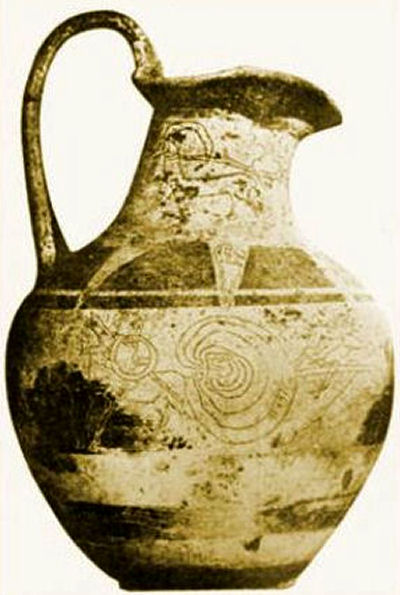
Those are difficult to make out, so here is a clearer version, on a Cretan coin 80 BC (Fitzwilliam museum)
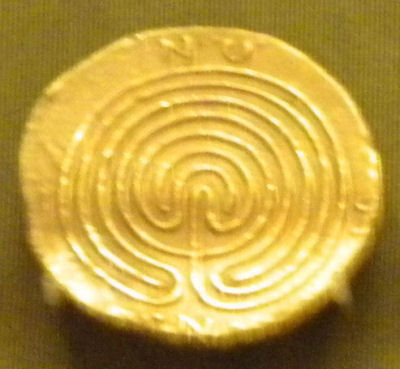
You enter at the bottom, and move between the lines, until you reach the centre.
Now to draw it! We draw the walls, not the path.
1. Draw a cross and four dots round it, making a square. Leave plenty of room round the outside, and don't make the cross too small.


2. Start at the top of the cross. Draw a small half loop (this will end up as the centre of the maze.) Draw inside the right top dot, then round it, and round the top (leaving plenty of room), to finish at the left hand top dot.

3. Start at the right arm of the cross. Draw up right round the previous line. Then draw round the left hand top dot. Then draw inside the previous line, to finish at the right hand top dot. I hope you had left enough room!

4. Start at the left arm of the cross. Draw up right round the previous line, all the way down to inside the bottom right hand dot, and round it. Then draw outside the previous line (leaving room), to finish at the left hand bottom dot.

5. Start at the bottom of the cross. Draw to the right, right round the previous line. Then draw round the left hand bottom dot. Then draw inside the previous line, in the gap you should have left, to finish at the right hand bottom dot.
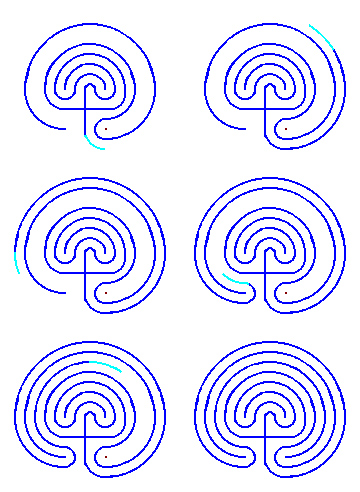
As I mentioned, these are the walls of the maze. Here is actually how you walk it (in red):

This shows one problem with mazes. If you show the walls and the path, it gets too complicated to understand. But if you just show one, then you must be sure whether the design is showing the walls or the path. Here is the path by itself.
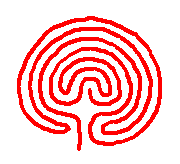
The square form of the maze is similar - you just draw squares rather than circles!
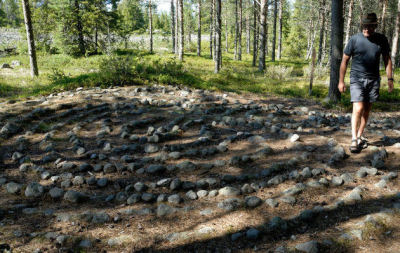
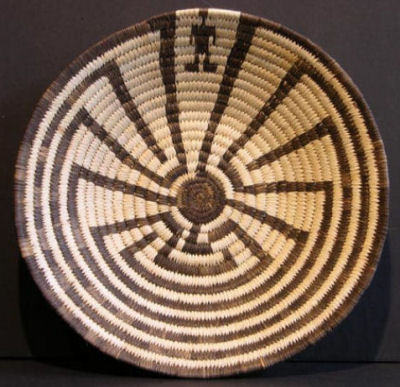
This pattern is wide-spread. The examples above are all Mediterranean. Here is a pebble maze from Sweden, and a basket from Arizona!
Labyrinth, Renskar, Sweden 14C AD
Basket from Arizona, modern
There seems to be different reasons for these mazes.
This design is known as the House of I'itoi or Siuku Ki, used in the baskets of the Tohono O'otam and Pima tribes of Southern Arizona. I'itoi brought people to this earth from the underworld. He lives in the maze so people can't find him.
The Scanavian pebble mazes were made by fishermen, who believed that by walking through them before setting out to sea they left their bad luck behind.
So, was there an original maze which other people copied, or did various groups figure it out for themselves? I feel that there could be different origins. The technique for drawing it (above) is quite simple. Imagine doing a doodle - draw the cross and four dots, and then try to join the cross to the dots without crossing any lines. The oldest dated maze (12C BC) is on the back of an accounting clay tablet, which seems suspiciously like a doodle! But once people drew the pattern, they could then come up with different meanings for themselves.
One last point - the previous pattern was Greek keys. It might seem that there is no connection between Greek keys and unicursal mazes, but there is a Greek key embedded in a Classical maze deisgn. Try unrolling it!

There is more about Classical mazes on Mazes website.
The next group of mazes are found in Roman mosaics.They seem to be purely decorative - a pattern on the floor. On problem with the Classical mazes is that the top half of it is just curving lines. The Romans wanted a maze design which would look more sttractive. So they divided the maze into (usually) four, and did a design in each quarter. One quarter led onto the next.
The most obvious quarter pattern was a line which wiggles from side to side filling the space. This is a serpentine pattern. It is easy to see for a circular maze:
Mosaic in Cyprus - serpentine
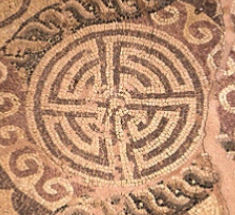
If you do this, then if you start at an edge, you end up in the middle. The next quarter will be the same, so you need a line from the centre to the edge so the quarters join up.
Unfortunately, most mosaics are square rather than circular! This is a little trickier. It is best to start in the centre. Colour in to make a square. Leave the centre of each side blank (to make the four quarters). But make the bottom gap three squares wide, not one. By the way, I'm colouring in the squares in red, to remind you that this time, we're drawing the path of the maze, not the walls.
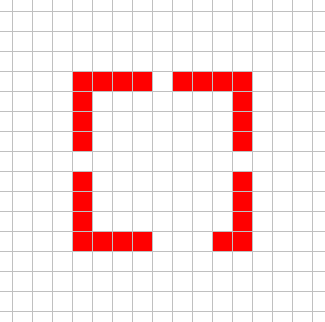
Now draw in lines leading outwards. These are the lines taking you from the edge to the centre, for the next quarter. There is one per quarter. They will end up longer than this, and you can extend them as you're drawing the mazes, but they are necessary to show the limits of each quarter.
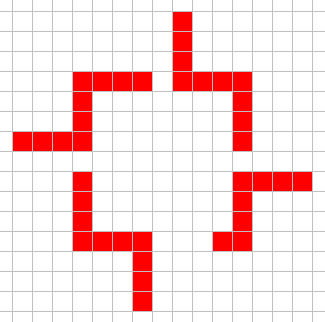
You also need to draw the final line of the path, leading from edge to centre, and not attached to anything (yet). This was why you need a bigger gap on one side. The four quarters are not identical. You start at an edge. If the quarters were identical, then you'd end at an edge. We want to end at the centre, so you need this extra line.

Starting at one of the gaps (blue square) make a zizag between the two lines, not touching the lines, and not touching the previous zigzag. It's rather angular, but you can see how it winds back and forth. Extend the edge lines as necessary. Make the quarter as big as you want!

Join the path to the next line heading for the centre (blue square). Carry on drawing the next centre's path in the same way. You will find that it's twisted round a quarter.

Do the same for the remaining two quarters, starting from the blue square. The last quarter is shorter than the others, as it has to stop before the last line.
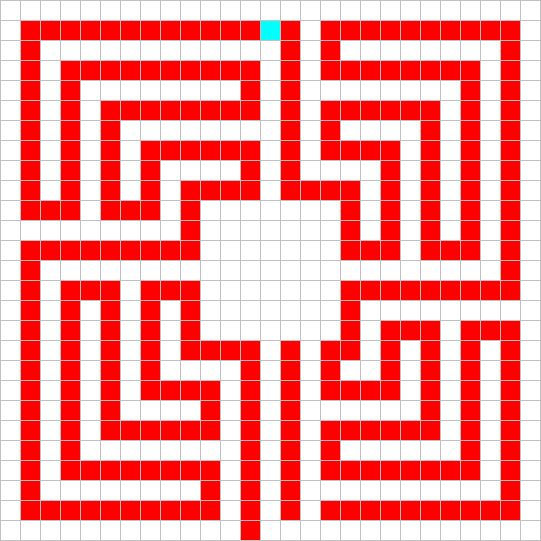
Join up the path so far to the line into the centre by filling in the last square.

We have been drawing the path - where you would walk (if the maze was big enough!) To get the pattern of the walls, you fill in the rest, and get rid of the path.

That is a "simple" serpentine pattern! There are more complicated patterns. You can have a spiral in each quarter:

This has to be a double spiral, of course. The path winds its way to the centre of the quarter (not the maze), then has to wind its way out again. It looks strange because it's been bent into a square shape.
The next pattern is called a meander. If you look carefully, there are two parts, with each part being a double spiral. Remember that "meander" was another name for a Greek key, and Greek keys are repeated patterns. Also note that this is just one quarter - this gets repeated four times to make the complete, bewildering, maze! You can even make the two spirals with more turns, creating a complex meander.

Mosaic in Switzerland - serpentine - with Theseus and the Minotaur in the centre
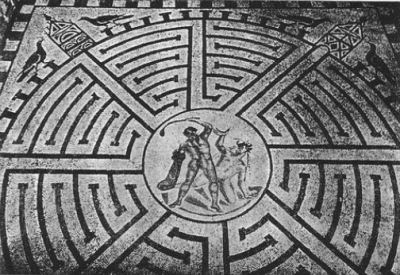
Mosaic in Portugal - meander
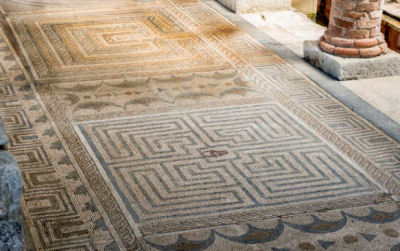
Mosaic in Spain - meander
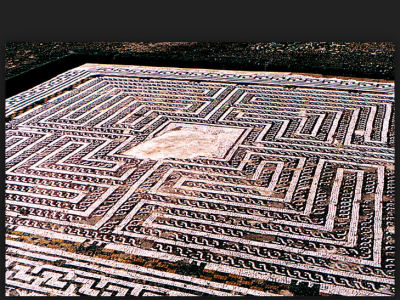
Mosaic in Austria - complex - there are three units in each part, not just two. And I think that the path is drawn in red, and the walls in black, with the white surrounding everything. Theseus and the Minotaur are here, as well.

There is more about Roman mazes on Mazes website.
The Roman mazes can be pleasant to look at, but rather boring to walk. You do one quarter (which may be interesting), but then you move onto the next quarter, and do that, then the next... This probably didn't matter as a mosaic pattern, as no-one was expected to actually walk it.
However, in the Middle Ages, for some reason churches got interested in mazes, and they did want to walk them. There are suggestions that walking a maze was considered to be a mini pilgrimage, or a penance. Even today, people often regard walking a maze as a spiritual event.
But if you want to walk a maze, you might as well make it interesting to walk! Another factor was the associations. The Classical maze had pagan associations, with the Greek myth of Theseus, and perhaps other ideas that we no longer know. The Roman mazes were used in domestic settings rather than religious ones. Perhaps the churches wanted a truly Christian maze pattern!
One feels that they liked the basic cross pattern of the Roman maze, with quarters. (There's a cross in the middle of the Clasical maze, but it's not important.) But the Clasical maze also had a feel of moving from one part of the maze then back again, rather than the "one quarter of a time" of the Roman maze. There were various patterns in different places, but Chartres cathedral (built in 1235) had a pavment maze of such a good pattern that today the unicursal mazes are the Classical maze and the Chartres maze. The Roman mazes seem to have been forgotten!
Chartres cathedral, 1235 AD
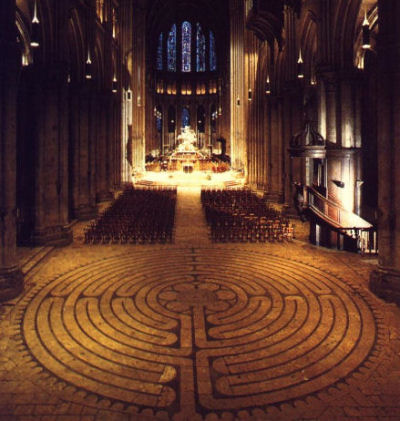
The Chartres maze tends to be circular. The blue below are the walls, and the red the path.
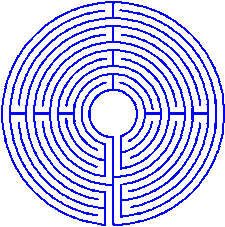
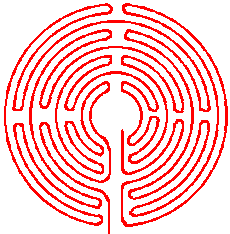
This look very complicated to reproduce! But it's not as hard as it looks. First, work out whether you are drawing the walls or the path.
All the curves are on concentric circles (circles with a common centre). So draw the right number of circles with a soft pencil using compasses, putting the point in the same place. (I do it on a computer, and there are tools for drawing circles.)
The side and top "arms" look very similar (but not identical!) For the paths, the line either carries straight through, or doubles back on both sides. The walls join circles (with a bit rubbed out either side) or not. Copy this carefully for each arm. The bottom arm is more complicated (the entrance to a unicursal maze usually is!) For the paths, rub out an area from edge to centre. For the walls, draw a line. Then, again, copy each bit carefully.
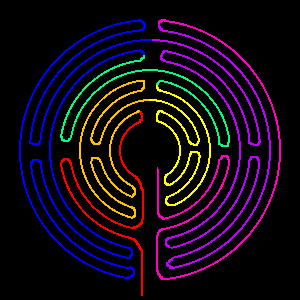
So why is this pattern so good? The diagram below attempts to show why.The path is a single line, starting with red, then orange, then yellow, and so on, through the colours of the rainbow. You can see how the path starts by nearly getting to the centre straight away, but then travels through a couple of quarters, then a different couple of quarters, ending up near the outside, then moving triumphantly to the centre. I can assure you that walking the maze is confusing, travelling from one part to another and not knowing which bit comes next.
Walking the Chartres maze
See more about church mazes on my Mazes website.
The standard Chartres maze is a double one. You can have a triple version, or even a single version. One triple version is the Saffron Walden turf maze. This is known to date back to 1699 AD, and may be older. It is on Saffrom Walden Common.
Saffron Walden turf maze, 1699 AD
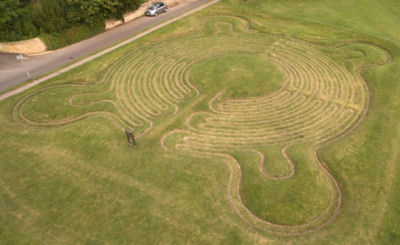
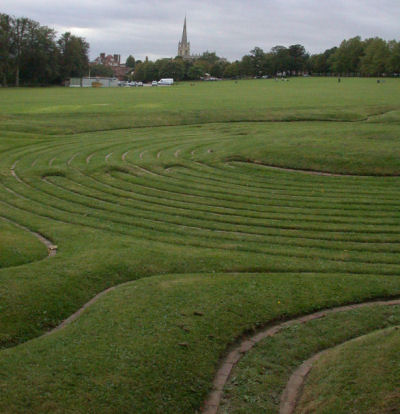
English turf mazes are fascinating. There are about eight traditional ones, and some are documented that have disappeared. They may have been constructed by cutting through the turf to the chalk underneath, but now they are maintained by laying a more permanent path. Shakespeare knew about them. In Midsummer Night Dream, Titania says "The quaint mazes in the wanton green, for lack of tread, are undistinguishable" and the Tempest describes a confused walk as "Here's a maze trod indeed, through forth-rights and meanders!" Both firmly say that you tread (or walk) the maze. Titania points out, if you don't, they disappear. The Tempest talks about "forth-rights" (right angles) and "meanders" (doubling back, or Greek keys!) which make up a maze. This seems to be a part of history going back centuries, and still surviving today.
See more about turf mazes on my Mazes website.
© Jo Edkins 2025 - Return to Patterns index