
| U3AC walks | U3AC walk - Public Art round Railway Station |
Route: Railway Station, Great Northern Road, Tennison Road, Station Road, bus stops, Brookgate, Hills Road
Length: 1.2 miles Start: Railway Station
Introduction: A walk based on the public art around Cambridge Railway station

Click on photos for a larger version.
The railway first came to Cambridge quite late, in 1845. This building dates from then, with the shields of the colleges, plus some local dignatories. It is listed grade II. If you want to know more about the shields click here and scroll to the bottom of the page.
This whole area has been redeveloped, and is called CB1. The art closest to the railway station is described here. It was funded by the development.


Ariadne Wrapped was installed in 2022. Artist Gavin Turk explains: "She is this classical figure who gives Theseus the golden thread so he can kill the Minotaur; a surrealist mental image. Here she is reclining like in a classical painting, and wrapped; a blurred vision of an archetypal sculpture." It has been used as a picket line during the rail strikes!

Continental Drift: This is inside a building, round the back of the station cycle park, but inside a back entrance which I suspect most people don't know about. Start at the station, walk towards the carpark, and find a staircase straight ahead. It is marked as an entrance to the cycle park. The plaque nearby says "Continental Drift, Troika 2016, Aluminium, steel, LEDs and motor, Commissioned by Brookgate, CB1 estate". It is a two-dimensional world map projected onto the ceiling by a faceted globe. The original description said that the globe was rotating, but but that doesn't seem to be working
.
Bike park: Cambridge takes bikes seriously! The bike park at Cambridge Railway Station was opened in 2016. It is a multi-story park (the bikes have to be wheeled up ramps). The outside is decorated with what seems like circles, but look carefully, and you will see that two of the circles are bike wheels.


Ridgeons Centenary Park: with bench, commemorates Ridgeons' centenary in 2011 is close to the site of the company's original office. It is on the corner of Tenison Road and Great Eastern Road. The artworks include a sculptural oak seat and a carved roundel featuring a quotation by the founder Cyril Ridgeon. It is by Jim Partridge and Liz Walmsley, with letter carving by Tom Perkins. It was comminsioned by Ridgeons, a well-known Cambridge firm. The central roundel says "Ridgeons timber and builders merchants began business 50 feet from this site close to the railway sidings. A family business since 1911."
Turn left up Station Road.


Reflective Editor: This is on the corner of Tenison Road and Station Road. It is dated 2011, and is described in the webpage about CB1 art here, where it says "This sculpture is one of a series of geometrical works entitled Reflective Editor by Doug Allsop. It forms a gateway to Station Square with a highly polished surface that reflects the architecture and movement surrounding it." The middle photo shows it mostly reflecting the local punt touts (people selling trips on a punt) who seem to be using it as an office.
There is a companion piece on the other side of the road (photo on right). That photo shows the original piece as well, other side of road, although a little hard to see. I don't know when this second piece arrived.

Tree of Life: This is on Station Road, beyond the junction with Tenison Road, closer to the station. It seems to have several names: the Tree of Knowledge, or the Tree of Life. It is by Jyll Bradley, 2017, who calls it Span.
The website of Jyll Bradley is here
At the station, turn right towards the bus stops.


Bee memorial: This is outside the station, towards the bus stops. The plaque says that it is in memory of Amanda Battini, who died in 2021. It is connected to the Bee Friendly Trust, which create habitats for bees and all pollinators to thrive.
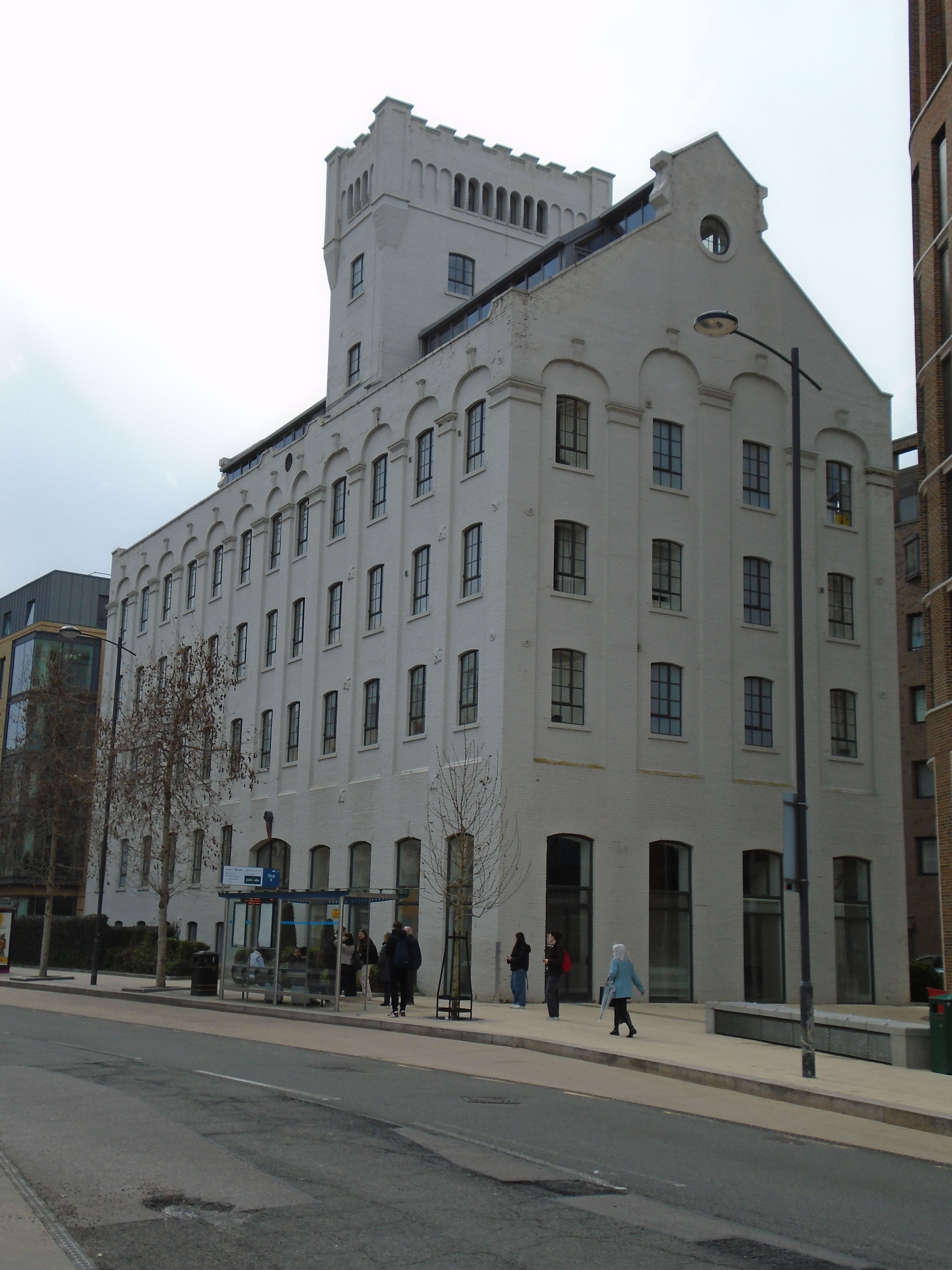
Spiller's Mill (also known as Foster's Mill) was built in 1898. The Foster family owned three mills in the city but the University of Cambridge prevented them from constructing railway lines to them, so they built this mill immediately next to the railway station. On 27 March 2010, during extensive demolition work on the mill, a major fire "accidentally" broke out which damaged the mill buildings causing their partial collapse. (The quote marks come directly from a Wikipedia article!)


Wander is by Dryden Goodwin, 2014. It is a series of 100 etched portraits of people the artist encountered as he travelled around Cambridge. They are both sides of the line of bus stops south of the railway station.
Walk to the end of the bus stops, cross the road (carefully!) and return.


Translucent Drawing: The second photo shows a close-up. It is by Antoni Malinowski, dated 2012, and a plaque nearby says "Traqnsluscent Drawing comprises 2,500 glass elements embedded into the facade of the building which respond to changing light conditions creating a dialogue between architecture and the envioronment." OK - if you say so!

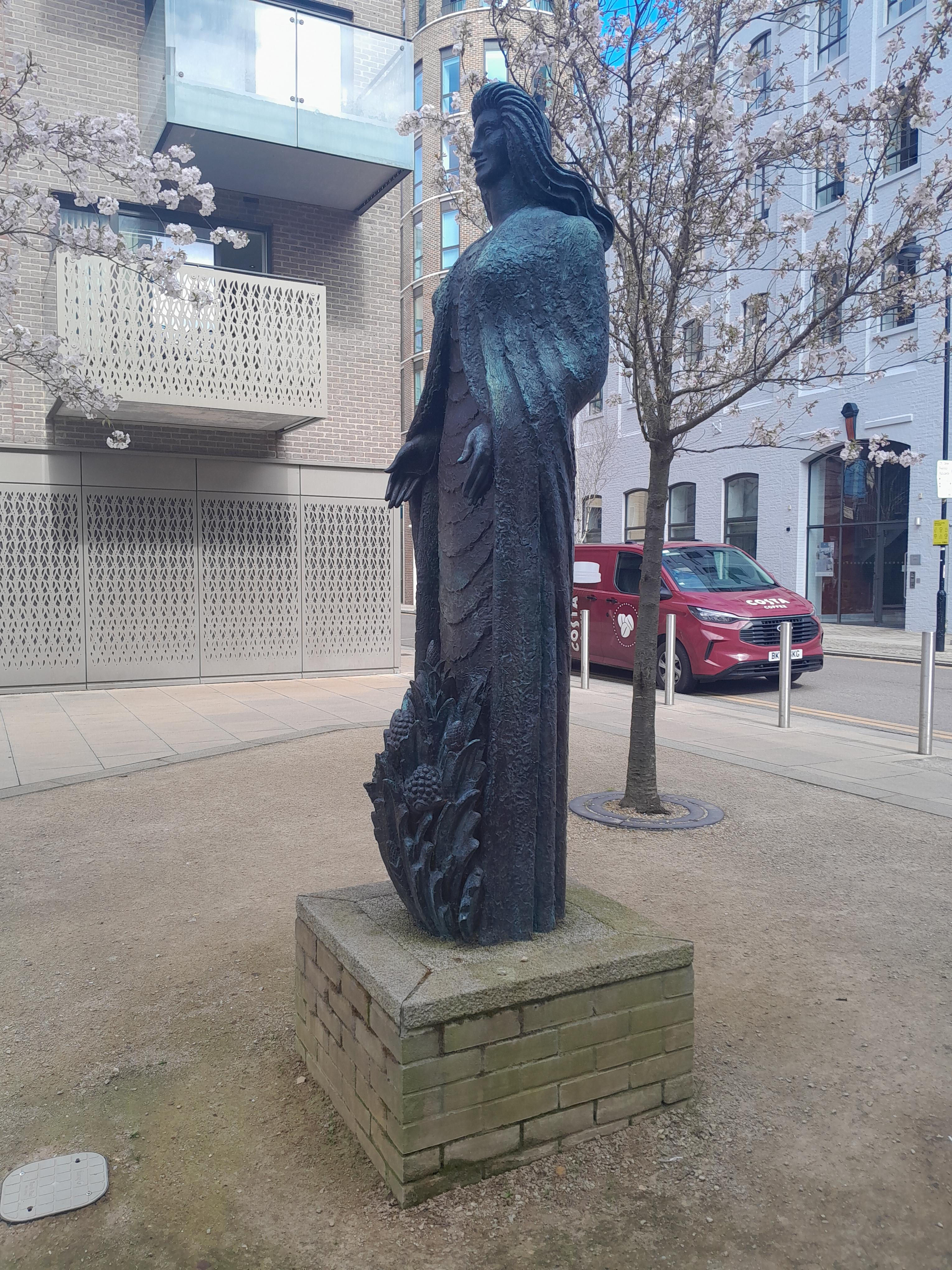

Ceres: Turn into the park just before Spiller's Mill, to see this statue is by William Bloye (with her back to you!) It was commissioned as Demeter 1961-62. It is close to the old Spillers Mill building - see above. Spillers was a flour company, and Ceres (or Demeter) was the goddess of wheat and growing things.
Further on, there is also the base of an old crane lift - more a piece of industrial archaeology than an artwork.
Walk through the green area to Brookgate. At the end, there are these posts. I don't know what they are!
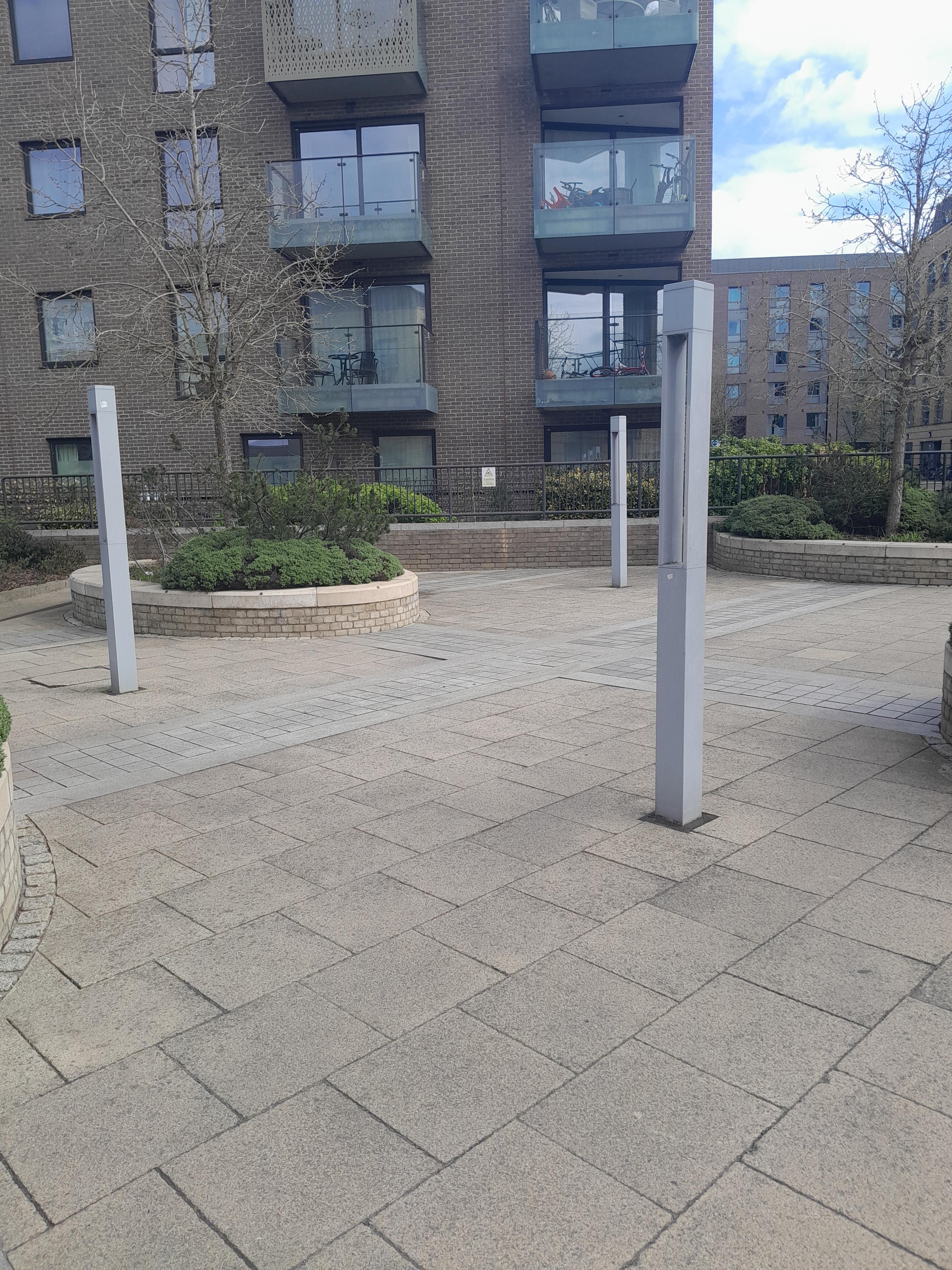
Walk through Brookgate, to Hills Road.
There is a group of public art round here, some of which mention W.J.Gredley as commissioning them. William.J.Gredley (Bill) and family were on Sunday Times Rich list of 2019 with a fortune of £241m. The family owns Cambridgeshire-based Unex Group, dealing mainly in property and to a lesser extent, bloodstock. This website interviews him at his home near Newmarket. He was born in the East End of London, evacuated during the war, and later moved to Essex to live with his grandmother when his home was bombed. This was where he learned to love horses. He has a reputation for being unconventional, and obviously has a love of art. Presumably that his company owns property round here. I assume that the artworks reflect his personal taste. Sometimes they get moved around!


Acrobats: These are on top of the building on the junction of Hills Road and Brookland Avenue, called City House. They appeared early 2020s. I know nothing about them.
Cross Hills Road, and walk to the elephant artwork.


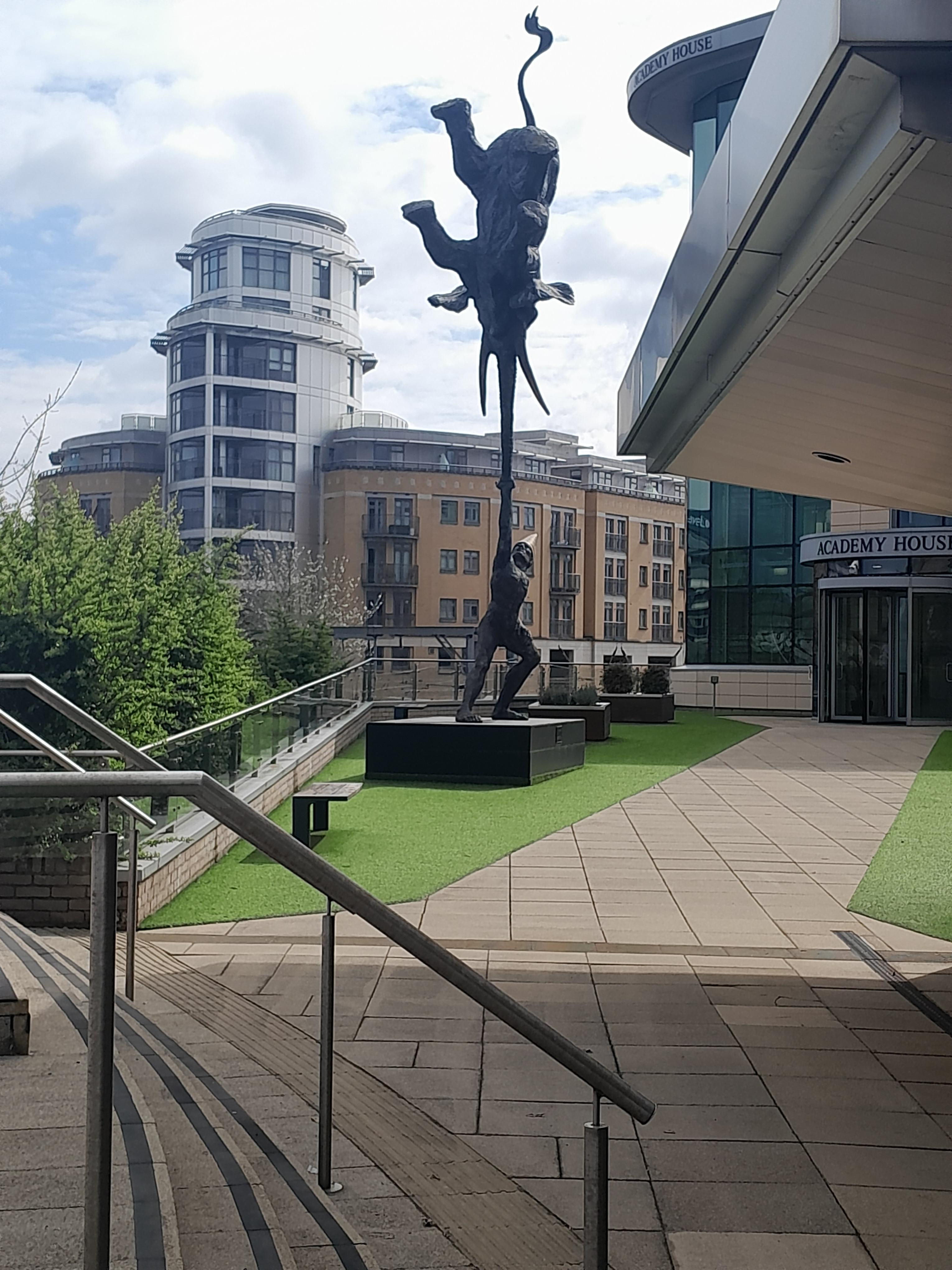
Dunamis: The sculptor is Bushra Fakhoury, and the title is Dunamis. It was first unvieled on Park Lane in 2013. The artist's website says 'The Impossible is possible. [This work] symbolizes human struggle to achieve excellence, pushing boundaries to make the impossible possible. We need to prioritise, work positively, and relentlessly towards reaching our goals, and dreams.' Another commentory by the artist says 'Holding the elephant in a high position gives homage to the traits that we share and gradually forget, such as family ties, solidarity, compassion and cooperation. The 'pointy hat' represents the knowledge through the ages. We may not have the extraordinary memory of the elephant, but we need to remember to support the survival of the endangered species.'
Walk along Hills Road, away from the bridge. First we meet more acrobats.


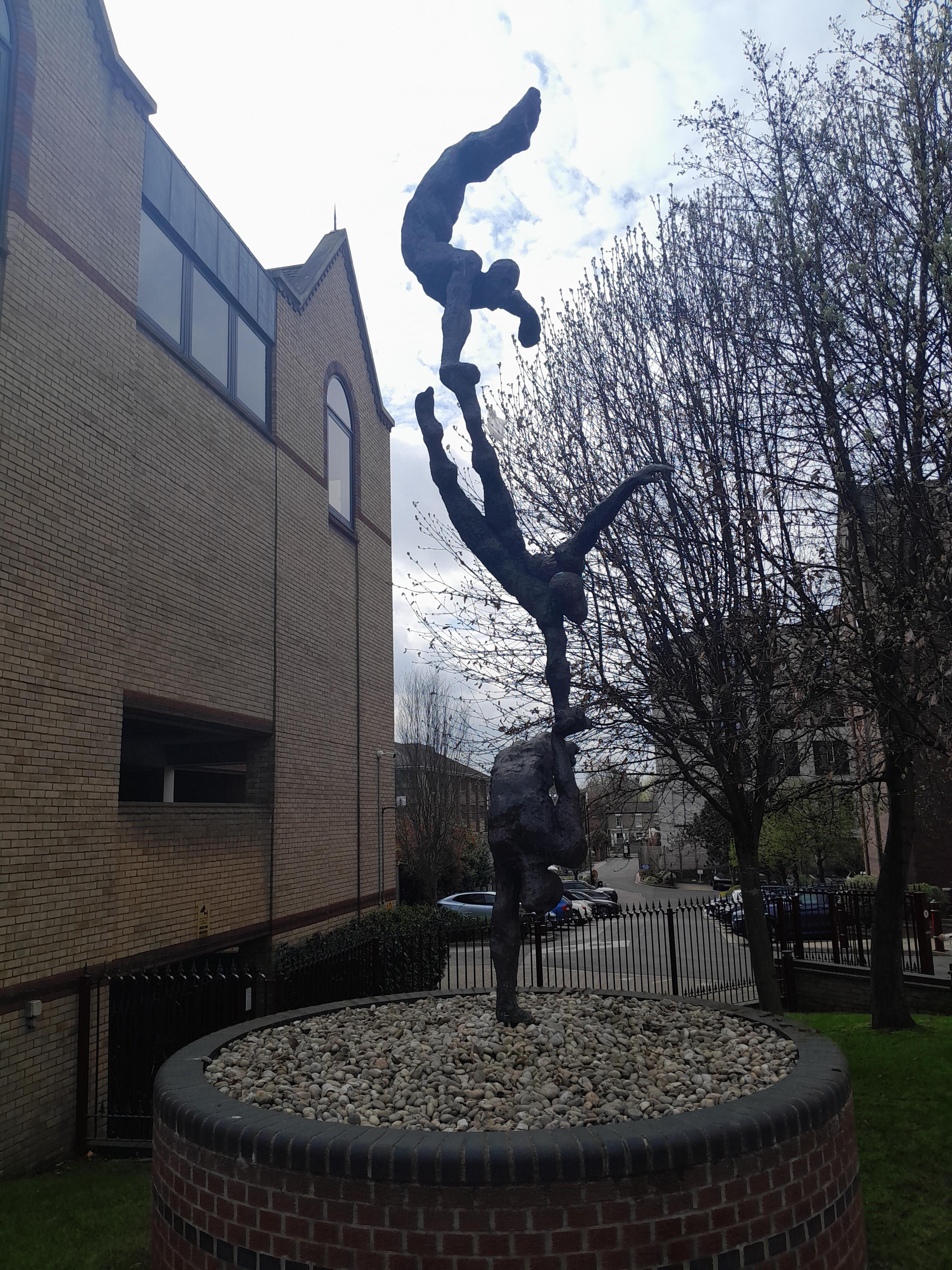
Danse Gwenedour: The sculptor is Bushra Fakhoury, and the title is Danse-Gwenedour. The artist's website says "It depicts 'Celebration of Life'. "Danse Gwenedour" was inspired by the dance performed by French villagers in Bretagne (Danse Gwenedour Du Pays Pourlet, Guemene Bretagne)." It was created in 2017.


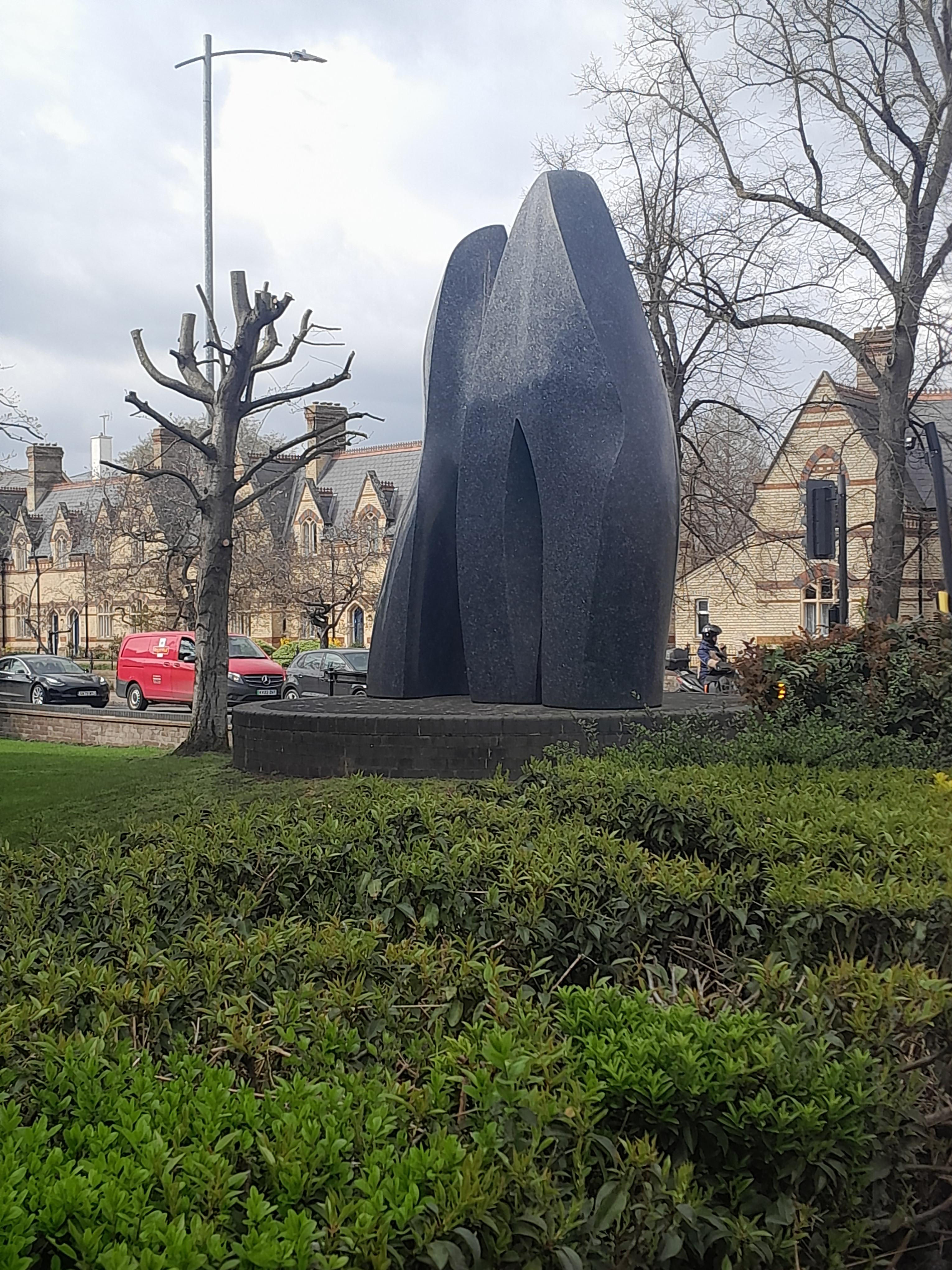
Chauvinist: This large sculpture is in front of a building called City House. It is by Helaine Blumenfeld, and is called Chauvinist. It was commissioned in 1990. Helaine Blumenfeld's website is here.

Walk back down Hills Road.

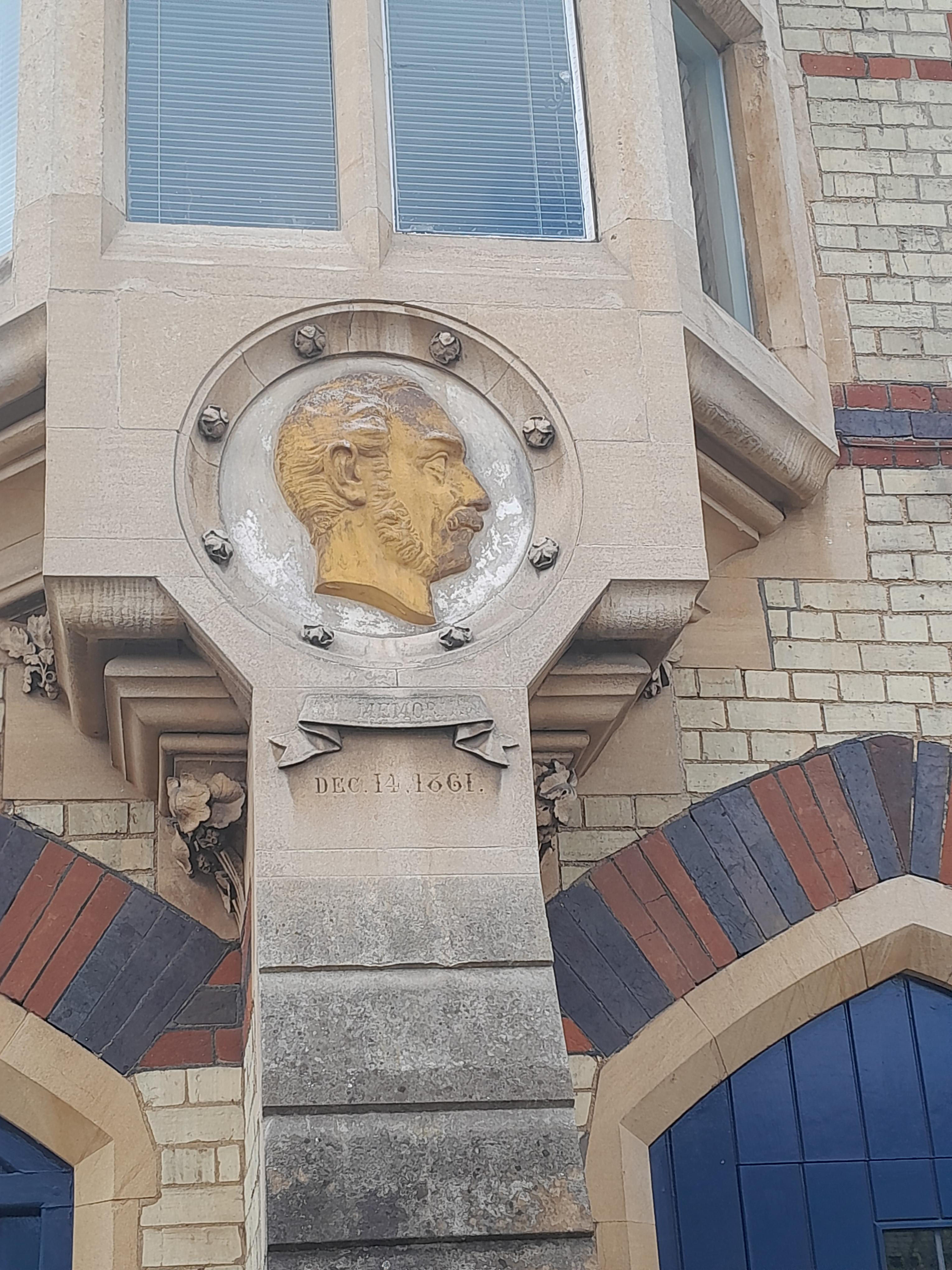
Royal Albert Homes is listed grade II. Built around 1861, in the Gothic style. It is still a registered almshouse charity. The plaque shows Prince Albert, and says "In Memory Dec 14 1861", which is the date of his death.
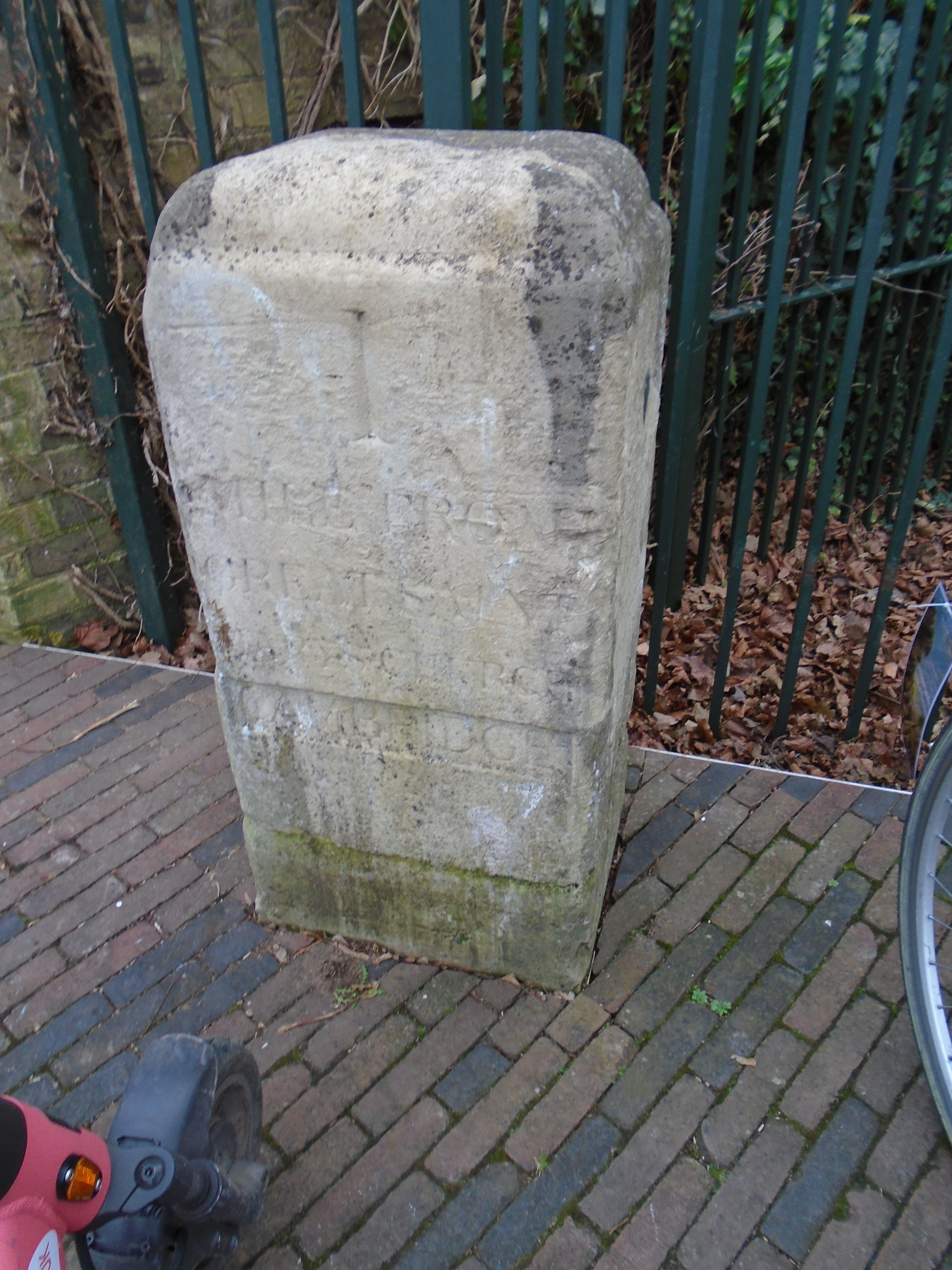
Mile stone It is listed grade II. Erected in 1731 by Dr William Warren. Stone block inscribed with "1 mile from Great St Mary's Church Cambridge". This is the first of a series of milestones that were erected to mark the distances between Cambrige and Haverhill. Dr Warren was a Fellow of Trinity Hall, who was also responsible for erecting a series of 16 milestones on the old road to London. There is a plaque on Great St Marys to show the base point. The name "Cambridge" is recessed. I wonder if it was removed during WWII and recut afterwards? I know that signposts giving locations were removed, in case the Germans landed and needed directions. But a milestone seems a bit extreme!


Kett's Oak: The big building on the corner of Hills Road and Station Road is Kett's House. On the side of it is this sandstone bas-relief. It is called Kett's Oak, dated 1962-63 and is by Willi Soukop. The original oak tree is in Wymondham where East Anglian rebel Robert Kett met his followers as they battled rich robber barns in 1549. The building is planned to be demolished and replaced, but it is hoped that this artwork can be reused in the new building. Kett is a well-known Cambridge building firm.
Cambridge war memorial is at the end of Station Road. This was made by Canadian sculptor Robert Tait McKenzie, and is known as as "The Homecoming" or sometimes "Coming Home". It was unveiled in 1922. It is a Grade II listed building. The young soldier is marching towards the city centre, back home from the war. But he is looking up Station Road towards the railway station, thinking of his dead friends that he left behind on the battle field. On the other side, you can see the old county coat of arms, supported by Great Bustards. This memorial used to be in the centre of the road. Hills Road is very busy, and they wanted to improve the junction, so in 2012, they decided to move the memorial to the side of the road. This would also make it easier for Remembrance Day ceremonies. The most important point was that the memorial had to be positioned so the soldier would still be looking up Station Road.
Turn up Station Road. On the right is 10, Station Road, with this artwork in front of it.
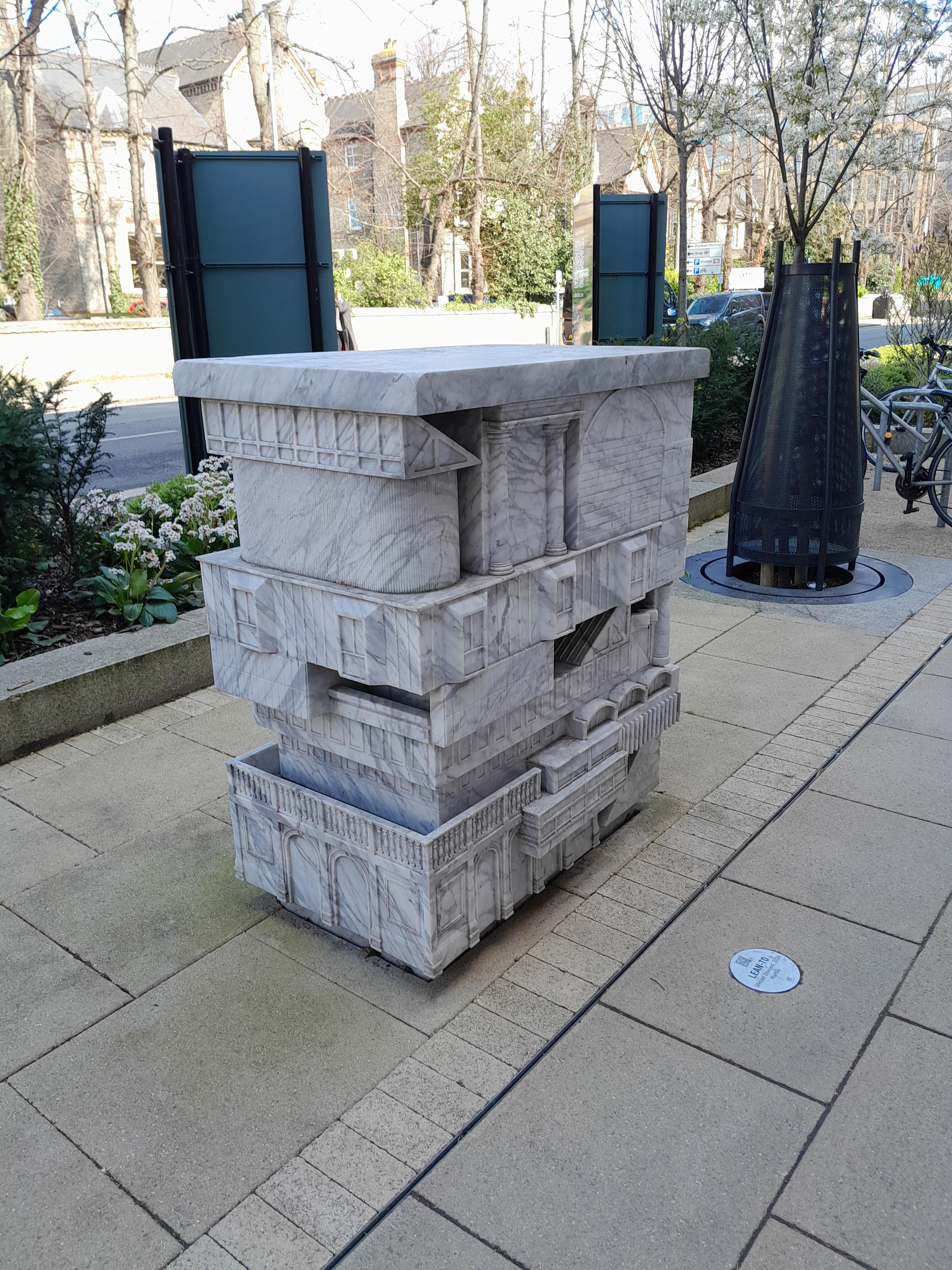
This is from the CB1 website:
LEAN-TO, a sculpture by multidisciplinary artist Shezad Dawood, was the latest to be unveiled at 10 Station Road, in July 2024. The piece explores the idea of sections meeting and morphing in space, to become a kind of fantasy meta-architecture - while also remaining discreet and functional. More information, including a walking tour of the buildings referenced can be found here. LEAN-TO is designed to be a place of meeting or a coffee break that references the array of architectural styles and movements that have contributed to the iconic visual language of Cambridge.
The following is not part of the official walk, but you might like to see it.

Walk through the station carpark towards Devonshire Road. There is this cycle (and foot) bridge close-by, going from Devonshire Road to Rustat Road. The official name of this bridge is the Tony Carter bridge (after a former councillor), but it's usually called the railway cycle bridge. It was opened in 1989.
Cross over the railway line using the bridge. Turn left, and walk down Rustat Road, Charles Street, Stockwell Street, and cross Mill Road.

Romsey R This sculpture is by Harry Gray and Will Hill. It was unveiled at the 2018 Mill Road Winter fair. Romsey is this part of Cambridge. It was developed in the nineteenth century to provide homes for railway workers. The project has been commissioned to celebrate the people and history of Romsey and their relationship with the railway. The destinations on the sculpture are residents' significant railway journeys.
If you're interested in finding more public art in Cambridge, try my Public Art in Cambridge webpage, which has photos and a little information on all the public art (that I know about!)
For other interesting things in Cambridge, try my Walks round Cambridge website, which covers other subjects as well.
I have indexed all the walks that I have done for the U3AC (including this one) here.
© Jo Edkins 2026 - Return to Walks index