Plaques and notices in Cambridge
Are you one of those people who, when they see a blue plaque on a wall, have to read it? If so, and you are in Cambridge, you may like to read the following. This is not all the Cambridge blue plaques. For a full list of those, click here. It is not just blue plaques either. I have added other plaques, notices, and anything written that I found interesting.
This page is arranged in themes. There are two maps, a large scale map of the centre and a smaller scale for the rest. Feel free to see the items in any order you'd like, or perhaps more sensibly, chose which you'd like to see. The map marks where to find the different items. For the city centre map, 100 metres is similar to 100 yards and 400 metres is about a quarter of a mile, so you can see that all of this is quite close together. On the smaller scale map, a kilometre is about half a mile, so everything is further away.
Things worth looking at are marked in red. Click on them, or on the links, for descriptions and pictures.


Click on the photos for a bigger version.
|
If you walk down Free School Lane, there are university buildings on one side. This site used to be called the Old Cavendish, but is now called the New Museums Site to avoid confusion with the new Cavendish Laboratory in West Cambridge. The Cavendish Laboratory was called after after William Cavendish, 7th Duke of Devonshire, who was Chancellor of the University and donated money for the construction of the laboratory. The Cavendish Laboratory has had many famous physicists. As of 2006, 29 Cavendish researchers have won Nobel Prizes. Click here for more about the history of the Cavendish Laboratory. The door of the Old Cavendish has this, from Psalm 111, "Magna opera domini exquisita in omnes voluntates eius" which can be translated as "Great are the works of the Lord. They are sought out by all who delight in them." This is a good tag for scientists. A plaque in Free School Lane commemorates the Old Cavendish Laboratories.
Above the entrance to the Old Cavendish is the Cavendish motto "Cavendo tutus" - Safety through caution. This is a pun on the name Cavendish, and good advice for scientists!
The other plaque in Free School Lane is about J J Thomson became Cavendish Professor of Physics in 1884. One of his students was Ernest Rutherford, who would later succeed him in the post. Thomson was awarded the 1906 Nobel Prize in Physics for the discovery of the electron and for his work on the conduction of electricity in gases. The others are inside the New Museum site. The plaque about B D Josephson next to the crocodile! The coat of arms of the university is further in, on the left. The motto is "Hinc lucem et pocula sacra", which can be translated as "From this place, we gain enlightenment and precious knowledge."
Once they had made this discovery, Francis Crick and James Watson crossed Benet Street to the nearest pub, the Eagle, to celebrate. As they walked into the Eagle, Crick announced "We have found the secret of Life." A blue plaque outside the pub celebrates this. The original plaque only mentioned Crick and Watson. There was a fuss about this, so it has been replaced by a new plaque, which also references Rosalind Franklin and Maurice Wilkins, the swcientists working in London, and "other scientists".
The Eagle has other claims to fame. It is a very old pub. Its entrance shows that it used to be a coaching inn. A notice outside the pub decribes other people who have drunk there. There is also a Greene King brewery plaque. These are quite common in Cambridge.
There are two plaques about Darwin on the front of Boots. One is one on the first floor level (so not easy to see). It says "Charles Darwin lived in a house on this site 1826". Note the careful wording! It is a 20th century building. The other is at ground level and says "Charles Darwin 1809-1992 kept in lodgings on this sitein 1828 while an undergraduate of Christs College
This plaque is at 22 Fitzwilliam Street, and says "Charles Darwin lived here 1836-7." The building is part of a listing of "early 19th century terrace of small houses", so it is possible.
These plaques are inside the Downing site. This is not part of Downing college (although close by). It houses various scientific departments and facilties. These are on the outside of the Physiology Building.
This barometer is set into the doorway, on the right-hand side, of 9 Kings Parade. Apparently scientific instruments used to be made here.
Notables of CambridgeOliver Cromwell
Thomas Hobson
The monument has two panels on it, which were added later in 1856. These describe a little of its history.
Transcription of the notice in front of the monument:
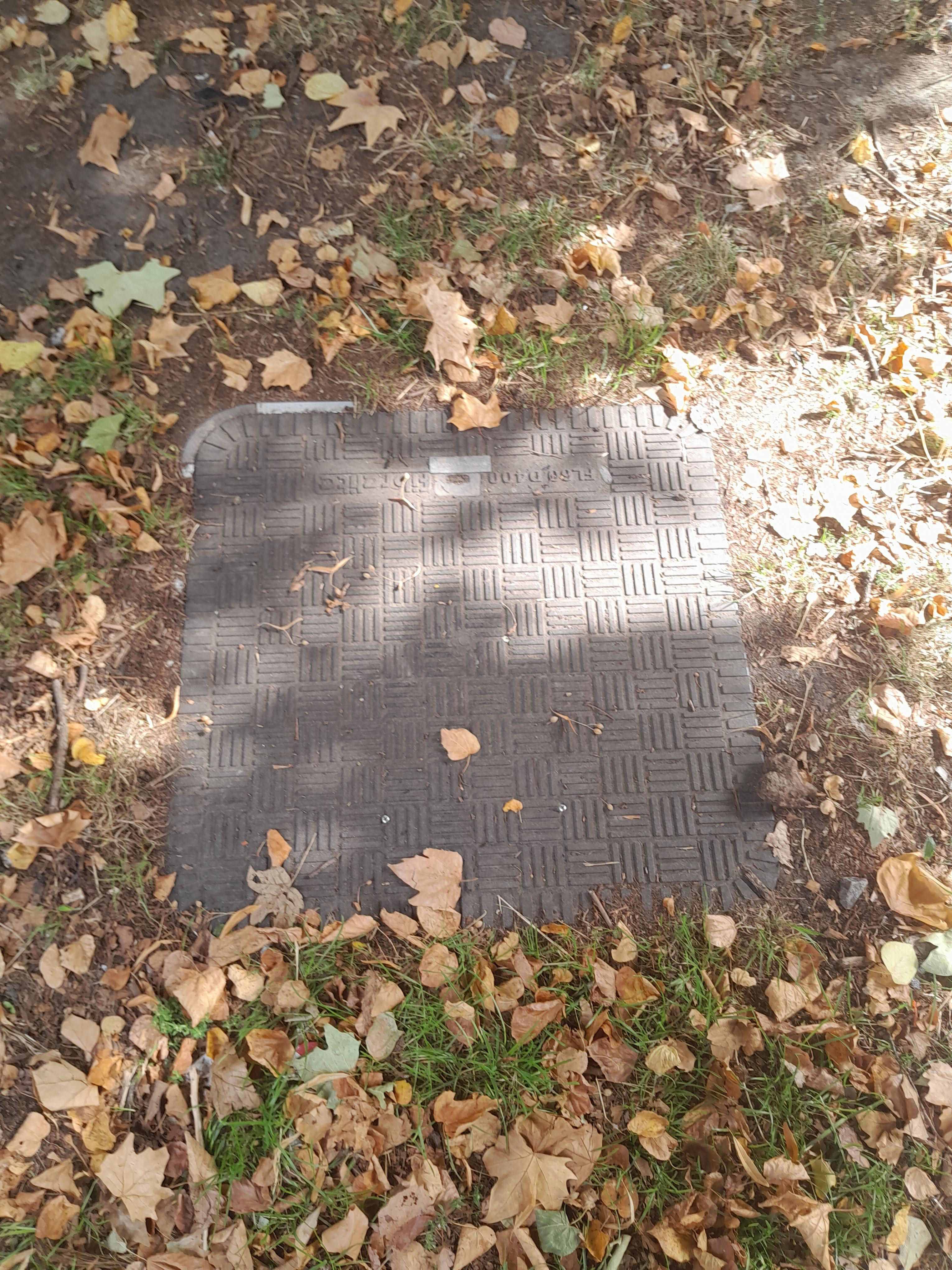
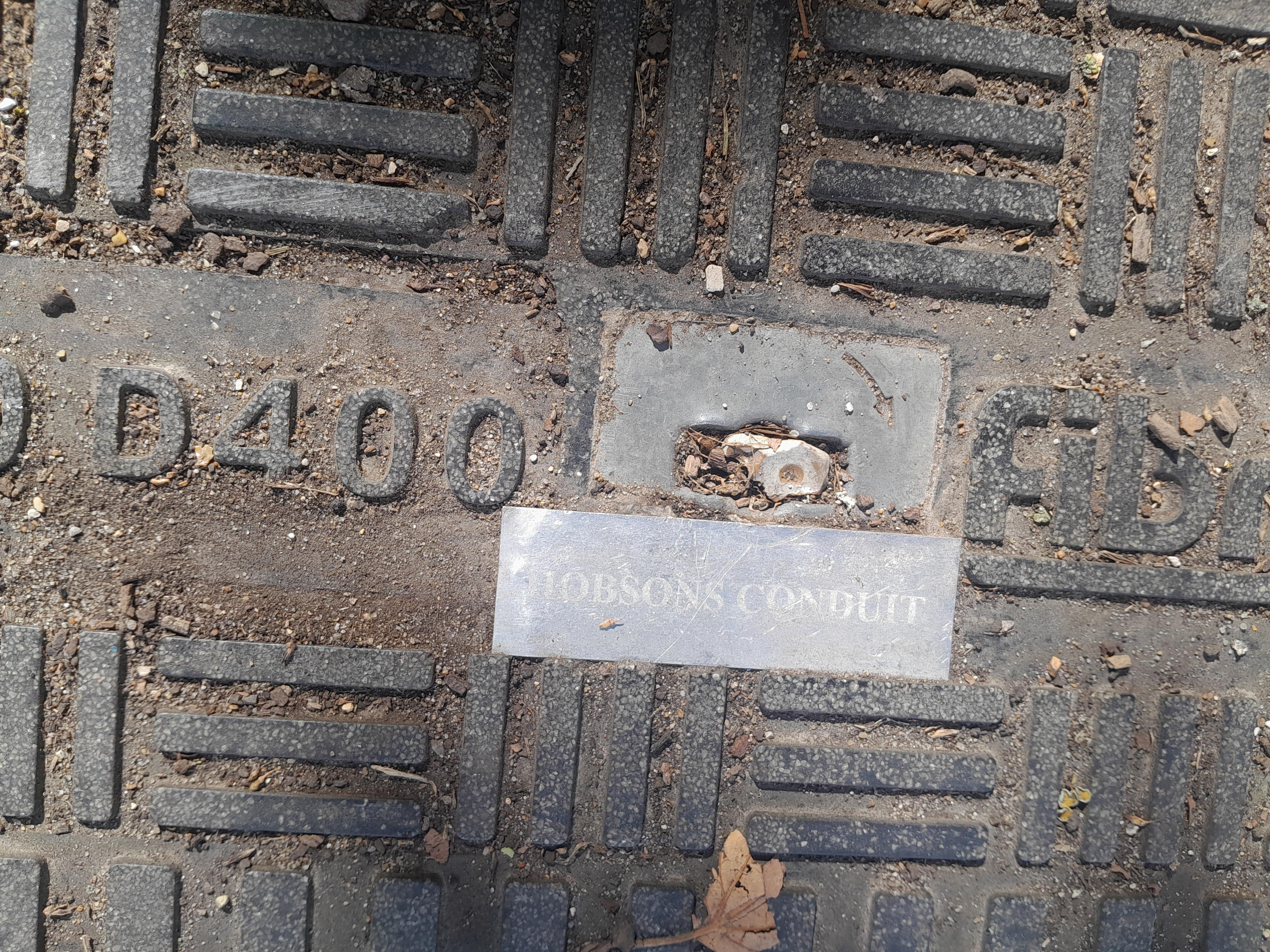
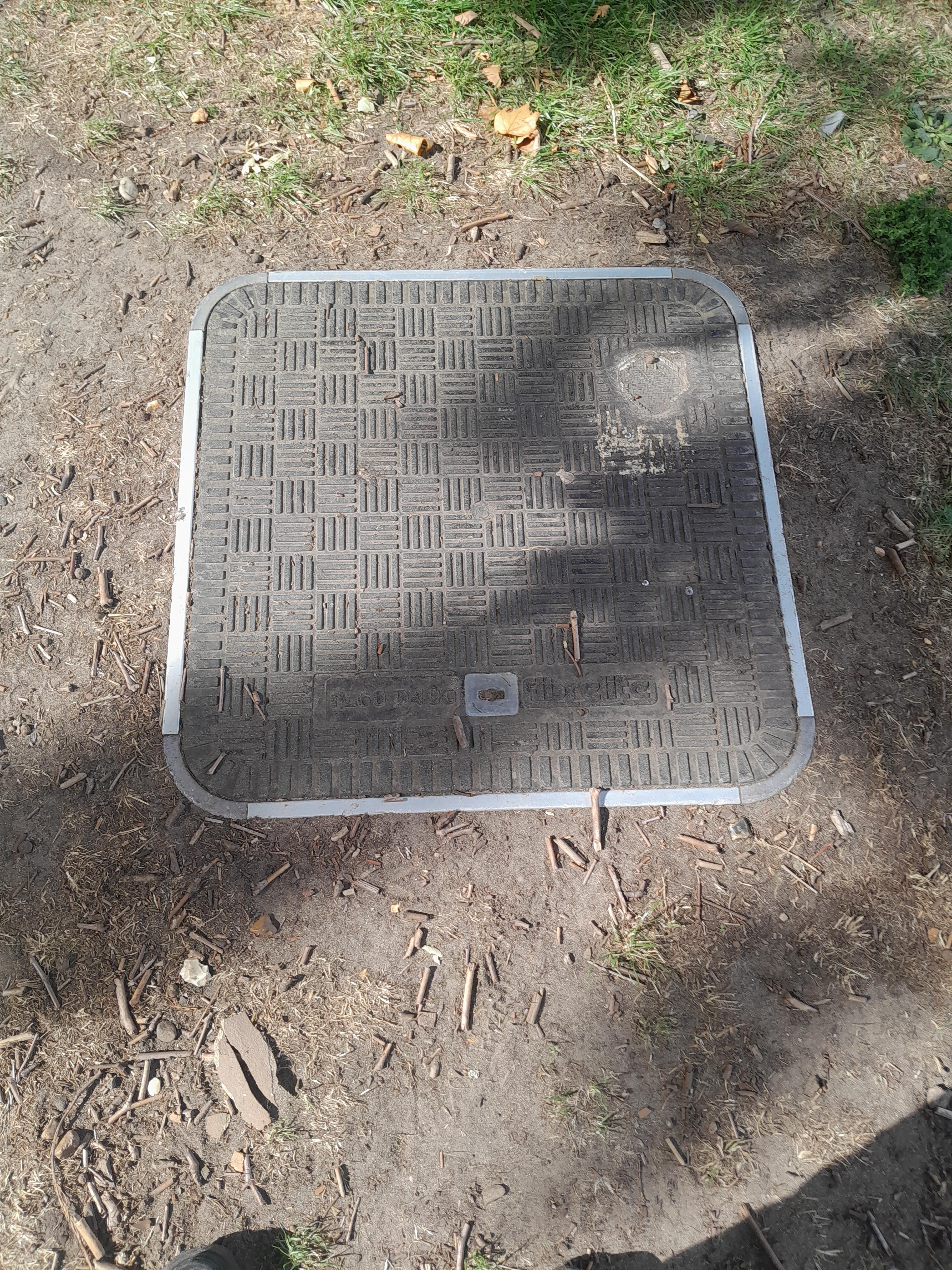
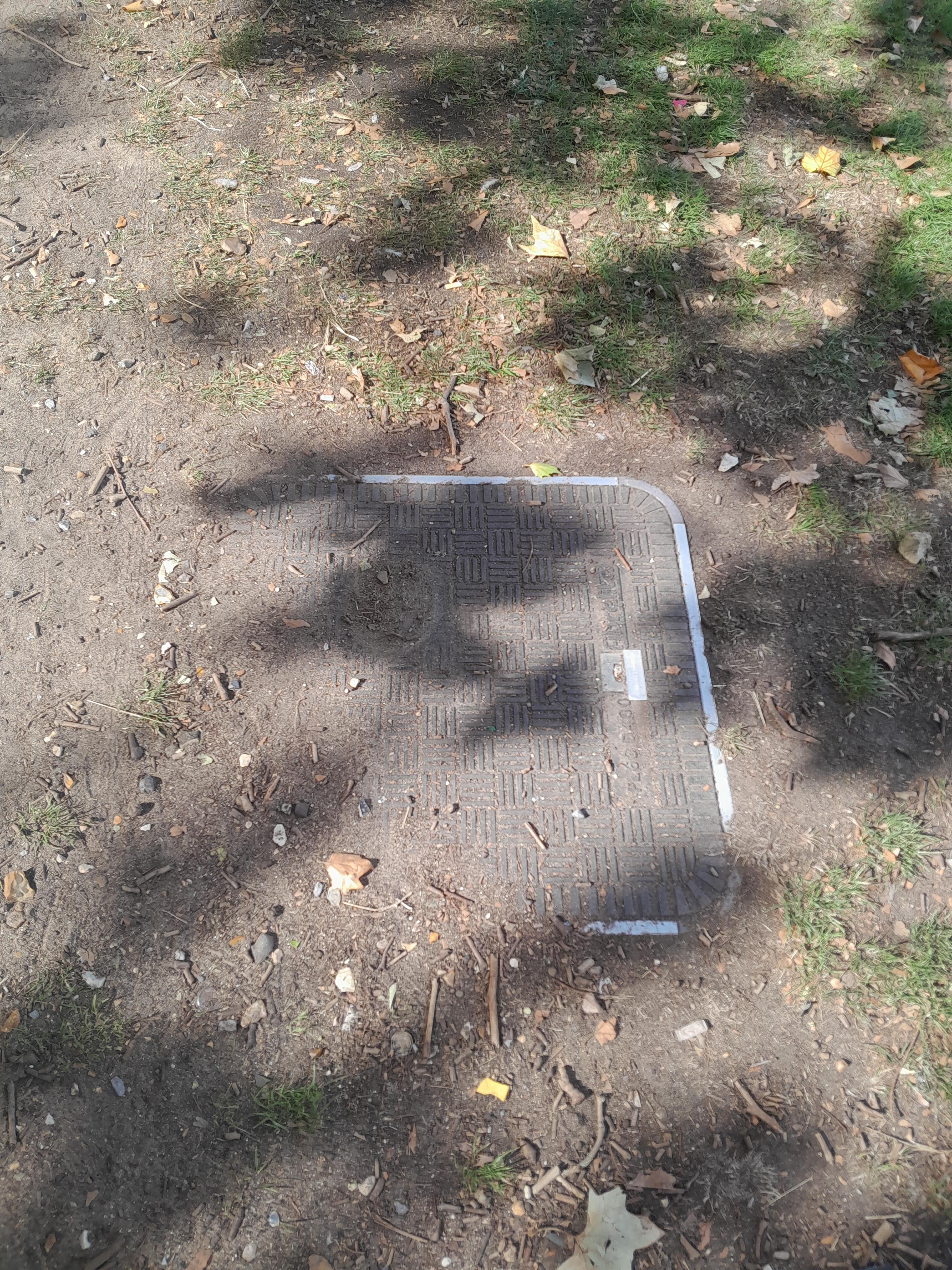
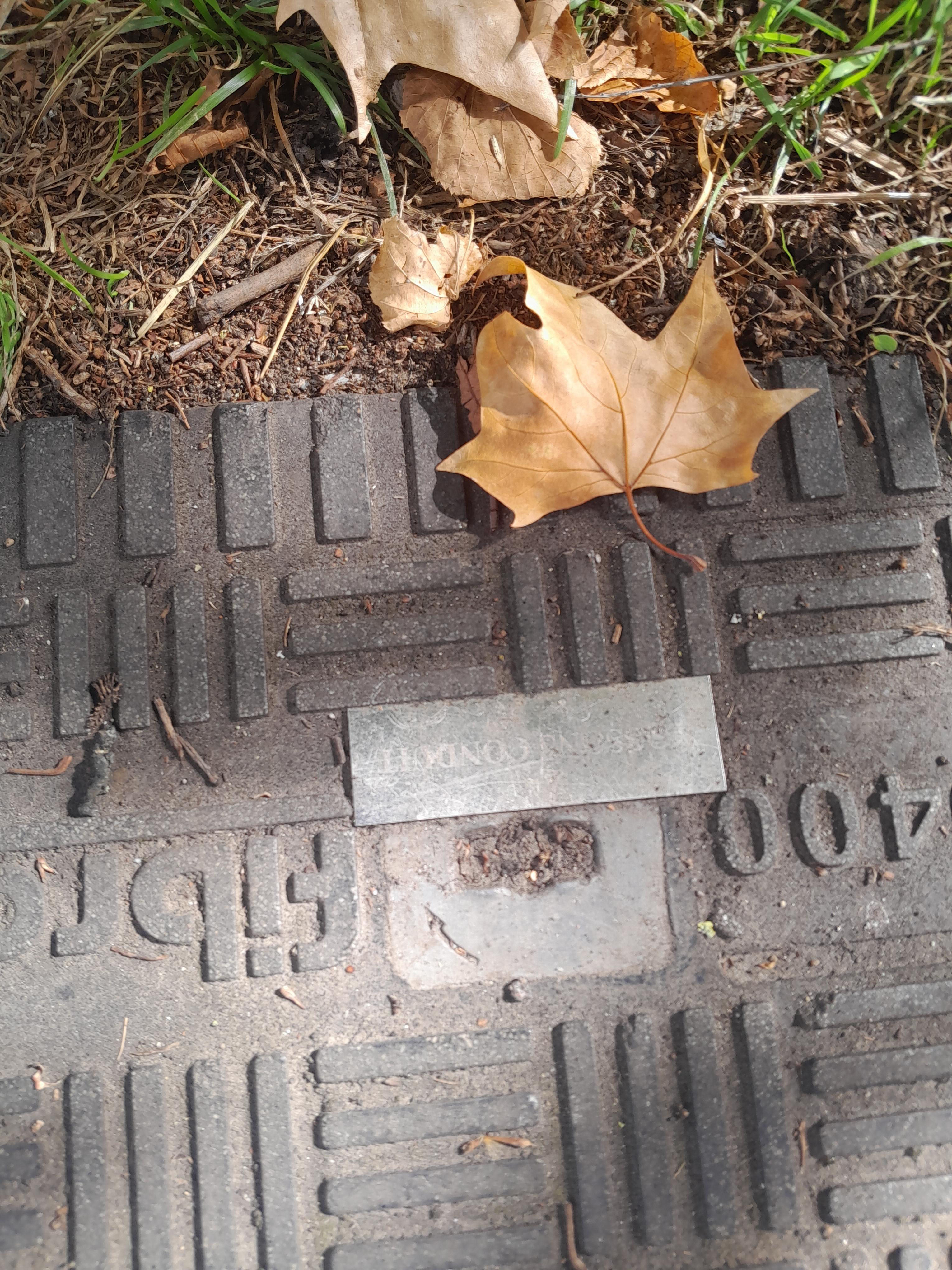
This map showing where the water from Hobson's conduit goes is taken from this website, which explains the various branches. The branch that goes through Parkers Piece was used to supply a cattle pond. The pond was filled in in 1827. There are three manhole covers showing its route. The first (labelled) is next to the toilets:
The next (unlabelled) is near Regent Terrace. The photo shows its position.
And the third manhole cover, labelled this time, closer to the University Arms hotel.
Hobson's Conduit goes underground in St Andrews St, but there are grills above it, and modern plaques showing its route. Start from Parkers Piece, and walk along that side of the road, walking towards the centre. At certain points, you will notice a grill running along the gutter. 
Then the plaques start to appear. Outside the Grand Arcade (other side of road). Note the grill is still there: Outside Cambridge Magistrates Court (other side of road): Outside optometrist (other side of road): Outside St Andrews chruch (other side of road): Outside Christs college: Now cross over the road and walk back towards Parkers Piece. Outside Christs college gateway (opposite side of road): Outside Christs college (opposite side of road): By entrance to Lion Yard (this shows the grill above the conduit): This shows how this grill goes along St Andrews St on this side of the road, all the way from the taxi rank to near the University Arms hotel. There are sometimes two! It seems to start as the drain from a gutter, but this is obviously just taking advantage of the existing drain. 


John Milton, the famous poet, who studied at Christ's College wrote two sonnets about Hobson. Apparently, Hobson was not allowed to travel freely because of the plague, and then died. Milton imagines that since he was forced to stay still, Death was able to finally catch up with him!
John MortlockThese plaques are on the wall of Barclays Bank in Benet Street. This building has been a bank for a long time, as these plaques show. John Mortlock was a famous, even notorious, politician. He ran Cambridge as his private fiefdom for many years. He used to drink at the Eagle. The plaque says 'John Morlock 1755-1816 "Master of the Town of Cambridge". This site was his home where he opened the first banking house in Cambridge. Draper, Banker, MP, Recorder and thirteen times Mayor. "That which you call corruption I call influence."' Mortlock's portrait is in the Guildhall.
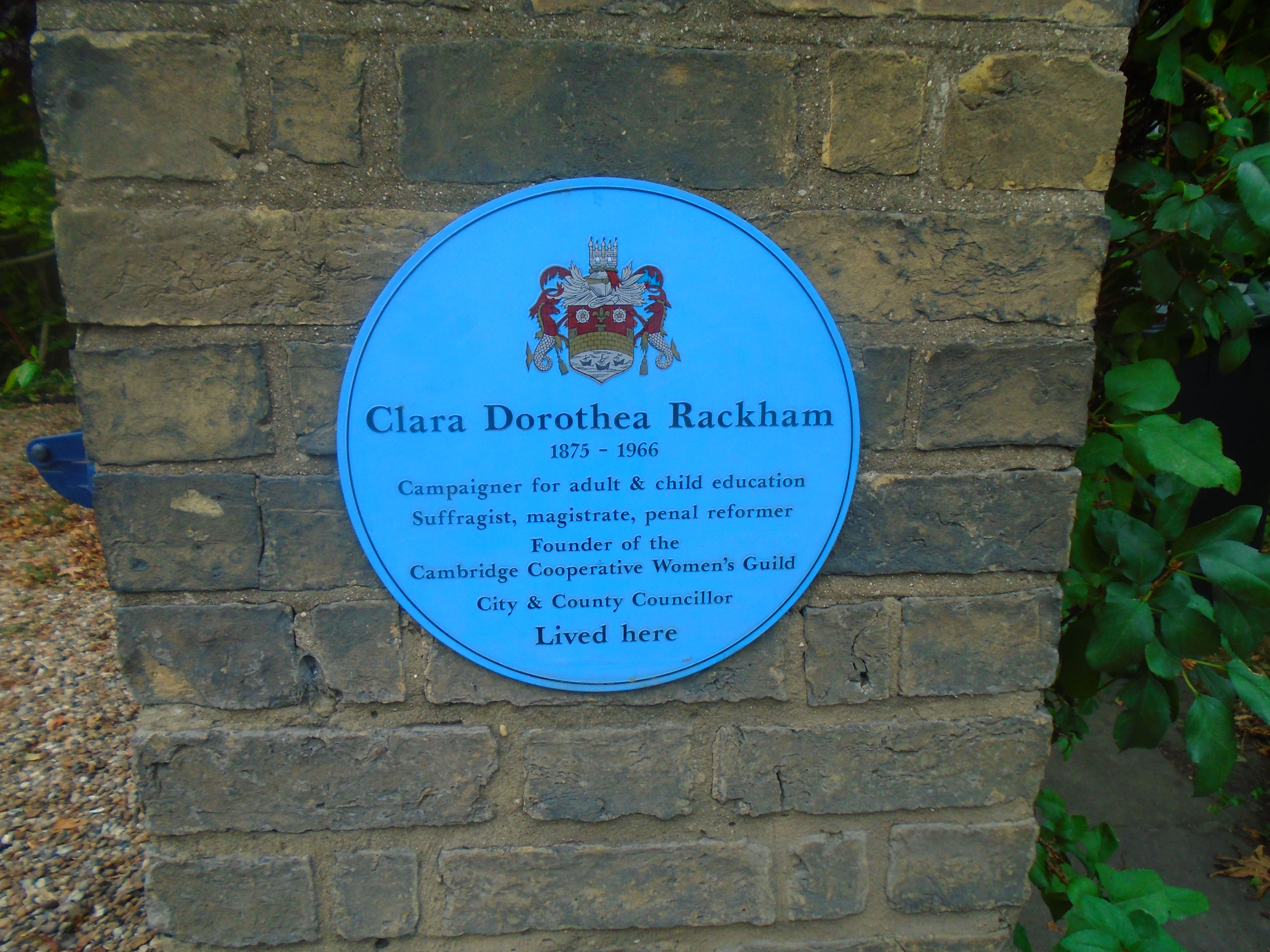
Millicent & Henry FawcettThis is a double! There are two blue plaques, one above the other, on Brookside, to a pair of Cambridge notables.
John Maynard Keynes
Jack Hobbs
Hobbs Pavilion was built by public subscription following Jack Hobb's incredible 1925 season, during which he broke W G Grace's record of test centuries. Jack Hobbs was born in Brewhouse Lane off Gwydir St, in 1882. The eldest of 12 children, he left St Matthews School early and became a baker's errand boy, but could often be seen honing his cricket skills on Parkers Piece at 6am. He joined Surrey crickey team at the age of 17. He finished his career with more than 5,000 runs from 61 England caps and is widely regarded as one of the greatest opening batsmen. He died in Hove in 1963.
Cycles near Parkers PieceAt the edge of Parkers Piece, in Gonville Place, there used to be a sign in the road showing where Cambridge was once part of the Tour de France. Nearby, there is a cycle counter.
Charles Humfrey
Dr John Addenbrooke
This plaque is not shown on the map, and is not worth making a trip to see, but you might notice it if you pass it. It is by the main entrance to Addenbrookes Hospital (centre photo) which is to the south of Cambridge, between Hills Road and Long Road. The plaque describes a little of the history of the hospital. The original site (right) is still known as Old Addenbrookes, but is now the Judge Business School and has nothing to do with medical matters. It is the large building opposite the Fitzwilliam Museum. You can still see 'Addenbrookes Hospital' written across the front, and the neighbouring restaurant has 'Outpatients' over the door.
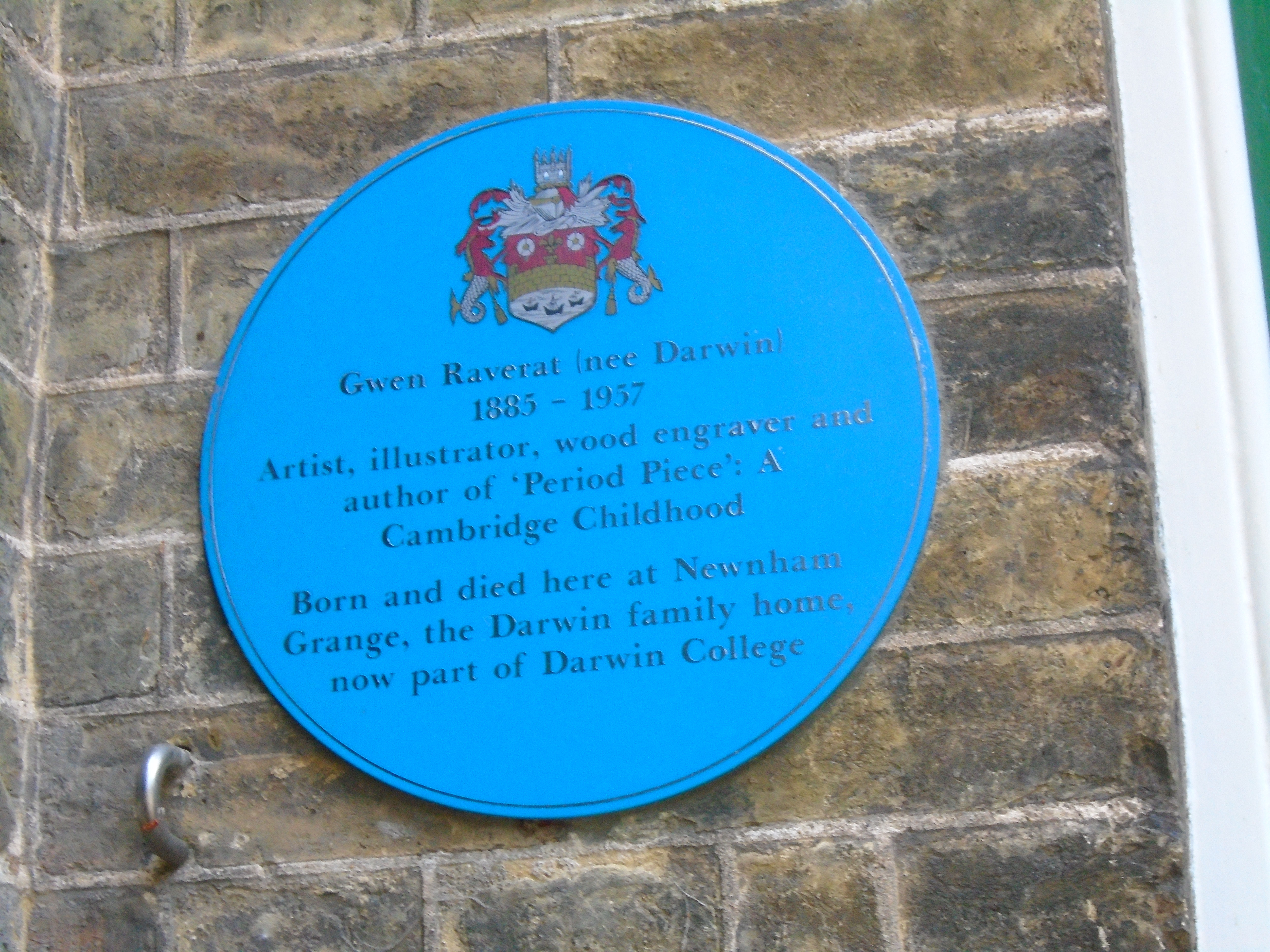
This plaque is on the south side of Silver Street. It says "Gwen Raverat (nee Darwin) 1885-1957. Artist, wood engraver and author of 'Period Piece: A Cambridge Childhood'. Born and died here at Newnham Grange, the Darwin family home, now part of Darwin College".
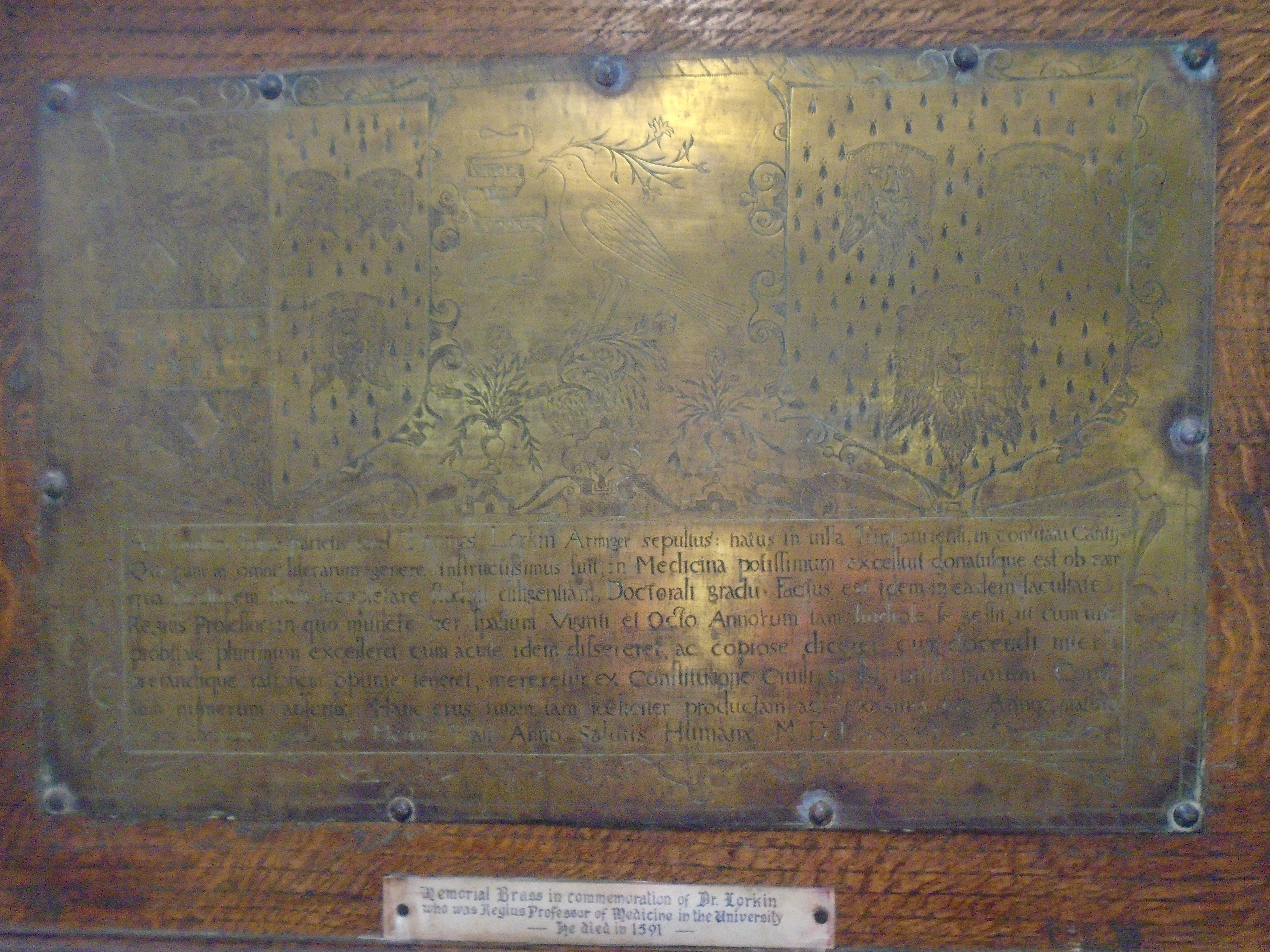
Thomas Lorkin (1528-1591) was Regius Professor of Physic (medicine). He has an attractive memorial in Great St Marys church (north wall, go through the gift shop!) The bird is a lark, a pun on his name. It carries a columbine. The memorial is in Latin. The Latin motto says "Voce et Odore" (with voce and fragrance).
Nearby is the memorial of Michael Woolf (died 1614). He was the landlord of the Rose Tavern, which gave its name to Rose Crescent. The memorial says (in Latin) "Hic situs est Michael Woolf, vir bonus et probus hospes, inter iucundos gloria prime senes. Innocuam vitam non livor non mala fama, laedere quidquam ausa est nil nisi mors potuit. Obiit vto martii, anno Dni 1614, posuit Bar. Woolf." (Here lies Michael Woold, a good man and an honest landlord. Among jolly old men he was the first glory. Neith envy nor malicious gossip dared to hurt him in the least. Nothing but deat could do that. he died on March 5th, 1614. Bartholomew Woolf set this memorial up." There is also a rose, referencing the tavern.
Institutions
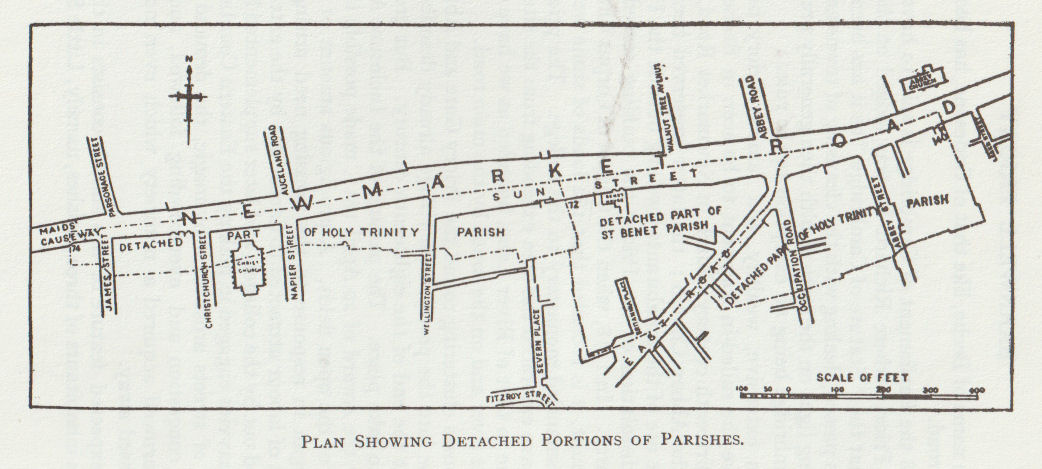
There are various parish boundary marks round Cambridge. Here is a map of the boundaries, c.1800.
This map shows the rather strange detached parish boundaries along Maids Causeway and Newmarket Road. It is from "Cambridge Revisted" by Arthur B. Gray, originally published 1921 (so the Elizabeth Way had not yet been built). He suggests that the reason may be that these were based on the original "common fields" around the town, and when these were enclosed, they were mostly allocated to the parish of the near-by church, but the inner city churches were also allocated some.
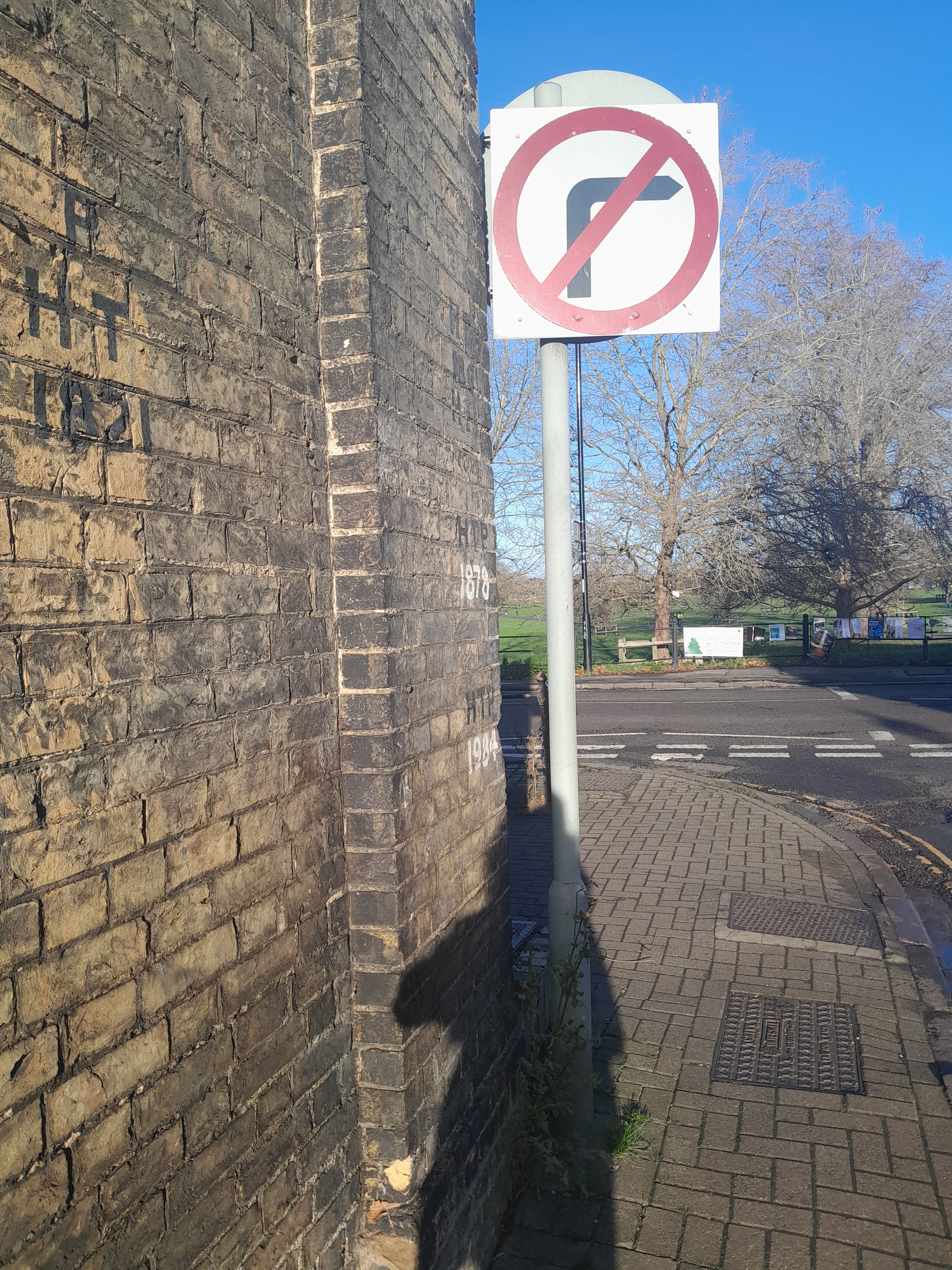
These ones are on the corner of Maids Causeway and Fair Street. They mark the boundary of Holy Trinity Parish. Holy Trinity church is in Market Street, near Cambridge market in the city centre, but the map above shows that the parish stretched out along Maids Causeway. The parish bordering it was Great St Andrews. The dates shown are 1821, 1861, 1878, 1984 (when I suspect that the whole lot were repainted). There does seem to be an extra, faded, date above 1878.
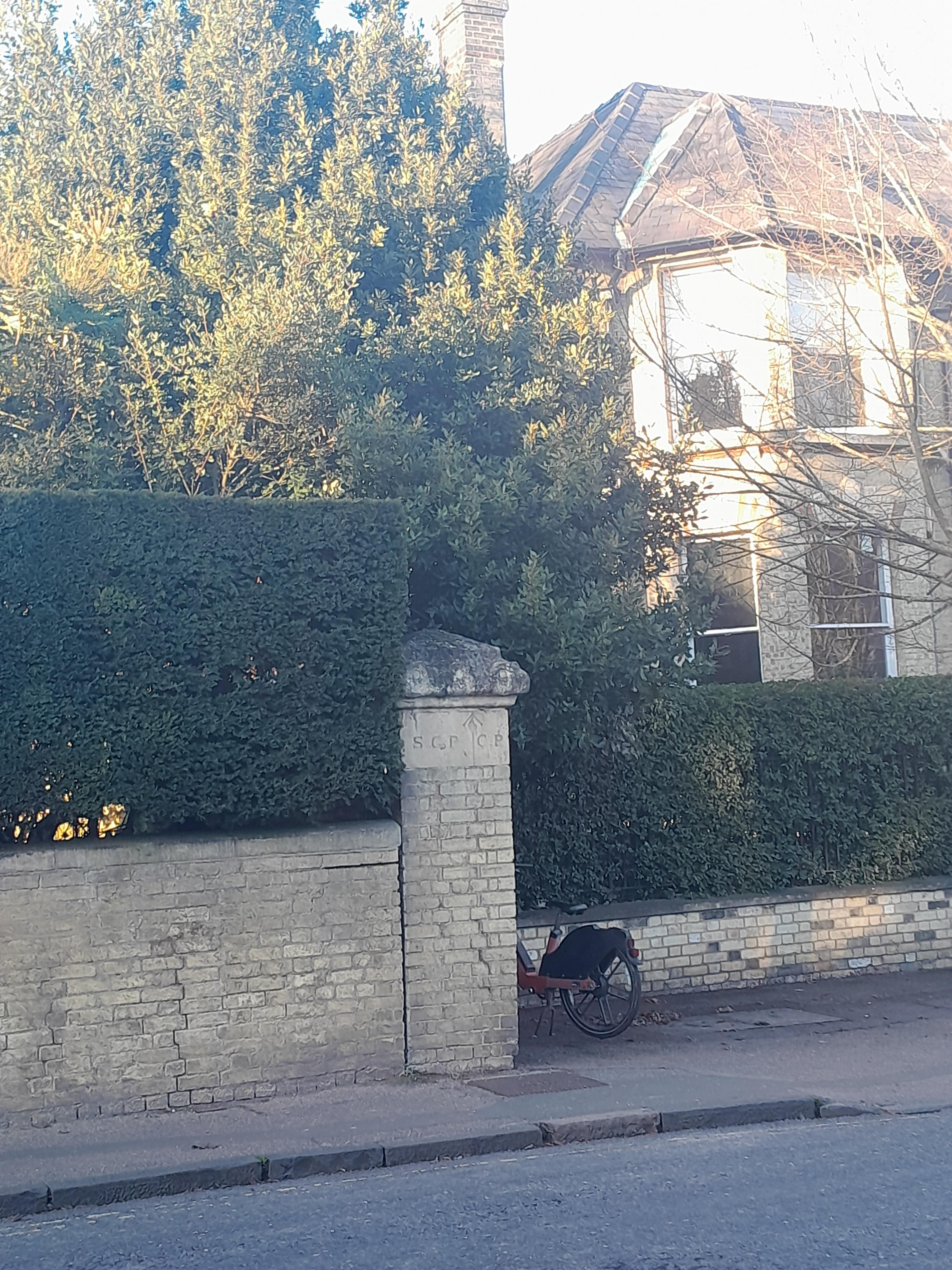
This is in Chesterton Lane, at the point it turns into Chesterton Road. It says "S.G.P. (arrow) C.P.". It has no date. It marks the boundary between St Giles parish, and Chesterton parish (St Andrews, Chesterton). Chesterton was outside the borough of Cambridge.
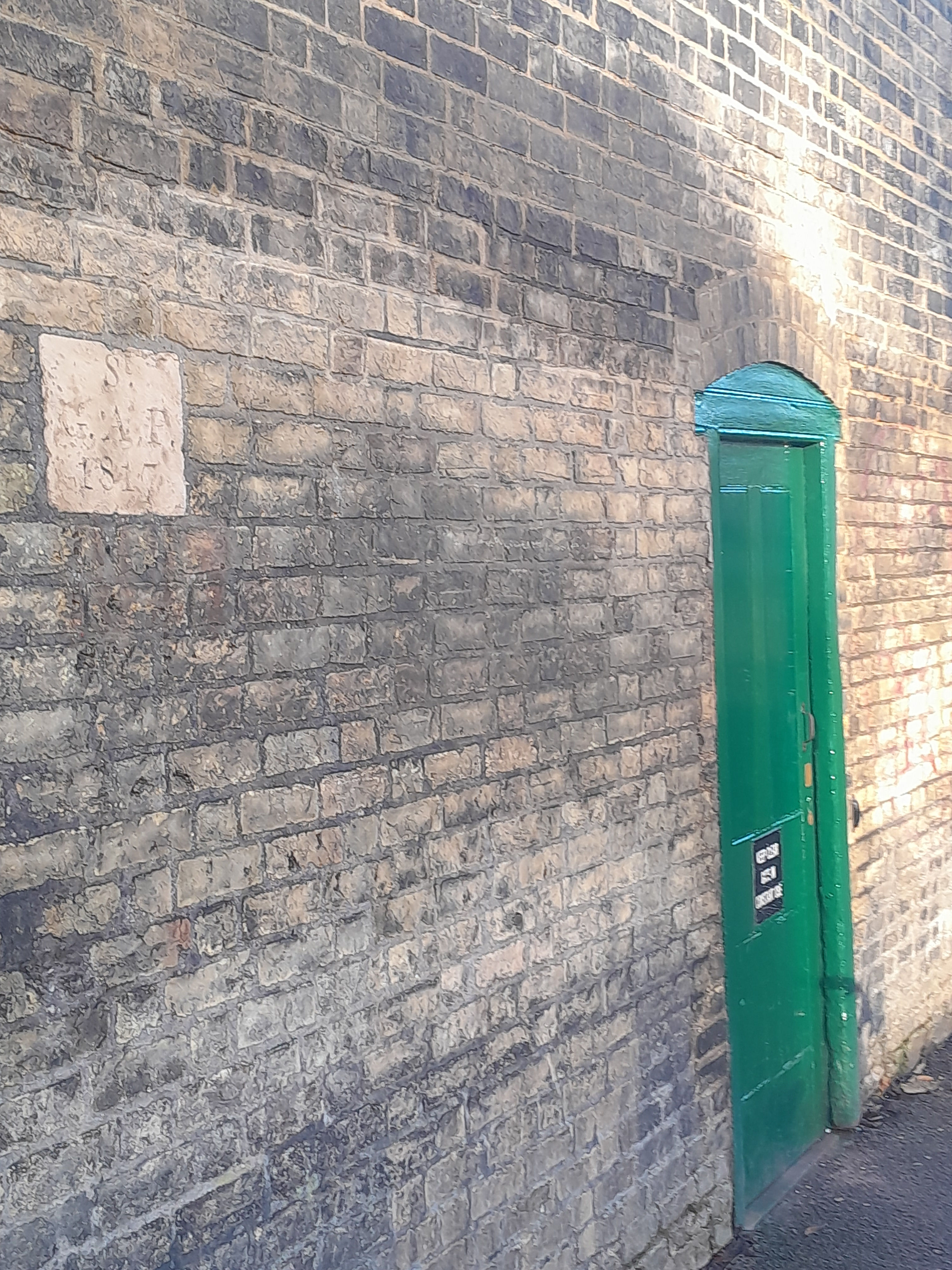
This is on Milton's Walk, in Christs Pieces, on the wall of Christs College, near Drummer St bus station. There are two green doors. This one is near the right hand door. It is dated 1817. It marks the boundary of St Andrews the Great parish. Great St Andrews church is near by. The parish bordering it was Holy Trinity.
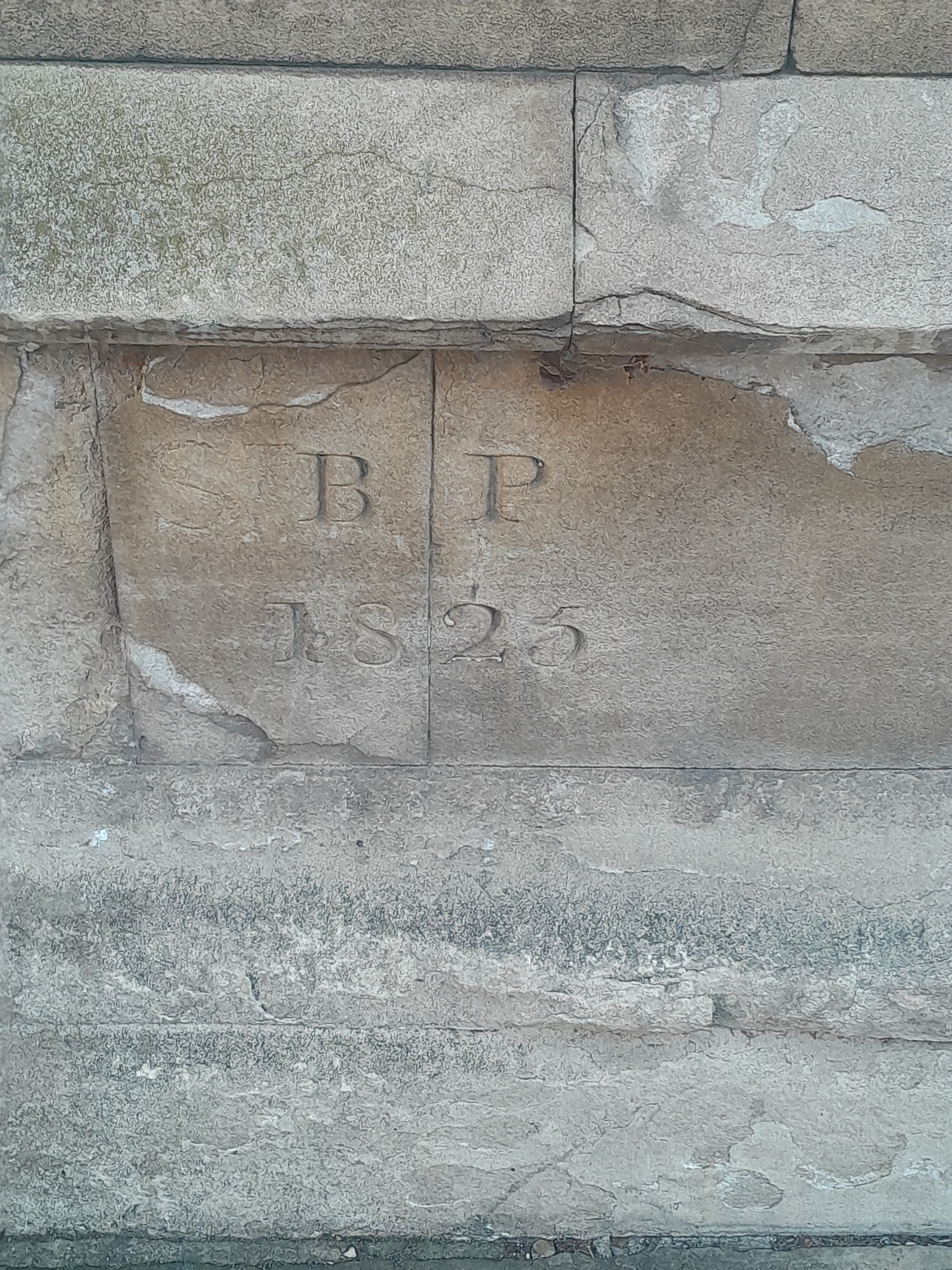
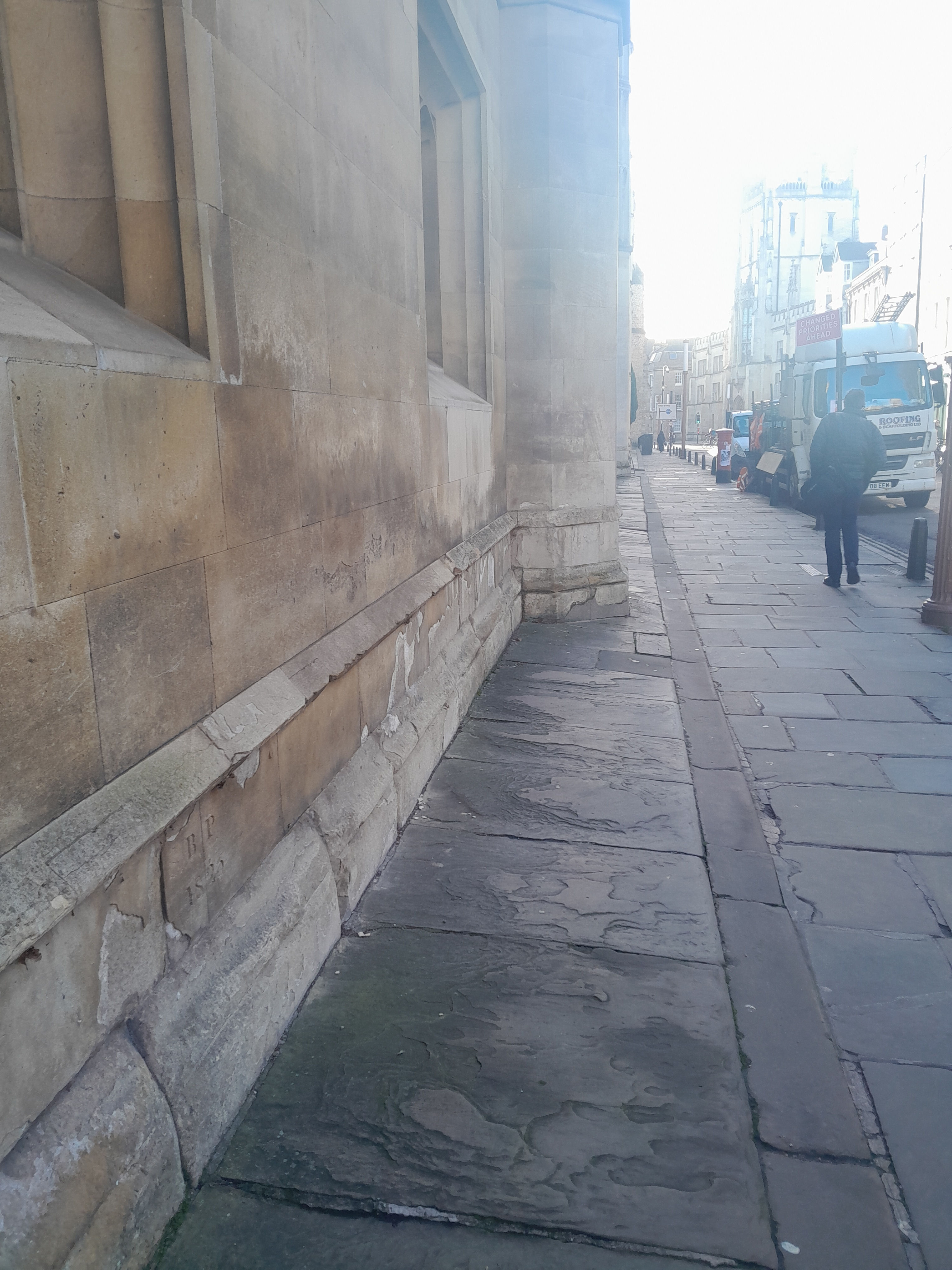
This is on the front of Corpus Christi college, on Trumpington Street, near Benet Street. It is dated 1825. It marks the boundary of St Botolph and St Benet, which makes the marking rather ambiguous! St Benet church and St Botolph church are near by.
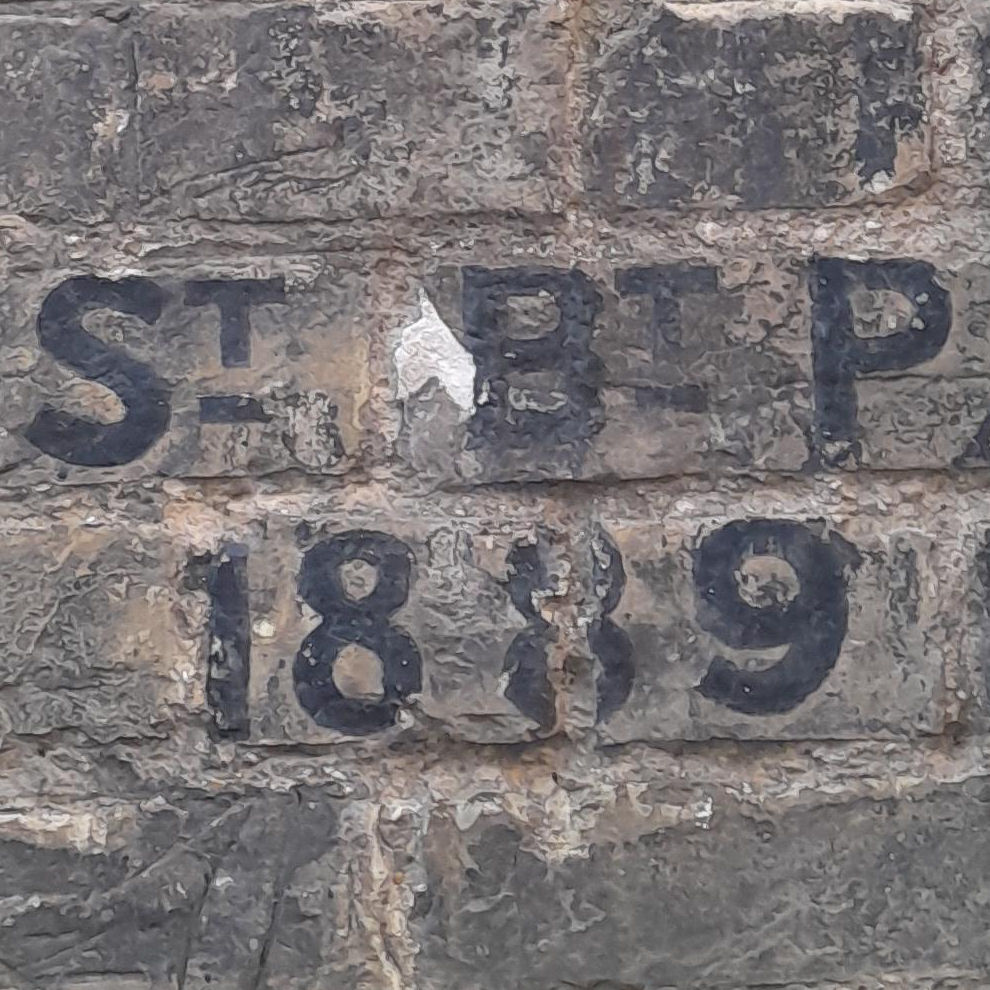
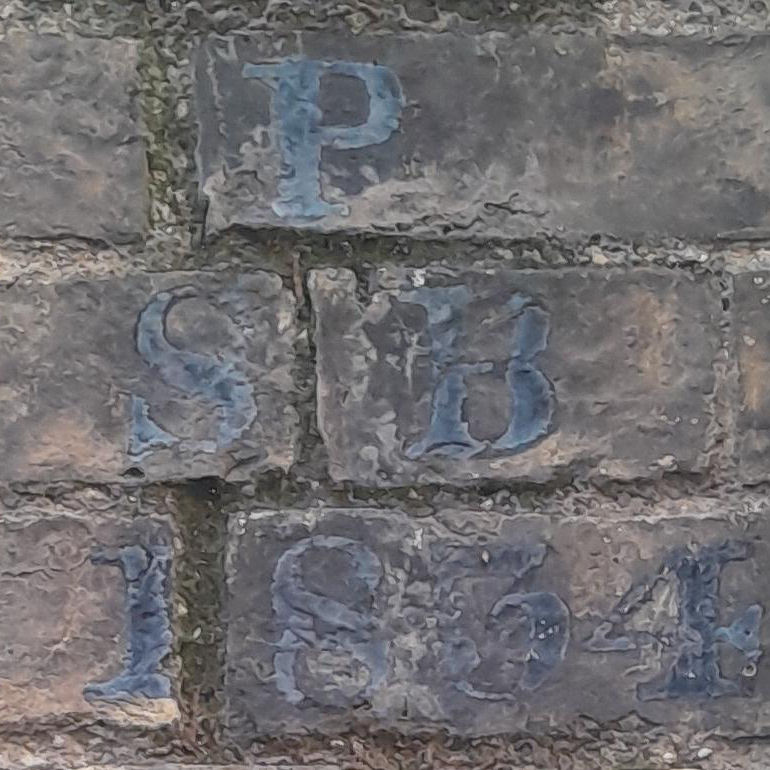
This is at the back of Corpus Christi college, in Free School Lane, near Benet Street. It is just after the end of the back of Old Court. There are two different boundary marks. The clearer one is at the bottom. It is dated 1889. It marks the boundary of St Botolph and St Benet. The marking says "St Bt P". The upper one is more faded. It is dated 1834, and says P SB. Again, this the border between St Benets and St Botolphs. The Bt is probably St Benets, and the SB St Botolphs. (One frivolous suggestion is that SB stands for St Both!) There is a suggestion of some painted letter just above the St Bt P mark, but I can't make it out.
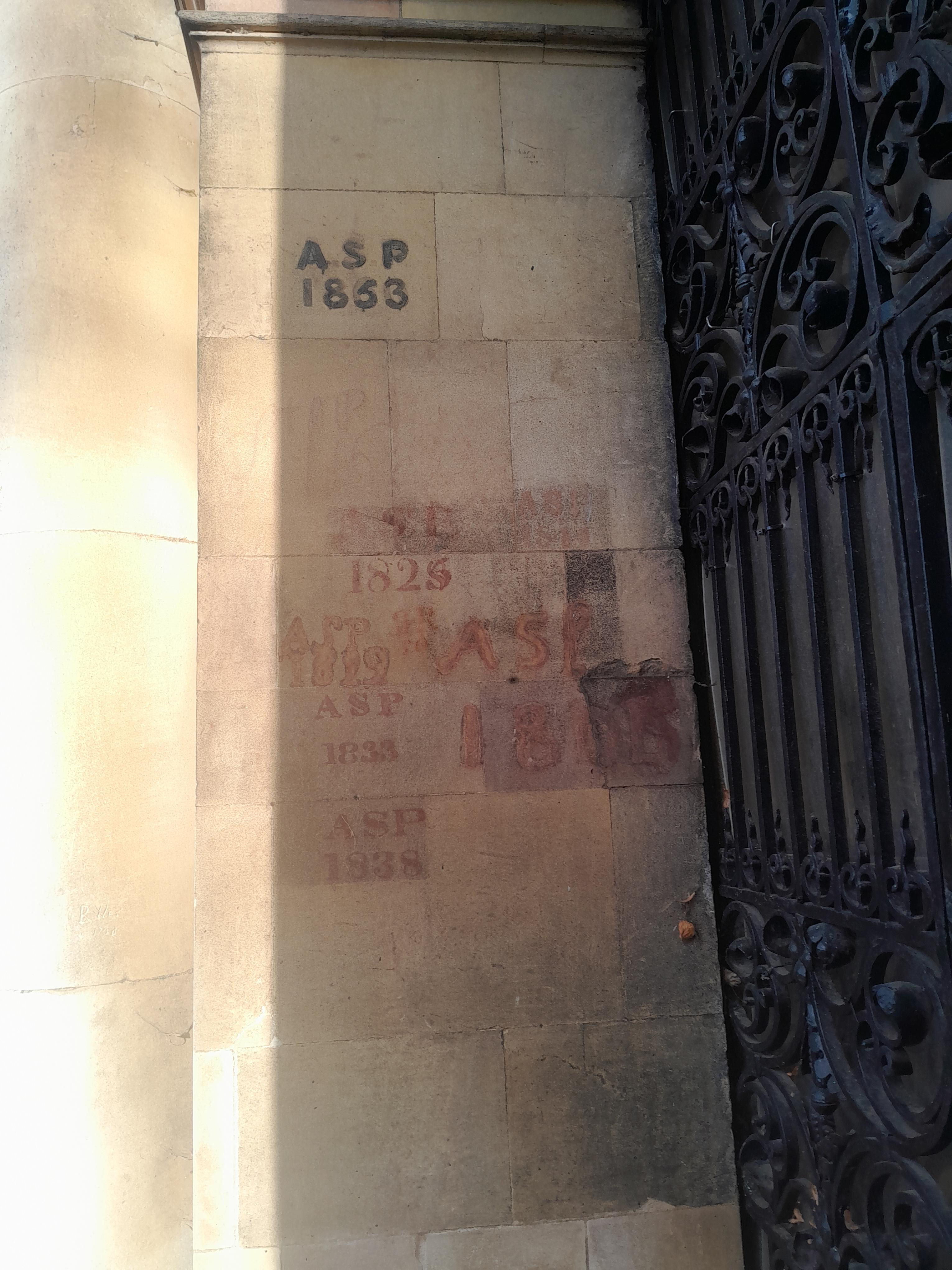
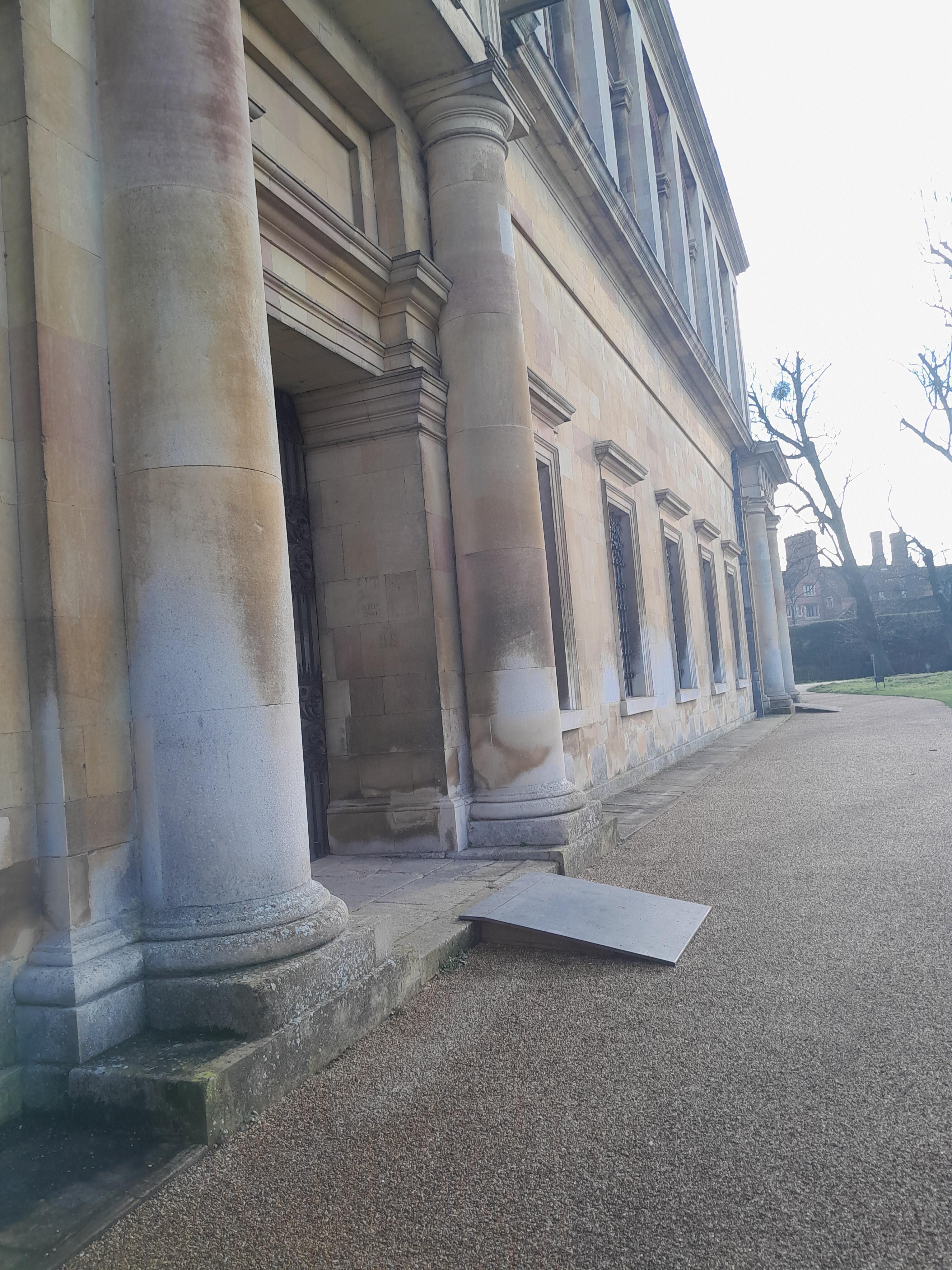
These are either side of a passage underneath the Wren Library, in the middle, on the river side. You can get there from Garret Hostel Lane, but it is on Trinity College property, and they may charge for entry. The first says "ASP" (All Saints parish) with dates 1853, 1826/8, 1829, 1833, 18??, 1838 (I think). One of the dates seem to be changed from 1826 to 1828.
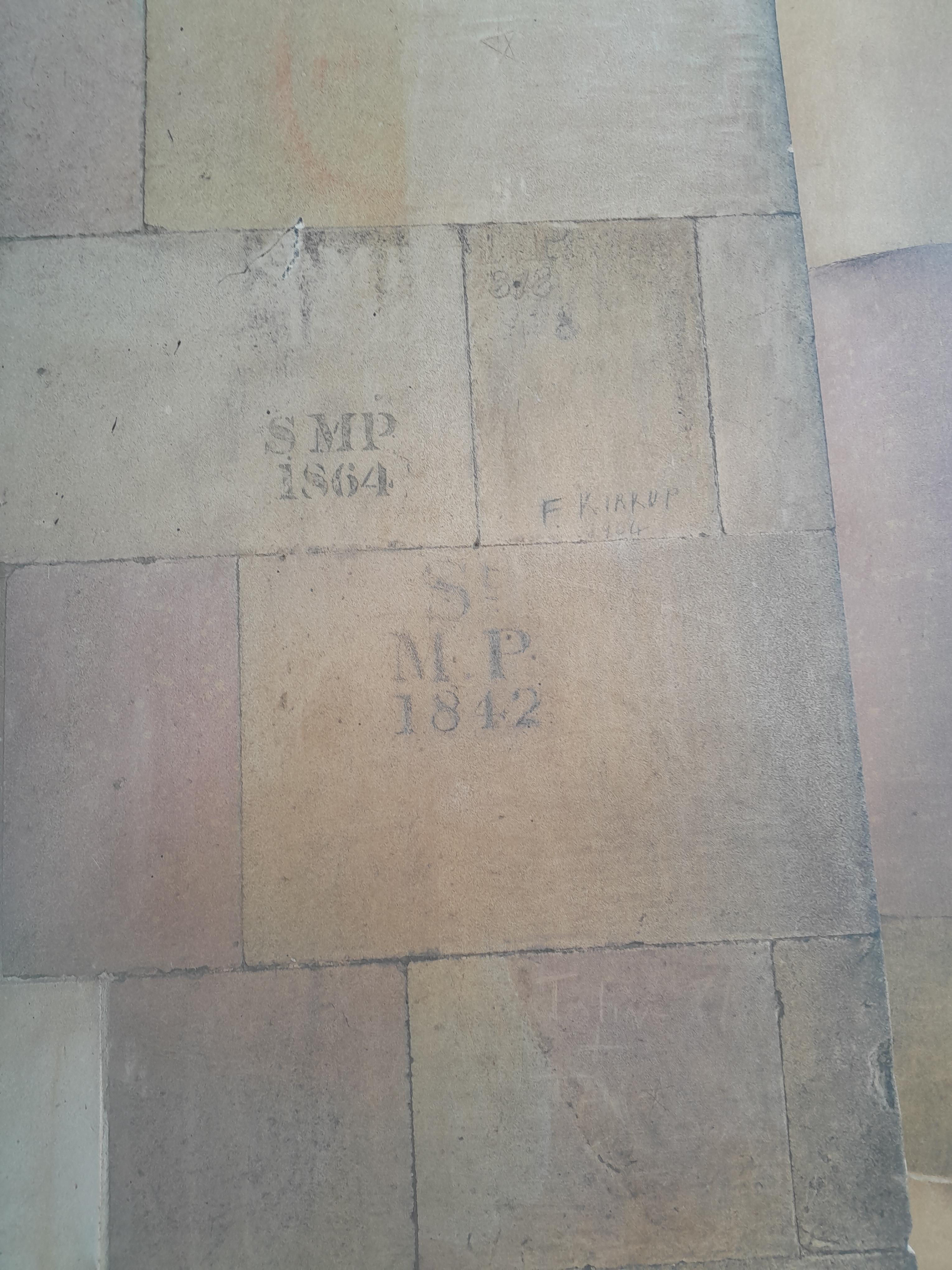
The second, facing the first, says "SMP" (St Michaels parish) with dates 1842, 1864. There may be a faint 1818 above.
The almshouses are in Kings Street, near the Midsummer Common end. There are two plaques on the wall, as below.
I noticed this when I wondered why a lamp post had a little fence round one side. At the base, it says "Century - 2022. Rotary in Cambridge".
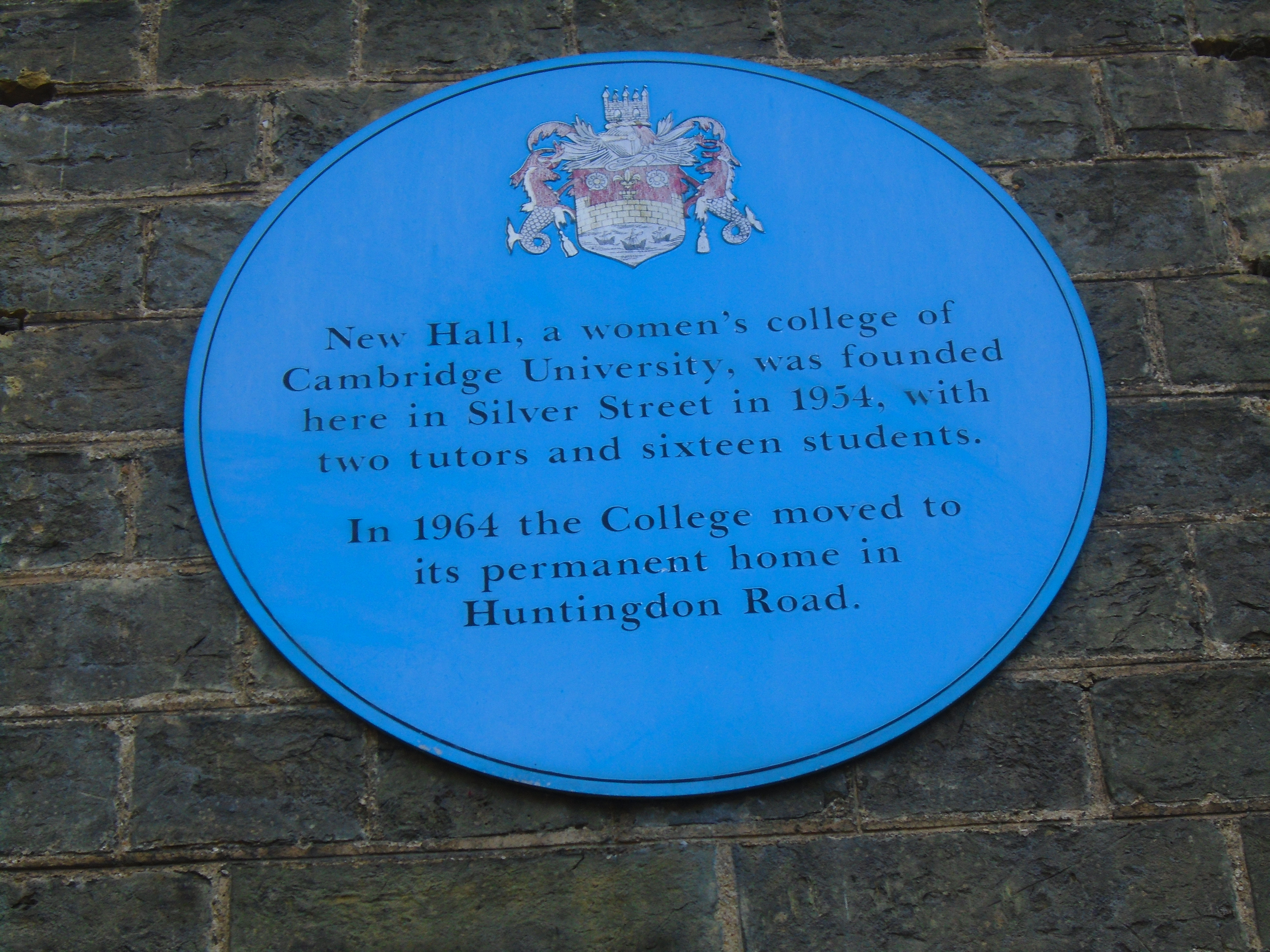
This plaque is on Silver Street, corner of Newnham Riad. It says "New Hall, a college of Cambridge University, was founded here in Silver Street, in 1954, with two tutors and sixteen students. In 1964, the college moved to its permanent home in Huntingdon Road." The middle photo shows the original house, and the third one shows the current college, now called Murray Edwards. OtherHere are some more plaques, notices and other items which don't fit the themes above.
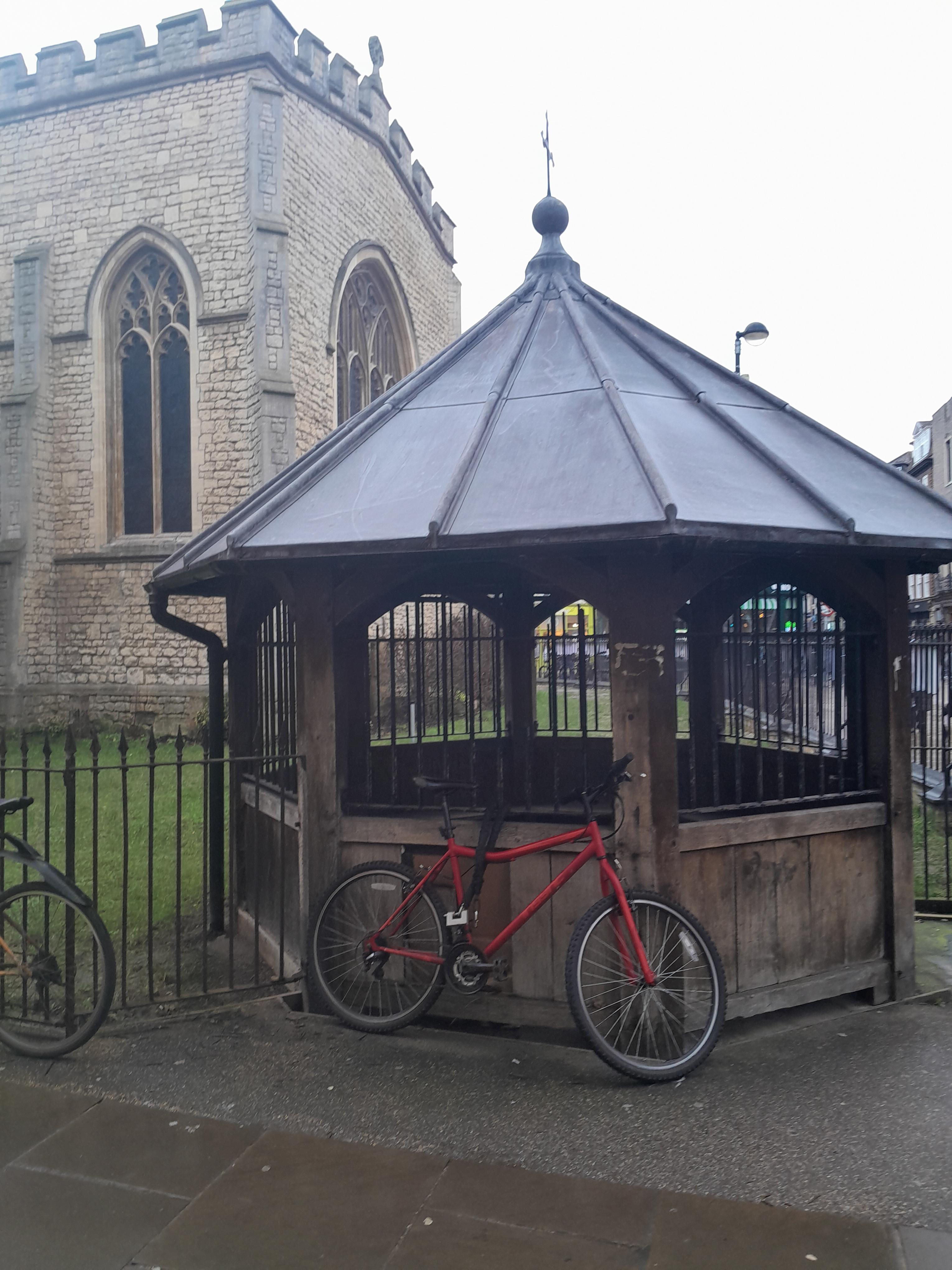
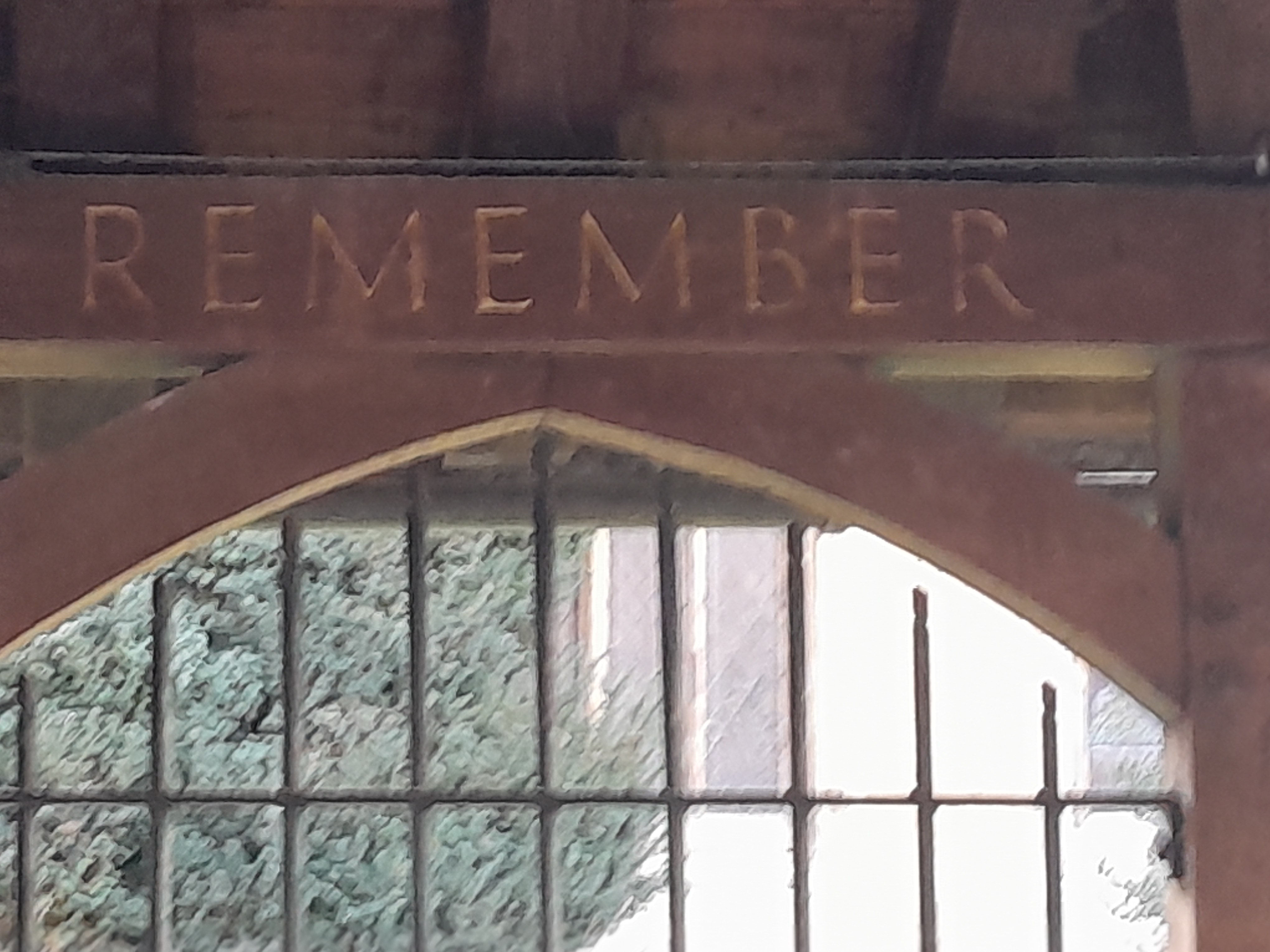
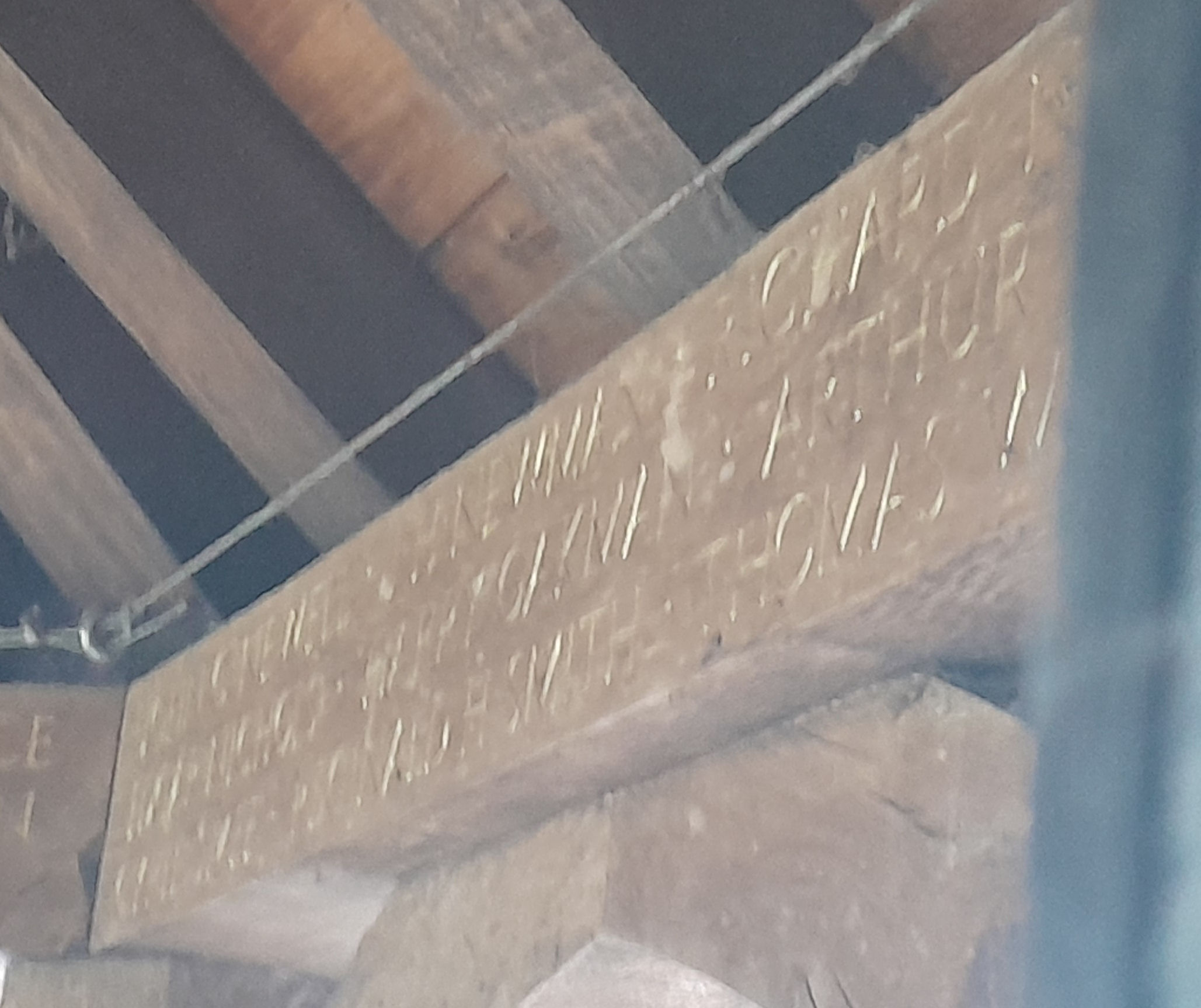
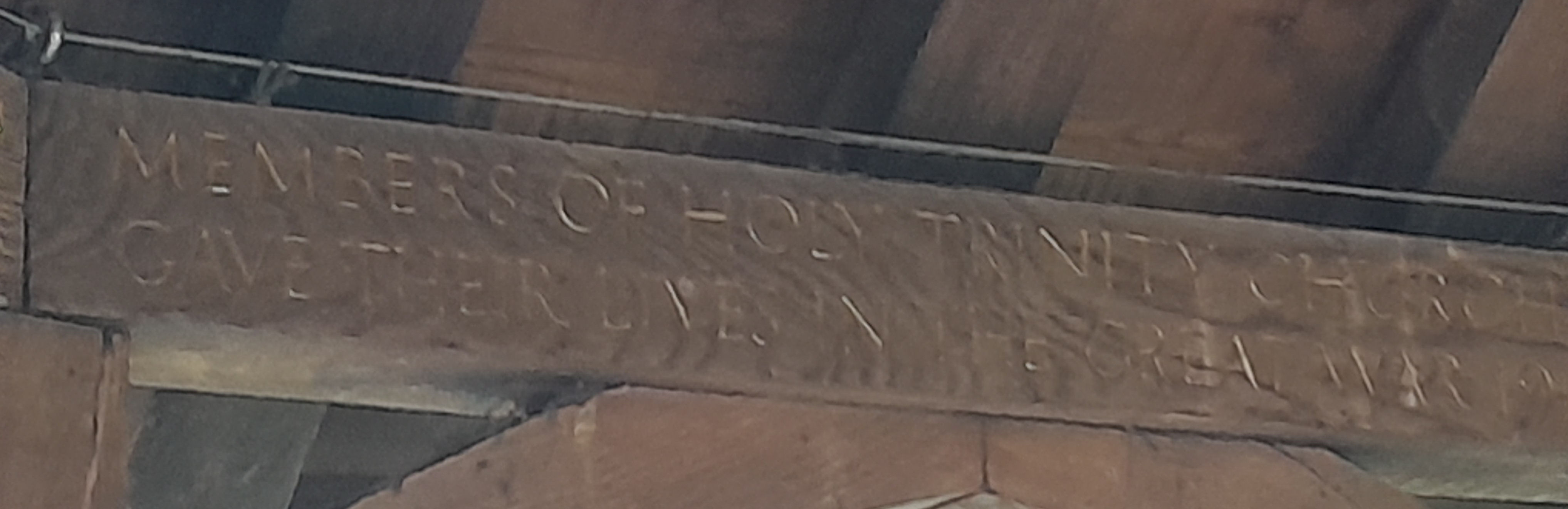
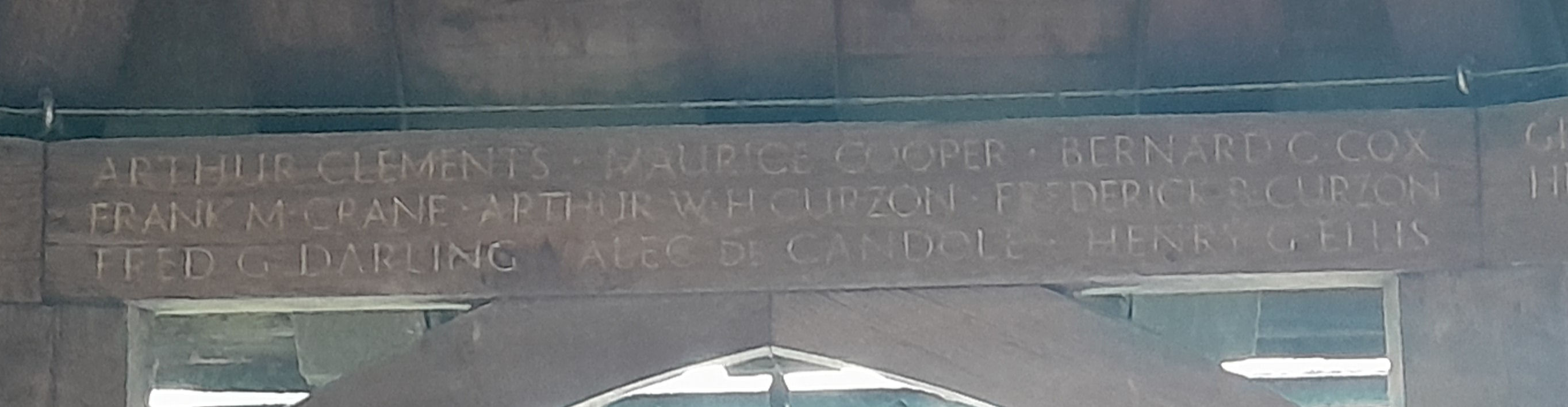
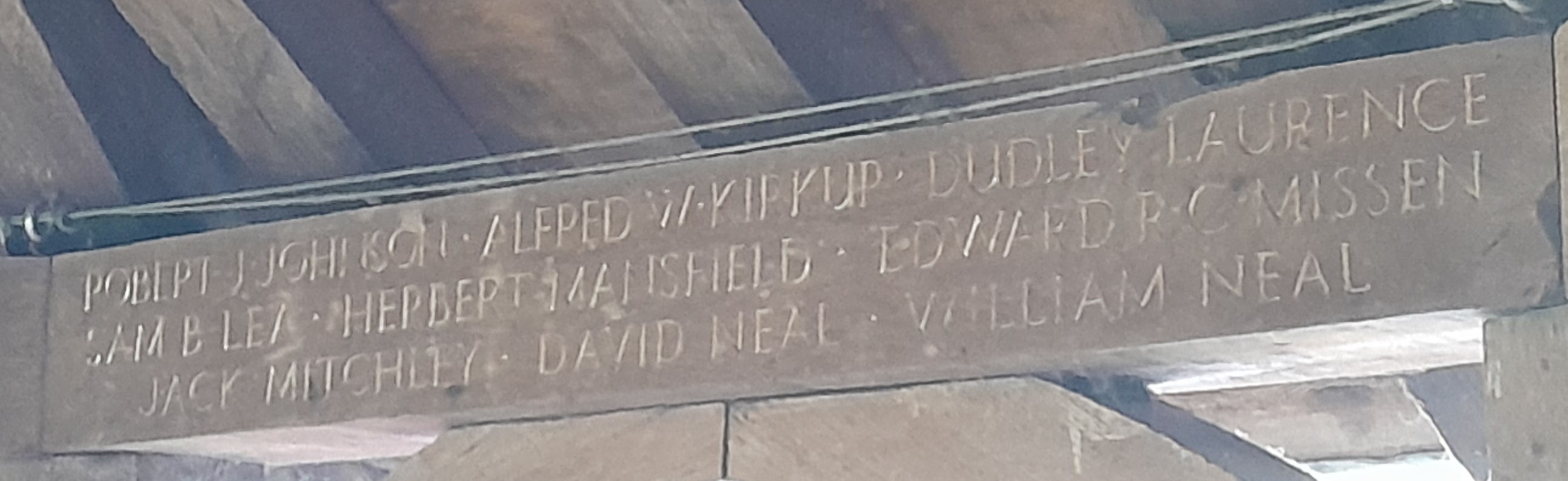
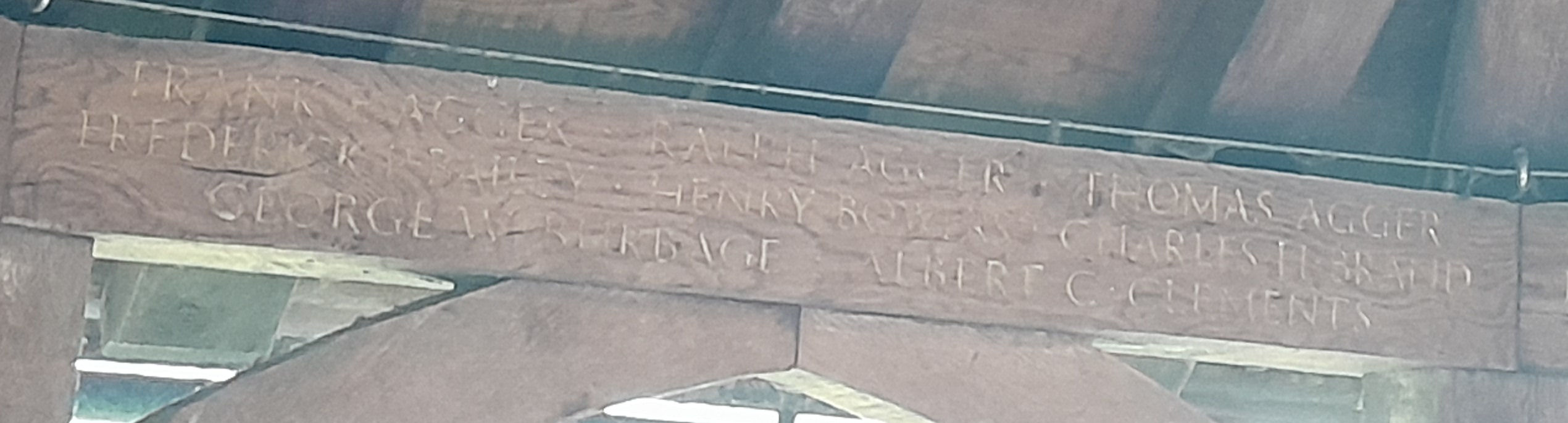
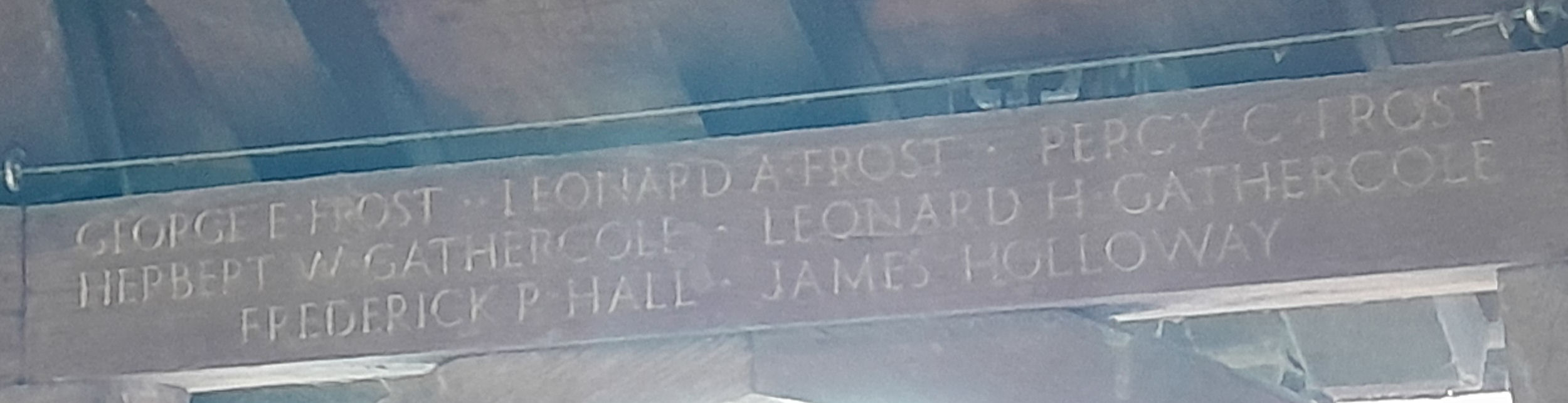
In St Andrews St, the Holy Trinity War Memorial is a timber octagonal shelter with a lead pointed roof, arched window openings and a wooden bench. It was built in 1922 and commemorates 45 members of Holy Trinity Church who died in World War I. It was restored in 2012. It is supposed to be a shelter, with seating inside, but is kept locked. That makes it hard to see the inscriptions. Click on a photo for a larger image. |
|
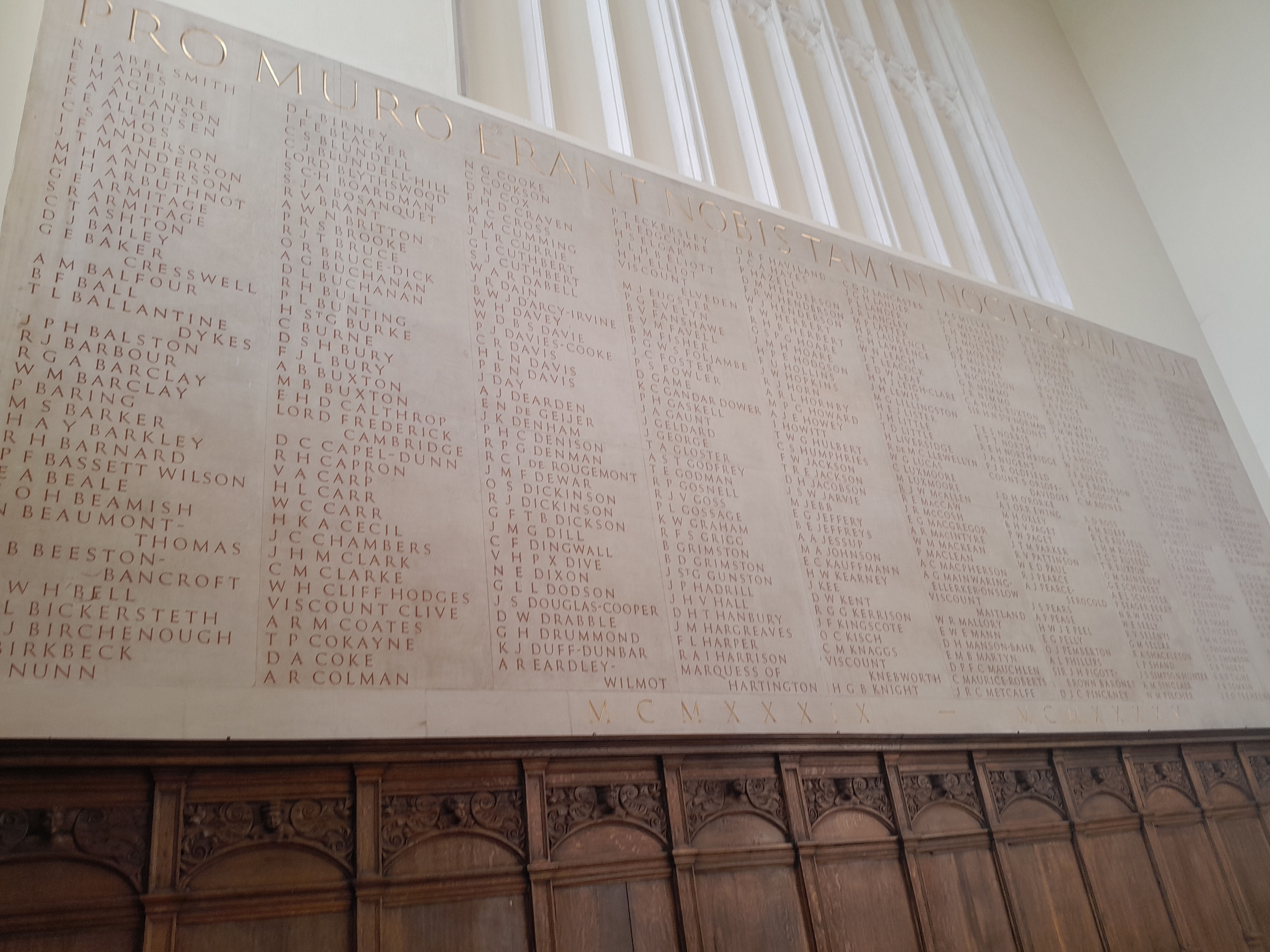
This is the Trinity College war memorial, inside Trinity Chapel. |
|

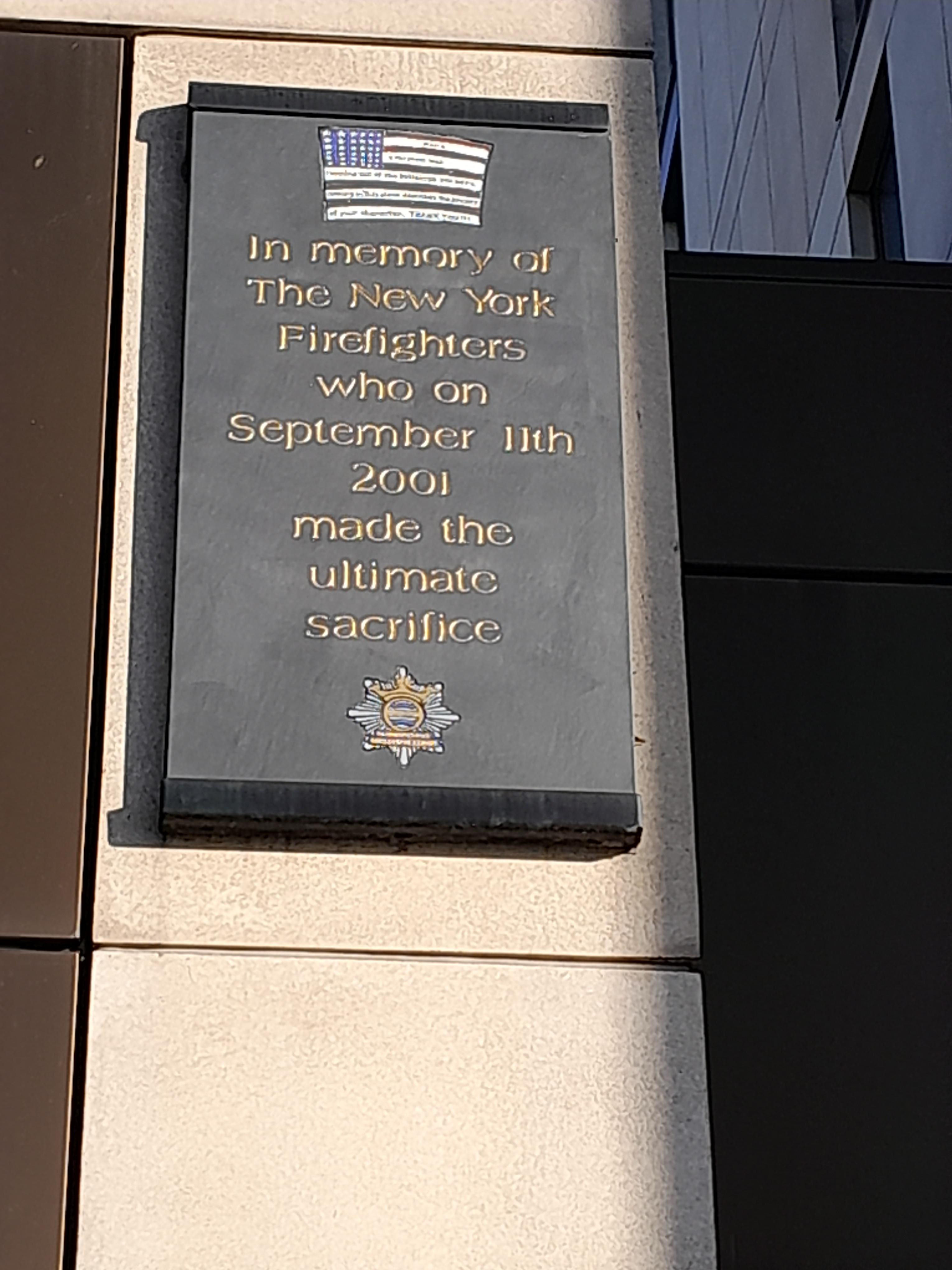
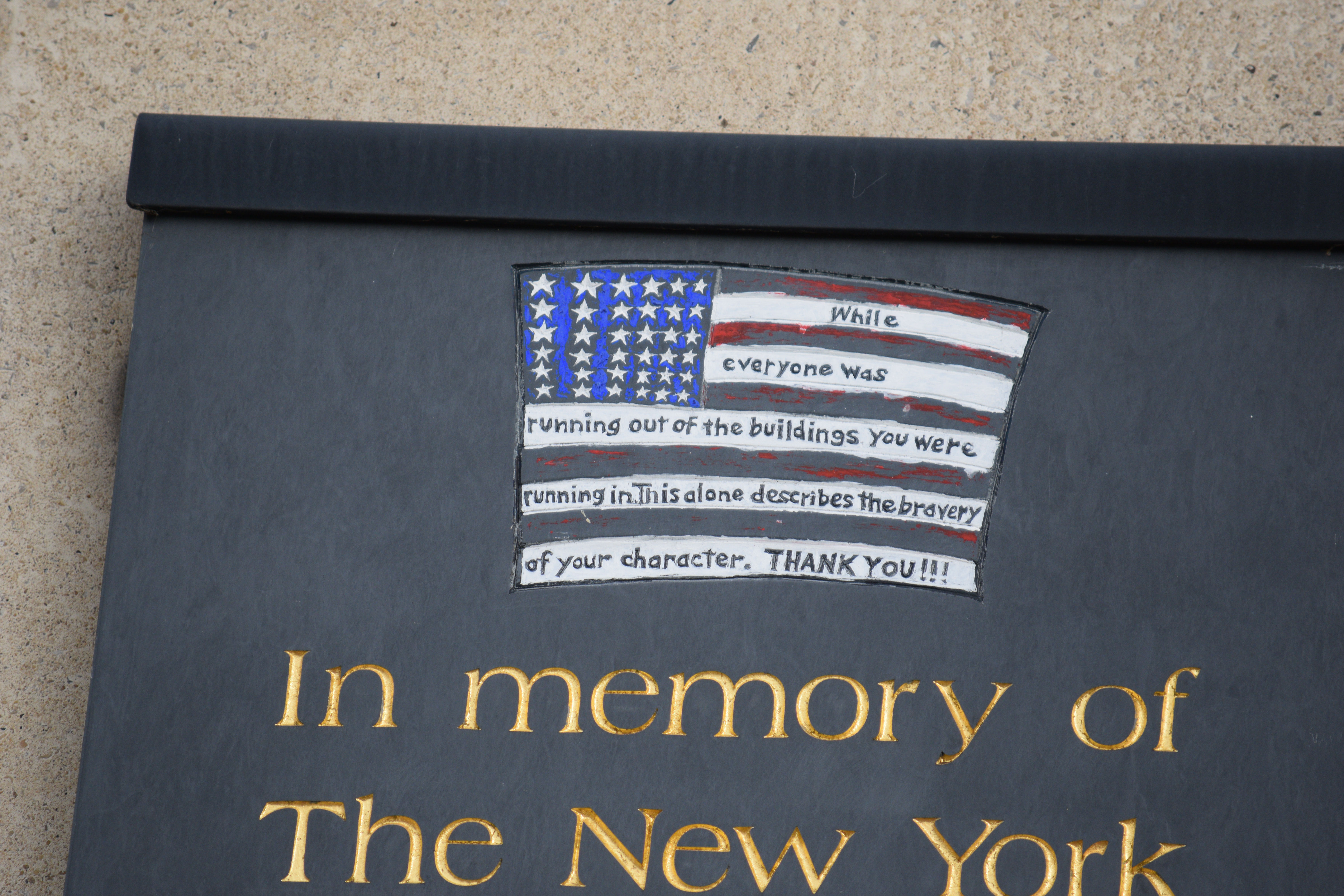
This is a memorial to the firemen who died in the 911 attack, by the Cambridgeshire fire service. It is on the fire station, on Parkers Piece. There is some writing on the representation of the US flag. It says "While everyone was running out of the buildings you were running in. This alone describes your bravery of your character. THANK YOU!!!"
On the corner of Market Street and Rose Crescent, the shop used to be a tobacconist called Bacon. There is a plaque on the wall in Rose Crescent with a light-hearted poem in praise of tobacco, mentioning Bacon. This was written by Charles Stuart Calverley (1831-1884). He came to Christs College, Cambridge after being expelled from Oxford.
|
|
Calvery's Ode To Tobacco (Written at Cambridge in 1862) A tribute to this firm Thou, who when fears attack Bidst them avaunt, and Black Care, at the horseman's back Perching, unseatest; Sweet, when the morn is grey; Sweet, when they've cleared away Lunch; and at close of day Possibly sweetest: I have a liking old For thee, though manifold Stories, I know, are told Not to thy credit; How one (or two at most) Drops make a cat a ghost, - Useless, except to roast - Doctors have said it: |
How they who use fusees All grow by slow degrees Brainless as chimpanzees, Meagre as lizards; Go mad, and beat their wives; Plunge (after shocking lives) Razors and carving-knives Into their gizzards. Confound such knavish tricks! Yet know I five or six Smokers who freely mix Still with their neighbours; Jones - (who, I'm glad to say, Asked leave of Mrs. J - ) Daily absorbs a clay After his labours. Cats may have had their goose Cooked by tobacco-juice; Still, why deny its use Thoughtfully taken? We're not as tabbies are; Smith, take a fresh cigar! Jones, the tobacco jar! Here's to thee, Bacon! |
"Black care" is an echo of the Latin poet Horace, Odes 3.1.41: post equitem sedet atra Cura (black care sits behind the horseman). A 'fusee' is a match that stays alight even in a strong wind. A 'clay' is 'a clay pipe. It is tempting to say that "Confound such knavish tricks" is an echo from the second verse of the National Anthem (1745) "Confound their politics, Frustrate their knavish tricks".
|
|
Garret Hostel bridge is the only public footbridge across the river between Magdalene Bridge and Silver Street Bridge. There is a plaque by it saying "This bridge was given in 1960 by the TRUSTED family members of Trinity Hall. It was designed by Timothy Guy MORGAN, an undergraduate of Jesus College, who died in that year." |
|
|
The passage over the bridge is called Garret Hostel Lane. There is an old piece of wall on the Trinity Hall side of the lane, sticking out slightly. There is a plaque on the side of the sticking out bit, high up, saying "Plan - shewing Trinity Hall - line of boundary - outside stable buildings" and a very simple plan underneath. There is no date, but "shewing" is a spelling suggests that it is pre-Victorian. The wall itself is listed, but there is no mention of the plaque. |
|
|
This plaque is attached to the wall of the Chophouse in Northampton Street. It says "Foundation of Edward Storey, established by will 1692, original clergy widows almshouses, built 1729" |
|
|
This plaque is attached to a house in Kings Parade, near Great St Marys. It says "Edward Fitzgerald 1809-1883". He was the translator of the Rubaiyat of Omar Khayyam. |

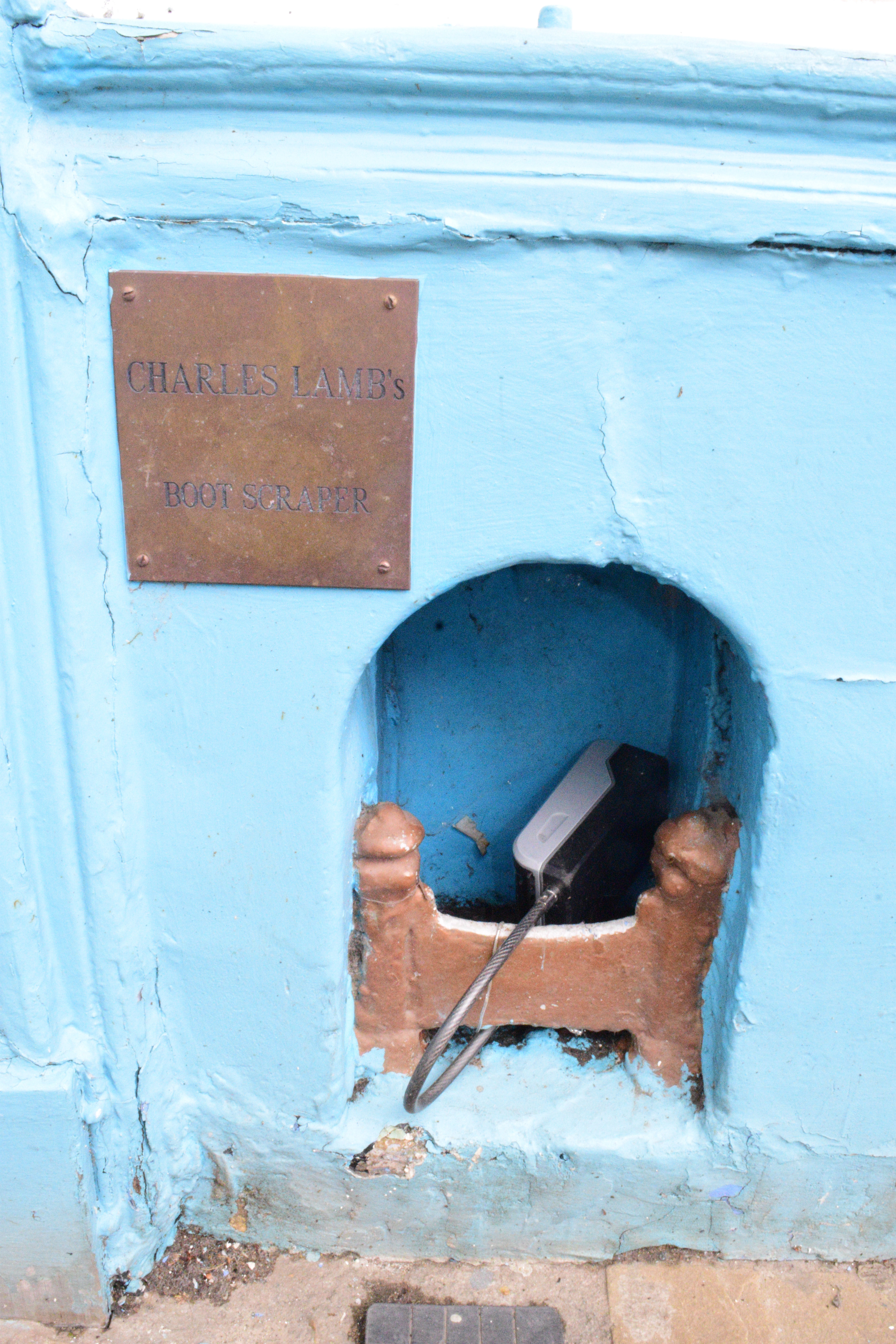
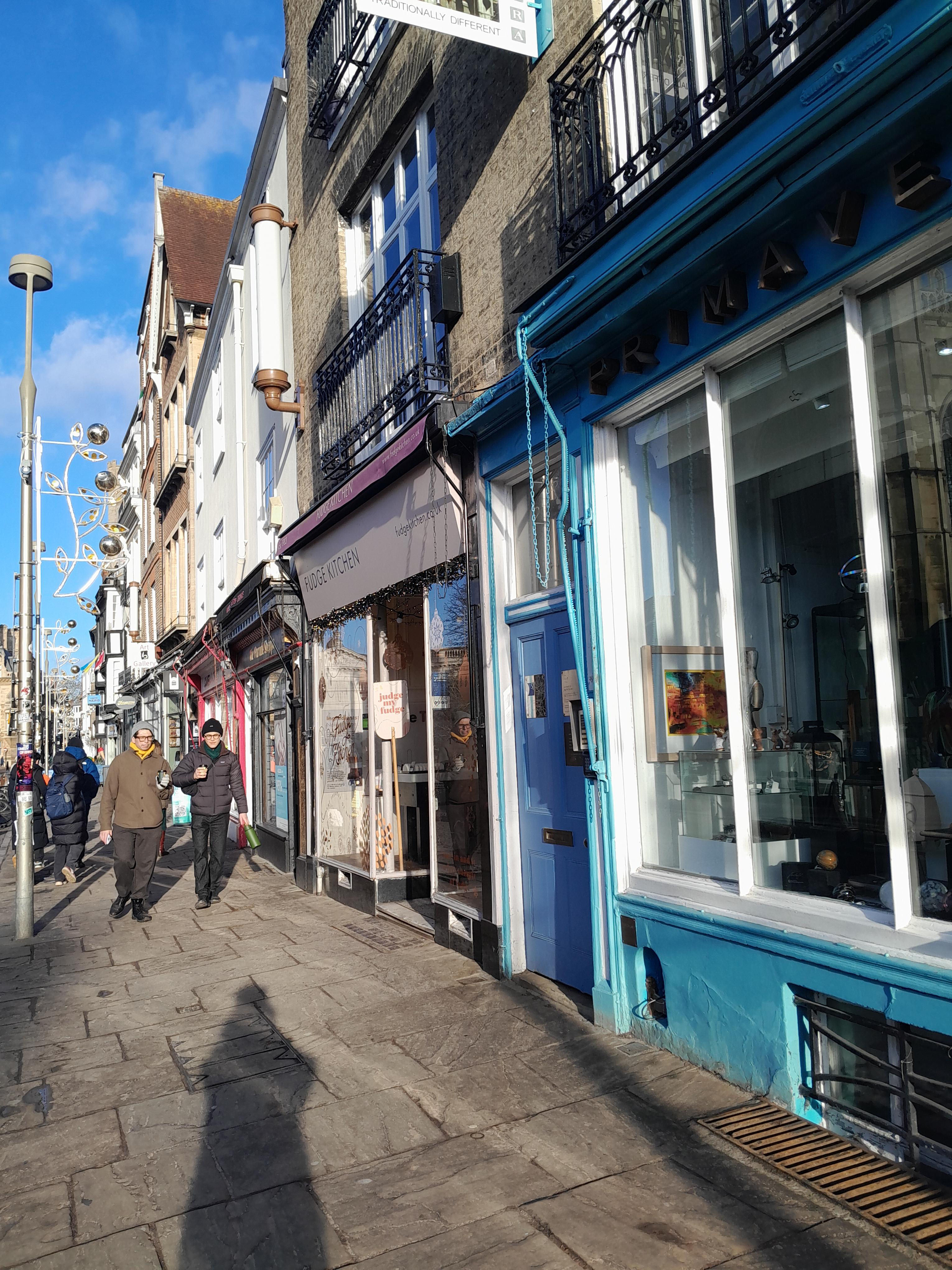
This plaque is attached to 11 Kings Parade. It says "Charles Lamb lodged here August 1819". Underneath, there is a boot scraper labelled "Charles Lamb's boot scraper". He was an English essayist, poet, and antiquarian, best known for his Essays of Elia and for the children's book Tales from Shakespeare, co-authored with his sister, Mary Lamb.
|
|
This plaque is on Newmarket Road, near St Andrew's the Lesser church. It says "Casey's Yard. Between 1963 and 2009 here in this yard, Donn Casey invented many objects useful to solving small and world problems. Most notably the FILCHIE clip and its instruments. To this day it is the clip most used and continues to give choice and independence in individual personal lives. DONN CASEY Australia 1931-2009 UK" |
|
|
This plaque is Park Terrace, behind the Univesity Arms hotel. It is part of a quote by Walter Mildmay, who founded Emmanuel College in 1584. Queen Elizabeth I said "Sir Walter, I hear you have erected a puritan foundation". Mildmay replied: "No, madam; far be it from me to countenance anything contrary to your established laws; but I have set an acorn, which when it becomes an oak, God alone knows what will be the fruit thereof". |
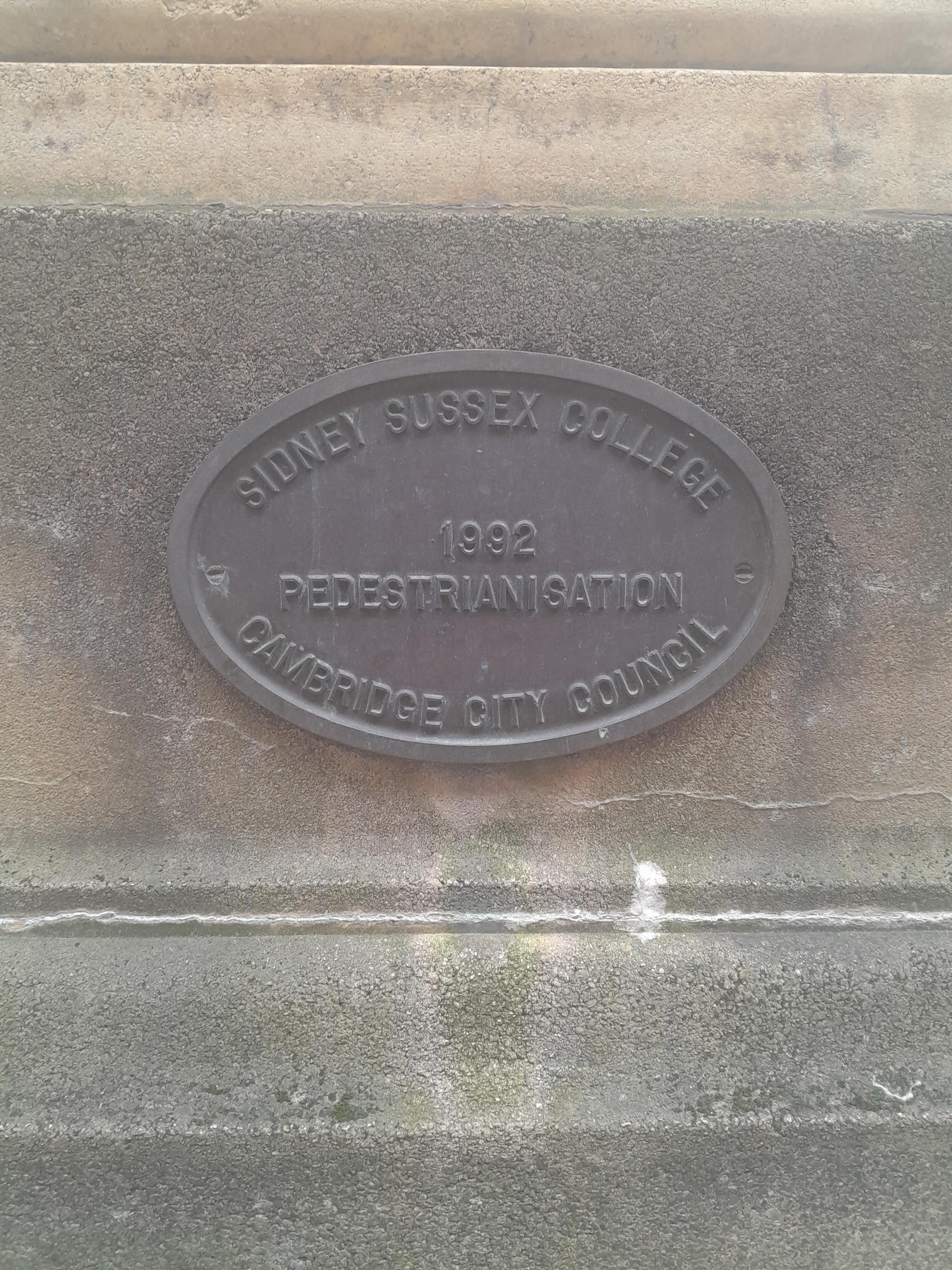
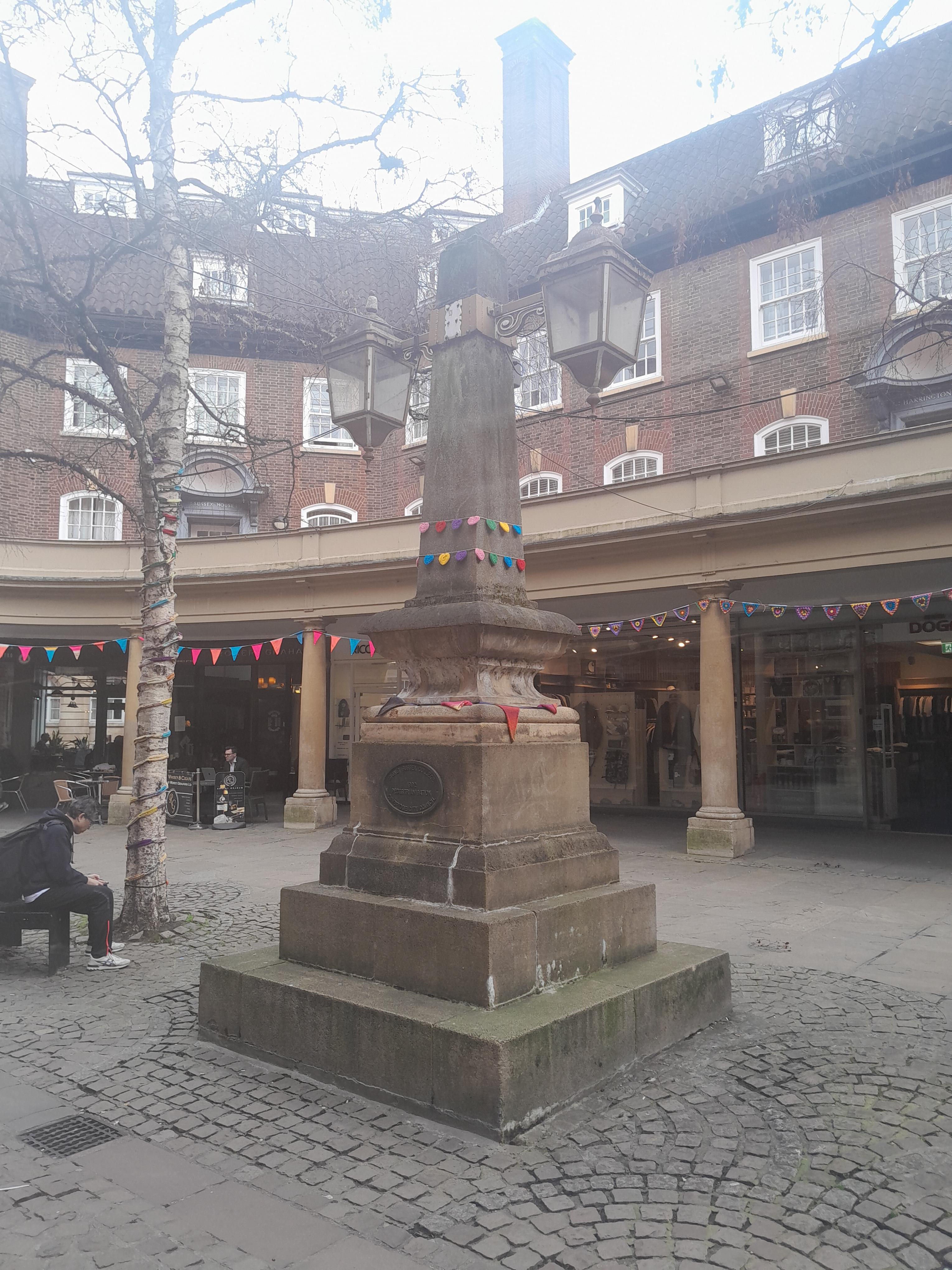
There is a grand lamp stand in the middle of Sussex Street, looking like an obelisk. Sidney Sussex and Cambridge City Council decided to fasten this plaque on it saying "Sidney Sussex College - 1992 - Pedestrianisation - Cambridge City Council".
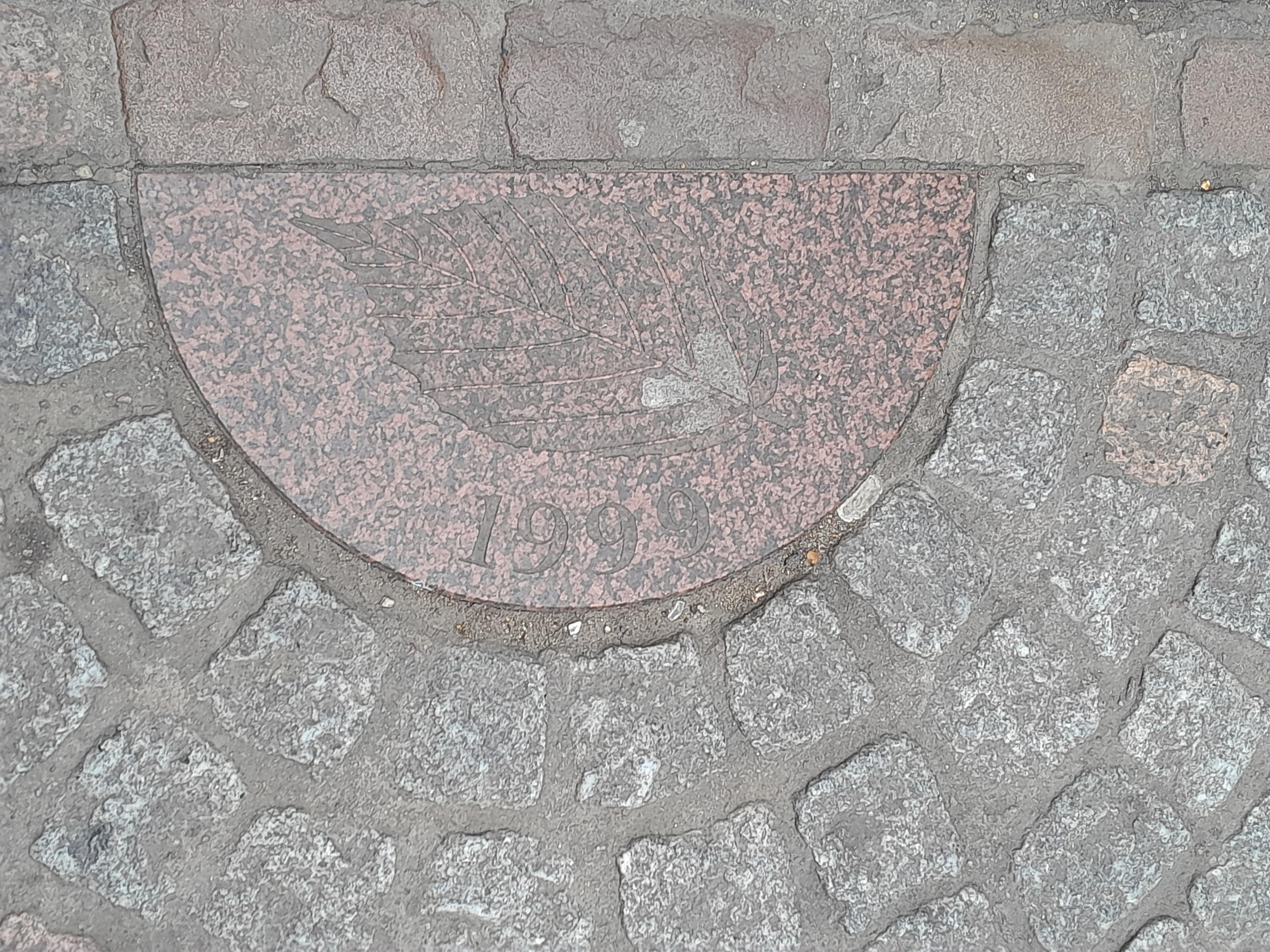
Another street improvement scheme happened in Green Street, in 1999, which included cobbles to give it a more historic look. THis plaque is at the end of Green Street. Not that there are any trees or plants in Green Street. But I suppose that leaves are green. (The street was actually named after Mr Green.)
There are some attractive 3D maps in Cambridge. These are not really plaques or notices, but they do use writing - braille. Since the maps are 3D, they can be felt as well as looked at, so they can be used by the blind. Two of them are on Kings Parade, outside Great St Marys church. The other one is near Queens Road, on Queens Green, round the back of Queens college. They are described on the Public Art page here and here.
There is more about him here.


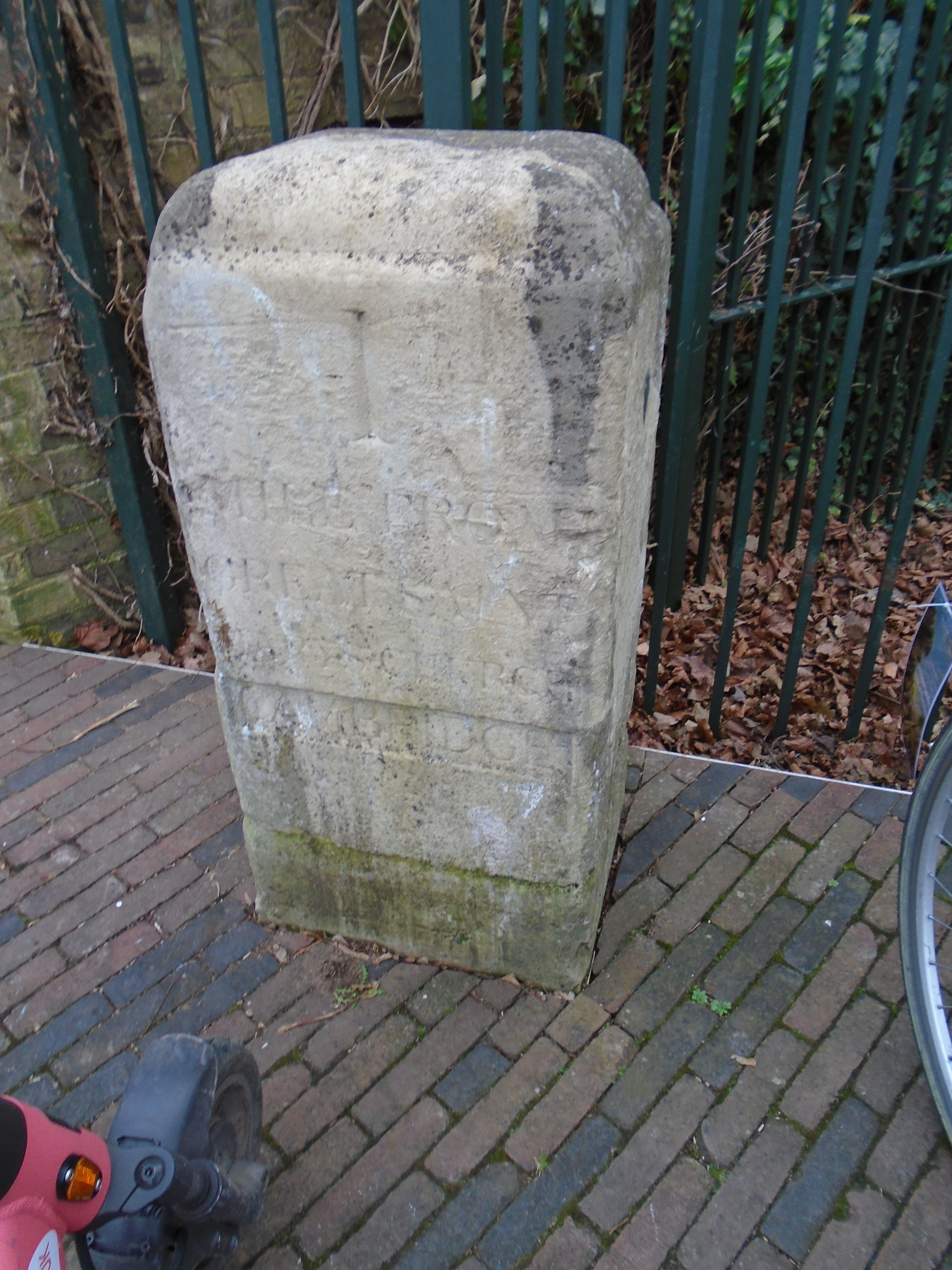
On the wall of Great St Marys church, there is this plaque, which says "This disk marks the datum point from which in 1725 William Warren, Fellow of Trinity Hall, began to measure the one mile points along the roads from Cambridge, at which were set up the first true milestones in Britain since Roman times."
Here is one of those milestones (centre). It is on Trumpington Road, at the end of Brooklands Avenue. It says "I mile to Great Saint Maries church Cambridge AD MDCCXXVIII". The year is 1728. This milestone is listed, and the listing says that William Warren set up the milestones "under the will of Dr William Mowse Master of Trinity Hall 1552-3. It is a rectangular stone with inset rounded head and has the arms of Trinity Hall impaling Mowse and a pointing hand."
Here is another (right). It is listed grade II. Erected in 1731 by Dr William Warren. Stone block inscribed with "1 mile from Great St Mary's Church Cambridge".
The name "Cambridge" is recessed on both stones. I wonder if it was removed during WWII and recut afterwards? I know that signposts giving locations were removed, in case the Germans landed and needed directions. But a milestone seems a bit extreme!
|
|
On the wall of Kettles Yard new building, on Castle Street, there is this notice about an old turnpike road. It used to be high up the wall, but is now at head height (and has been cleaned). A turnpike is a road for which a driver pays a toll or a fee for use. The content of the notice are given to the right (in case you can't read it from the photo). There are 8 furlongs to a mile, so the distance is 23.34 kilometres. |
GODMANCHESTER |
|
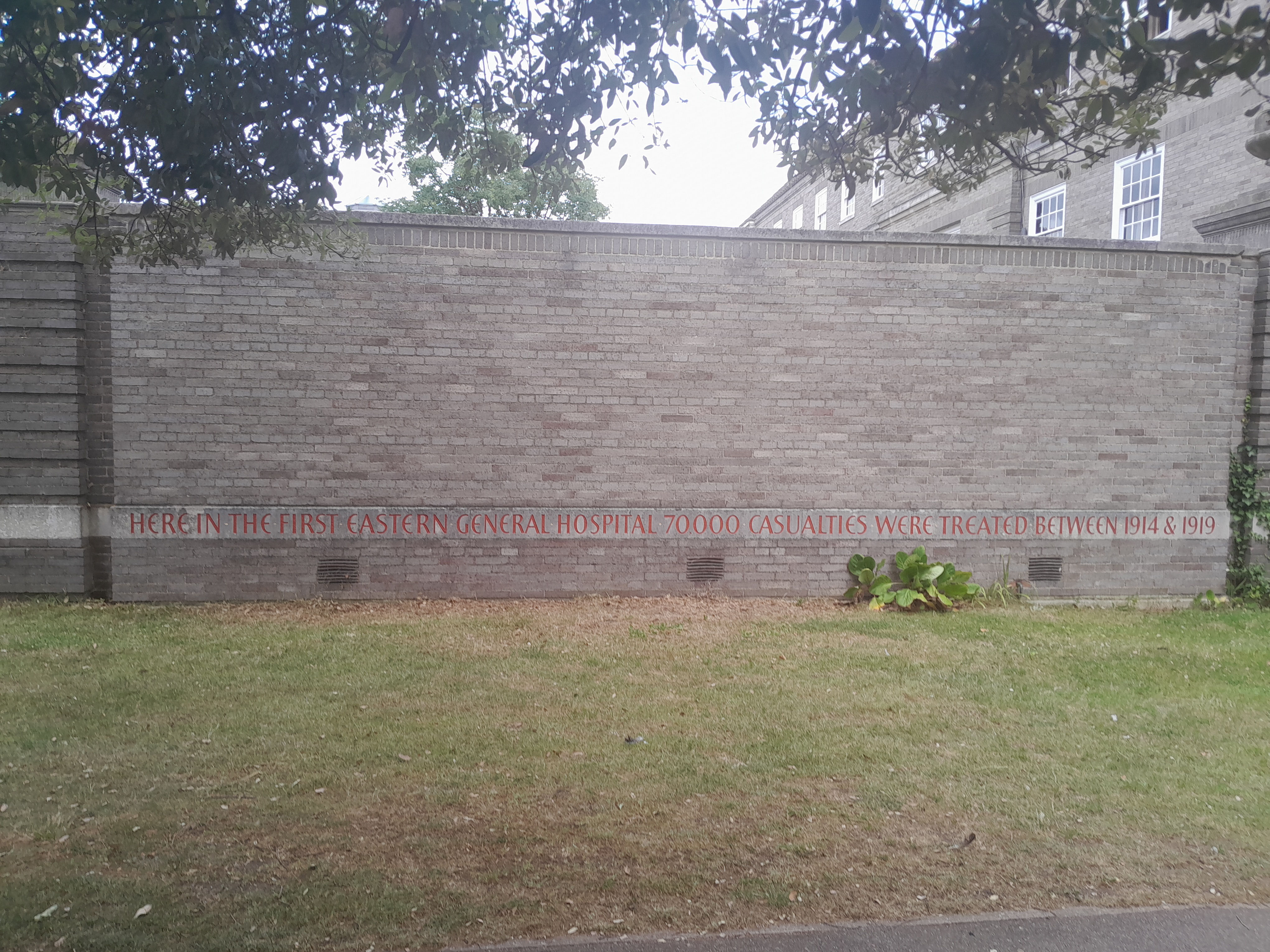
| This notice is on the wall of a Clare building, facing the entraance of the University Library, off Burrels Walk.""Here in the first Eastern general hospital 70000 casualties were treated between 1914 & 1919" |
|
|
King Street is famous for its pubs, and notorious for the King Street Run, a pub crawl where people try to drink in every pub in the street. Luckily there are less pubs than there used to be. The Champion of the Thames is one of these pubs. It has this sign on the corner, possibly directed towards the King Street Run. It says "This HOUSE is dedicated towards those splendid FELLOWS who make DRINKING a pleasure, who reach CONTENTMENT before CAPACITY and who, whatever the DRINK, can take it, hold it, enjoy it, and STILL remain GENTLEMEN" Kings Street is not near Kings Parade by the way. Cambridge enjoys having similar street names for roads in different parts of the city! |
 |
This pub is called the Petersfield. It is situated on the corner of Sturton Street and Hooper Street. It has a good (if bogus) coat of arms, showing a punt, a bicycle, chimneys and something else. I thought it was a beehive, referring to the near-by shopping centre, called the Beehive site after the Co-op (which isn't there any more!). But perhaps it is a fermenting vessel, for making beer. Or a smelter, after the Ironworks (which is also not there...) The Latin motto is "Comede gaudeo bibe" which translates as "Eat, drink, be glad!" |
 |
This pub is called the Kingston. It is situated in Kingston Street. The sign outside says "Briritsh cask ales and World Beers. Curmudgeon Retres since 1879.Non Facile Est, which means "It's not easy." |
|
|
This Latin and Greek sign is in Portugal Street. The Latin says "DUA ROTAE HI RELICTAE PERIMENTUR". This means "Two wheels left here will be destroyed" - that is - "Don't leave your bikes here!". Presumably the Greek means the same. |

|
Nearby, on Quayside, there is a wine merchant with a motto of "Vini, Vidi, Bibi". This means "I came, I saw, I drank". It comes from Julius Caesar saying "Veni, Vidi, Vici", or "I came, I saw, I conquered". |
|
|
This date is part of the pargetting (plaster work) on an old building, 10 Bridge St, listed grade II. It is a C17 or C18 building, so it's a little startling to find a date of 1976. But this shows (very honourably) when the building was renovated. |


These benches are at the highest point of Mill Road bridge, in memory of two well-known local people. One says "Allan Brigham 1951-2020 - He loved Mill Road and Mill Road loved him". The other says "Suzy Oakes 1950-2011 - Champion of Mill Road". Also marked on that bench is "Be the change." One of the Dinky Doors is between the benches.


These benches are near the Guildhall, in Peas Hill. The notice says "The timber used for this seating area has been slvaged from the Rugeley Power Station prior to its demolition between 2019 and 2021. Following a brief stay in Margate, it was transported to Cambridge in 2022 and was locally crafted into these benches. - Cambridge Garden of Resilience".


This lettering - S P with crossed keys between - is on a wall bordering the northern end of Coe Fen, close to the Graduate Hotel (foermerly the Garden House). The crossed keys is a symbol of St Peter, so presumably that is what S P stands for. Peterhouse is close by, but its coat of arms is different.

This plaque is on Fitzwilliam House, opposite the Fitzwilliam museum. It is above the right-most ground floor window. It says "1727 IH X" and a catherine wheel. It was originally thought to be something to do with St Catherine's College, but there is an alternative explanation. The house was owned by John Halstead (hence the "I H"). He was a brewer. Brewers were accustomed to masrk barrels of the correct size with X, and from the fourteenth century, some breweries were named The Catherine Wheel.
The railway came to Cambridge in 1845. The station has shields decorating its front, along the top. They are given below, in order. These are from the coats of arms of the colleges of Cambridge University. They are mostly the undergraduate colleges. One shield is very overgrown, but it looks like Robinson College. There are also Wolfson College, Clare Hall and Darwin College, which are post-graduate colleges. Christs College and St Johns College share the same coat of arms as they were both founded by Lady Margaret Beaufort. There is also the shields of Cambridge University and the City of Cambridge, with four shields between them of local worthies. Newnham College is hard to find, and originally I thought it was missing, but Paul Read kindly sent me the photo (below) and explained it is "very difficult to find as it is above a canopy on the platform side on the south side of the building." Homerton College is also missing, but that used to train teachers, and has only recently become a general undergraduate college. The other missing colleges are Hughes Hall, St Edmund's College and Lucy Cavendish College, which take post-graduates and mature undergraduates. Click here for more information on Cambridge colleges.
On the northern building (on the left, facing the buildings):
Robinson College, Wolfson College, New Hall, Clare Hall, Darwin College, Churchill College, Selwyn College
On the north side of the main building:
Magdalene College, Christs College / St Johns College
On the front of the main building (1845):
St Catharines College, Kings College, Trinity Hall, Pembroke College, Peterhouse, City of Cambridge,
7th Duke of Leeds (High Steward of Cambridge ?-?),
4th Earl of Hardwicke (Lord Lieutenant of Cambridgeshire 1834-1873),
3rd Duke of Northumberland (Chancellor of Cambridge University 1840-1847),
1st Baron Lyndhust (High Steward of Cambridge University 1840-1863),
Cambridge University, Clare College, Gonville and Caius College, Corpus Christi College, Queens College, Jesus College
On the south side of the main building:
Sidney Sussex College
On the southern building (on the right, facing the buildings):
Trinity College, Emmanuel College, Downing College, Fitzwilliam College, Girton College
For Newnham, see above.
 Robinson College |
 Wolfson College |
 New Hall (now Murray Edwards) |
 Clare Hall |
 Darwin College |
 Churchill College |
 Selwyn College |
 Magdalene College |
 Christs College / St Johns College |
 St Catharines College |
 Kings College |
 Trinity Hall |
 Pembroke College |
 Peterhouse |
 City of Cambridge |
 7th Duke of Leeds High Steward of Cambridge ?-? |
 4th Earl of Hardwicke Lord Lieutenant of Cambridgeshire 1834-1873 |
 3rd Duke of Northumberland Chancellor of Cambridge University 1840-1847 |
 1st Baron Lyndhust High Steward of Cambridge University 1840-1863 |
 Cambridge University |
 Clare College |
 Gonville and Caius College |
 Corpus Christi College |
 Queens College |
 Jesus College |
 Sidney Sussex College |
 Trinity College |
 Emmanuel College |
 Downing College |
 Fitzwilliam College |
 Girton College |
 Newnham College |
 Cambridge rail station showing some of the shields |
© Jo Edkins 2010 - Return to Walks index