
Click here for other foreign bobbin lacemaking.
Click here for English bobbin Lace.
I don't know much about German lace, but what I do know is on this page. Please contact me to point out mistakes!
Language: German

Bobbin lacemakers near Schlettau in 1936
German lacemaking terms:
Spitzenklöpplerin: lacemaker (see painting by Hendrick Goltzius)
Klöppelkissen: bobbin pillow (see painting by Gabriel Metsu)
Another painting of a lacemaker by Gabriel Metsu is called the Woman with the Bobbin Pillow. He is Dutch, but I found the painting's title in German: Die Dame mit dem Klöppelkissen, so Klöppelkissen means a bobbin pillow. Click here for the painting
Halbschlag: half stitch
Leinnenschlag: cloth stitch (or linen stitch)
Ganzschlag: cloth stitch and twist. It translates as "whole stitch". Whole stitch is often used in English lace to mean cloth stitch (but sometimes it does means cloth stitch and twist!)
Schlagwechseldrehungen: the twists between the different stitches (German)
Vollwerk: solid areas or clothwork, used for both half stitch and cloth stitch.
Droschel: same as Brussels ground. This is a well-known ground, but I am not sure of the language. It could be a Flemish word rather than a German one. It seems to mean 'thrush'.
The following came from a Facebook discussion about german lace:
Schwalm lace, or "Schwalmer Spitze," originates from the Schwalm region in Hesse. This style of lace is characterized by its delicate and airy appearance, often featuring floral and nature-inspired motifs. Schwalm lace is traditionally created using needle lace techniques, with the lace stitched onto a fabric background.
The Schwalm region has a rich tradition of lacemaking, and the lace produced here is highly regarded for its intricate craftsmanship and attention to detail. Schwalm lace is often used to adorn garments, table linens, and home decor items, adding a touch of elegance and sophistication.
The Germans call tatting lace Occhi-Spitze, Frivolite or Schiffchenspitze.

Someone showed me a photo of a spider called a German spider (see above), and we had a go looking at the photo and trying to work out how to do it. Click here for the result, but I don't know whether it is right, or indeed if the spider is German!
Taken from this website (with some additions from elsewhere).
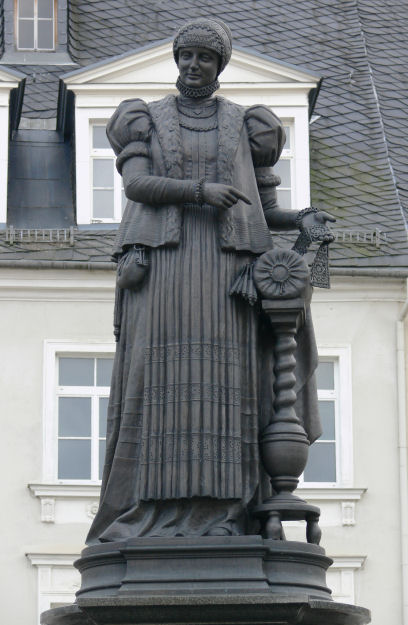
According to legend, bobbin lacemaking came to the German Erzgebirge in around 1560 because a refugee from Brabant found a room in the house of the family Uthmann in Annaberg. She is said to have had her lace pillow with her and to have taught Barbara Uthmann how to make bobbin lace. Barbara Uthmann is then said to have introduced bobbin lacemaking into the Erzgebirge and invented the bolster-shaped lace pillow which is typically used there. She found markets for the lace and became the employer of 900 lacemakers. She had recognized early on that lacemaking could be an important source of income for miners' families. There is some dispute as to whether the "lacemakers" made bobbin lace or braids.
The statue (see above) was set up in Annaberg, in 1885, to honour Barbara Uthmann.
For a time, lacemaking was a very important industry in the Erzgebirge. It has been estimated that, in about 1700, 10,000 persons made lace there; in 1785 it was 15,000. Later, and mostly because of poverty, lace was also made on a large scale in other regions of Germany: e.g. in the Harz Mountains, in Plon, Liebenau near Nienburg/Weser, Lugde near Lippe, on the Schwabische Alb, in Abenberg near Nuremberg.
© Jo Edkins 2017 - return to lace index