This headside is taken from a photo of some Sri Lankan lace - see pattern 37. I do not know if it is specifically Sri Lankan, but I have named it from where I found it. The rest of the pattern is Torchon, but this headside is closer to plaited lace such as English Midland.

Sri Lanka headside
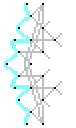
Pattern representation of a Sri Lankan headside
I am not sure where this headside begins or ends! It is next to a spider, which I am sure is not part of the headside.
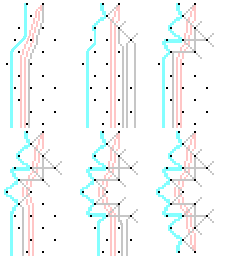
This headside is a mixture of twisted pairs and twisted plaits. This diagram avoids the complexities of the individual stitches by showing the twisted pairs as thin lines (grey) and the plaits as thick lines (blue). Where one pair crosses another, you should work it in cloth stitch and twist or half stitch, pin, half stitch. When a plait crosses a pair, work it as a 2 pair + 1 pair join.
|
|
Working: This is quite a complicated headside, and I am not going to describe every stitch, or even every row. The main components of the headside are a worker pair, two passive pairs (red), and a plait at the edge (blue), which also behaves like a passive. The worker pair goes back and forth. When it meets the passives (red), the stitch is cloth stitch and twist, as there is no pin. When it meets a pair coming in from the lace, the stitch is half stitch, pin, half stitch as there is a pin. (Two half stitches is the same as cloth stitch and twist, so these are essentially the same stitch except one has a pin in the middle.) When the worker pair meets the plait, there is a 2 pair + 1 pair join. The plait must be worked between the pins.
The directions of all pairs or the plait are marked on the pattern, and this includes which pair gets picked up where, and which gets discarded.
Not, perhaps, a headside for beginners unless you can figure out what's going on!
© Jo Edkins 2016 - return to lace index