Optical Illusions
What are optical illusions?
Literal optical illusions
Physiological illusions
Cognitive illusions
- Distorting illusions
- Ambiguous illusions
- Paradox or impossible illusions
- Fiction illusion
More paintings by Guiseppe Arcimboldo
Other illusions
Examples of optical illusions webpage
handout
Are optical illusions patterns? They are pictures which confuse our brain in some way. Our brains are pattern spotters. We see patterns, and interprete them to be something that we have met before. With optical illusions, our brain gets it wrong!
We have already met optical illusions. A Celtic knot is not really strands going over and under each other. They merely look as if they are.
There are different groups of optical illusions:
These create images that are different from the objects that make them. Paintings that do this are called trompe l'oeil (fool the eye).
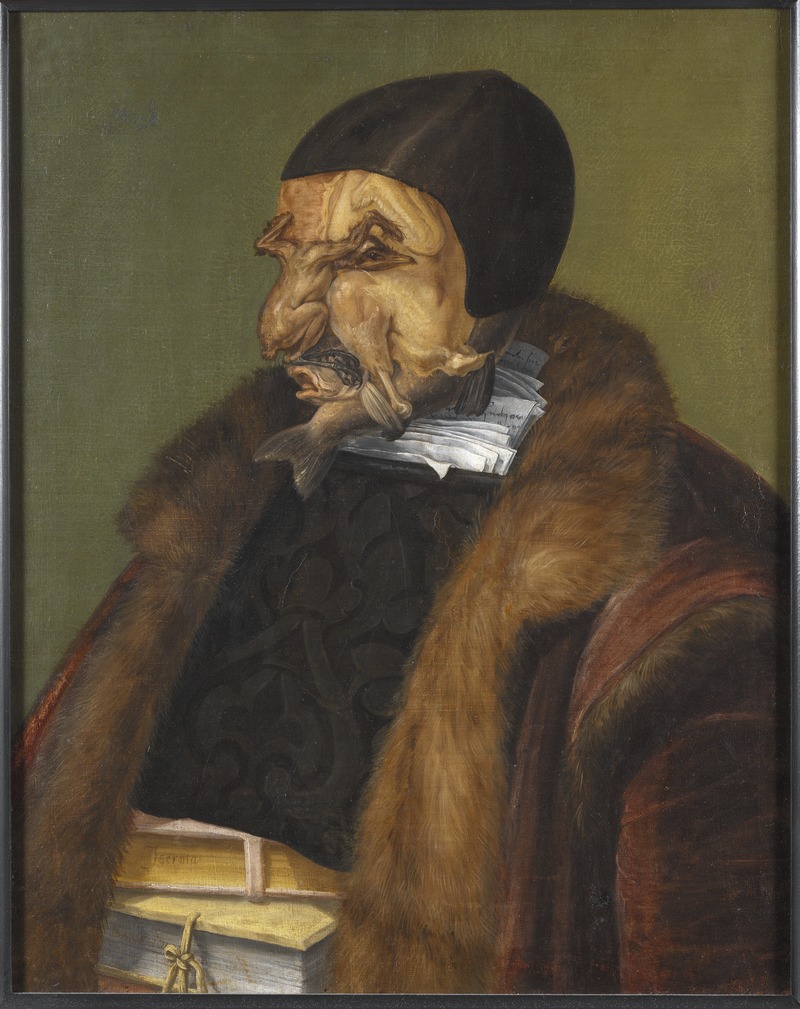
Guiseppe Arcimboldo (1527-1593) was an Italian Renaissance painter who produced wonderful paintings of objects that look like people. Click on the picture for a larger version.
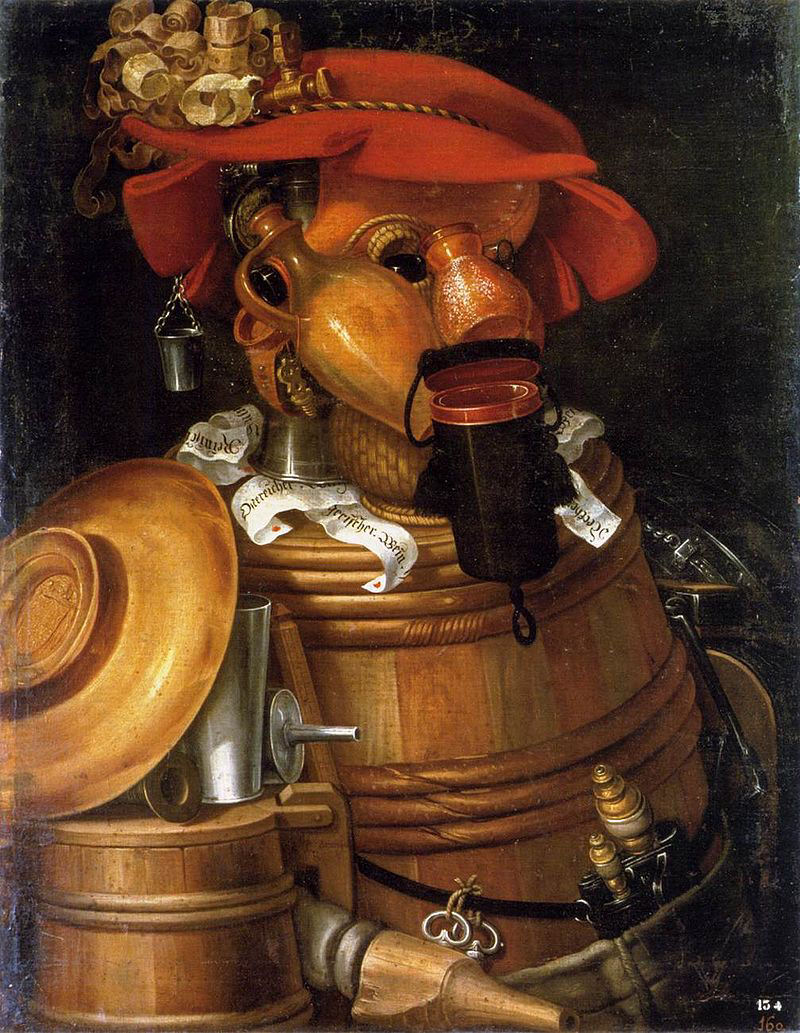
There are more paintings by Guiseppe Arcimboldo below.
It is hard to produce a convincing trompe l'oeil picture without artistic ability!
These are excessive stimulation of colour, size, position, tilt, movement, etc.
The dots at the junctions aren't there! This is the Hermann grid illusion.

This type of illusion depends on accuracy of drawing and strong uniform colours, so are hard to draw.
These are the result of unconscious inferences. You see a simple pictures, and your brain tries to understand it, but makes the wrong decision. Some of these are easier to draw.
Draw two dots and a line underneath. It looks like a face. The brain is very good indeed at making faces of things.It's fun to put the dots and lines in different places and see the different expressions, and also if the face disappears.

Cognitive illusions divide into smaller groups.
The brain get something wrong - size, length, position or curvature.
The grey lines are parallel, horizontal, and straight:

Here is a smple illusion of this type. Draw a line and mark the midway point.

Draw arrow heads as below. Although the two halves of the line are the same length, they don't look like it.

Another illusion of this type. Draw a parallelogram (a slightly squashed rectangle) standing on its long side.

Now draw another parallelogram exacly the same, same angles, same length, but now standing on its short side.
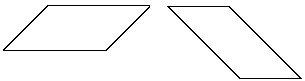
These are tables. Draw their legs.

The tables end up completely different shapes. We are, of course, seeing edges which recede into the distance differently from edges across our vision. I would expect some difference, but the amount astonishes me!
This is a picture which can be looked at in more than once way.

This is a woman looking in a mirror. But it is also a skull. Her head and head's reflection are the eyes, and the top of the mirror the top of its skull. It might be easier to see if you unfocuse your eyes, possibly by nearly closing your eyes.
Once you can see both, try "flipping" your eyes between them. First the woman, then the skull, then the woman, and so on. You will find it impossible to see both at the same time. The brain fixes on one image or the other.
It is possible to draw a simple one of these as well. Draw a like outling the profile of a face.
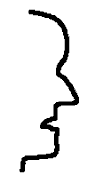
Draw exactly the same face, but mirrored.

Frame it in a box.
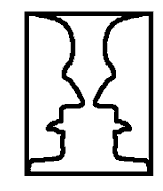
Colour in the faces.

You can still see the faces. But now, focus on the white between the faces, and you can see a candlestick. Again, you can either see the faces or the candlestick, not both at the same time.
We did similar when looking at Greek keys, flipping between the pattern and the generator. Sometimes mazes colour in the paths, and sometimes the walls. Spirals look different if you look between the actual spiral lines. It can be a good trick when designing patterns to be able to make the background into the foreground.
This is a fun category, where what is shown in the picture is completely impossible in real life.
The Penrose triangle is possible to draw, but is impossible as a 3-D object. (Roger Penrose also was responsible for Penrose tiling.) M E Escher used the Penrose triangle as the basis for his impossible staircase.


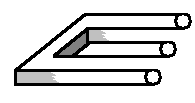
How many prongs does this trident have? On the left,there are two square prongs. On the right, there are three round ones.
Here is how you draw this. Start with six lines, the same length, equal distances apart. I'll number them 1-6, starting from the top.
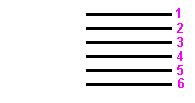
Make the bottom 2 lines (5 and 6) longer, and square off the end.

Draw a line from line 1 (top) to the end of line 5. This will be sloping.

Draw a line with the same slope to the right, from line 2 to line 4. You will need to make line 4 longer to join up.
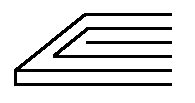
Draw a line straight down, from line 2 to line 3.

Draw a sloping line, to the right of the others, joining line 3 to line 6 (it won't be the end of line 6, but further to the right).
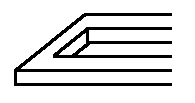
Now move to the righthand end of the trident. Make the ends longer (or rub bits out) so they are also in a sloping line, and draw circles on the end.

A bit of shading helps the illusion.
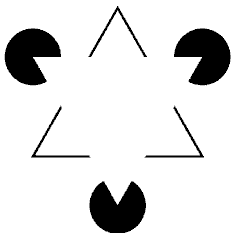
Here, the brain sees something that isn't even here!
Guiseppe Arcimboldo (1527-1593) was an Italian Renaissance painter who produced wonderful trompe l'oeil paintings. Click on picture for larger version.
Vertumnus by Guiseppe Arcimboldo

Summer by Guiseppe Arcimboldo

Librarian by Guiseppe Arcimboldo

Jurist by Guiseppe Arcimboldo
Distorting illusion - The black lines are straight:

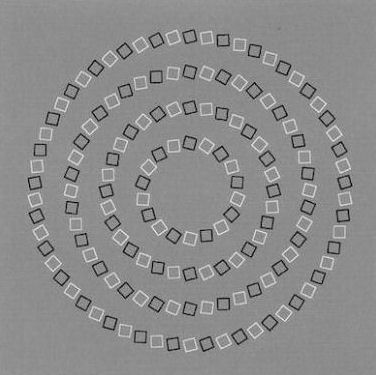
Distorting illusion - The circles do not overlap
If you draw a glass cube, you can indicate which is the front face by rubbing out bits of line where the edges cross. So the top cube has the bottom left face as the front face. But with the bottom cube, the wrong bits have been rubbed out. This means the front face is either bottom left or top right, depending where you look. So it is impossible!

Squares A and B are same colour. I have copied square A and square B from the bottom chess board, uing the computer. You can see that they are the same. But in the chessboard, because we know that squares have alternate colours, and we ignore the shadow (which has changed the colours), our brain will just not accept this!

This is by William Hogarth (1697–1764) - Satire on "False Perspective". It is full of impossibilities. Animals and trees get bigger, the further away they are. The inn sign does extraodinary things. And so on... Click on picture for a larger version.

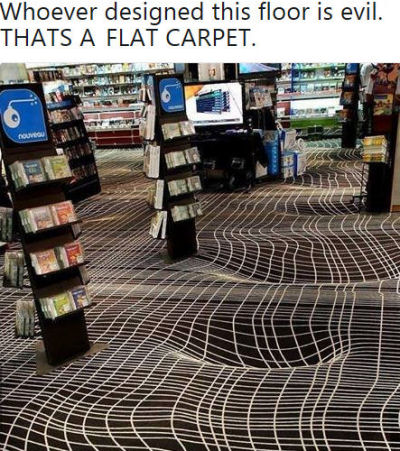
And finally, a comment from social media....
© Jo Edkins 2025 - Return to Patterns index