

See Crosses for other patterns.
Pattern:

Bobbins: 22 pairs per arm
Style: Torchon
Stitches:
half stitch
cloth stitch and twist
cloth stitch
twist pair
slip knot
overhand knot
Details:
cloth zigzag (red)
cloth strip (red)
chevron pointing downwards (red)
footside without passives (grey)
Torchon ground (grey)
cross, starting from middle
Description:
Pattern:
Follow the links above for explanation of how to work the different parts of the lace.
See cross, starting from middle for different ways to make this shape. You can work each arm separately, joining each arm to the previous. If you prefer taking the threads across the centre, the following diagram shows where the threads start.

I worked this by measuring out the thread, but only winding one bobbin onto on end, and making a slip knot to hang this bobbin from. The other thread was lifted behind, and gathered into a loop with the other spare threads, pinned out of the way. I worked one arm at a time, with the second arm being next to the first:

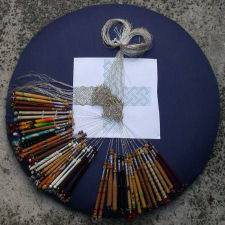
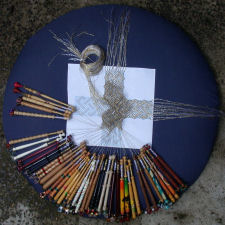
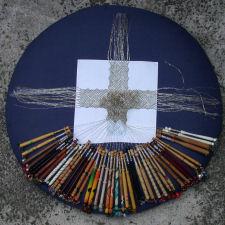
See the description of working a cross, starting from middle, for details. For thread, I used metallic thread, with one gold thread and one silver thread in each pair. This gave a lovely shimmering effect. By the way, each thread was four feet long, and was used in two arms.
A few notes about the pattern itself. The ends finish with a little Torchon ground which gives a straight edge, which works better with a fringe. The strips inside the cross overlap by two, which is more than my other patterns. This makes a better Celtic knot design, but does need more bobbins. They can't overlap by two in the middle of the cross, in fact, they can't overlap at all. (I didn't realise this at first!)
This overlap needs four stitches of Torchon ground between the strips and zigzags, which needs a certain amount of working part of a strip, then a different part of the pattern, then finish the strip (especially near the edges). There is also a bit of Torchon ground at the edges to make sure that there are enough threads in the curved parts. I also was careful to keep the maximum amount of threads in the strips at all times. When you start a strip, at the point, you do the first stitch, then have to decide which pair of bobbins become the worker pair. One side of the strip feeds threads into the pattern, the opposite side removes threads from the pattern. If you chose one pair of the first two as the worker, in the main part of the strip, you will work through 4 pairs one way, and 5 the other. But if you chose the other pair, you will work through 5 one way, and 6 the other, which gives a thicker strip. What you need to do after the first stitch of the strip, is to chose the pair which is working towards the side which is feeding in threads, not the pair which works towards the side which is losing threads. Of course, you normally have a problem with zigzags, since the worker pair which had the 5/6 direction suddenly becomes the 4/5 direction. But in this pattern, I've put an extra hole in at the edge, so the worker pair should be 5/6 in both directions (if you've chosen right!) If you have got the direction wrong, then just ignore this extra pin hole. (And hope no-one notices! They usually don't.)
© Jo Edkins 2017 - return to lace index