
Pattern:

Bobbins: 30 pairs + 6 gimps
Style: Bucks Point
Stitches:
half stitch and twist
twist
cloth stitch
half stitch
cloth stitch and twist
picot
gimp
twist pair
Details:
Bucks Point net (grey)
honeycomb (green)
Torchon ground (cyan)
solid half stitch (blue)
cloth footside (grey)
trail (red)
picots and passives headside (grey and red)
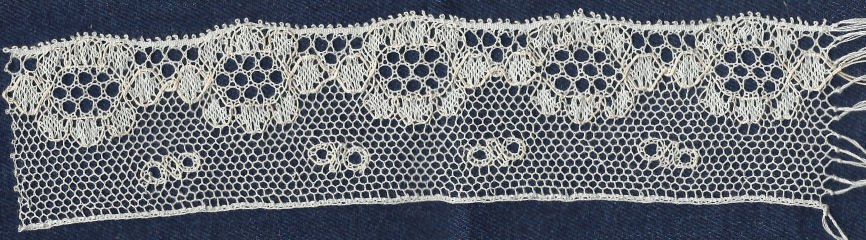
bee
Description:
Follow the links above for explanation of how to work the different parts of the lace.
Headside is picots and passives headside with variable passives, like a trail. The number of passives varies from one to three.
The bees are each surrounded by two gimps which need to be started and finished for each bee. The wings of the bees are beads and the body is Torchon ground (so it looks different to the surrounding Bucks Point net).
The surrounds to the flowers are honeycomb, so are the centres of the flowers. The petals are half stitch. The gimps sometimes have to double up, similar to pattern 65. The petals sometimes have edges parallel to the edge. The pattern gives extra holes in these, which are unsupported by pairs joining or leaving the petal. This makes the petals quite dense, and also makes sure that you have the same number of pins on each side of the petal. There are three ways of working these - your choice! You can leave these extra pinholes out, which means that you will need to work in the direction of the extra pinhole first (or you will run out of holes on one side!) Or you can work it with the pinholes that I have shown. This makes some of the rows a little floppy at that point, as you end the row, pin, and work back again, and this edge is then unsupported at that point. The last method, which I (mostly) used is to use the extra holes, but at that point take the workers not just through all the passives, but also over the gimp as well. Pin inside both the workers and the gimp, then bring the workers back under and over the gimp to do the next row. This means that the gimp itself supports the end of the row.
© Jo Edkins 2016 - return to lace index